Bhagavad Gita 2.54
Sankhya Yoga · English Translation
अर्जुन उवाच | स्थितप्रज्ञस्य का भाषा समाधिस्थस्य केशव | स्थितधीः किं प्रभाषेत किमासीत व्रजेत किम् ||२-५४||
arjuna uvāca . sthitaprajñasya kā bhāṣā samādhisthasya keśava . sthitadhīḥ kiṃ prabhāṣeta kimāsīta vrajeta kim ||2-54||
What Does This Verse Mean?
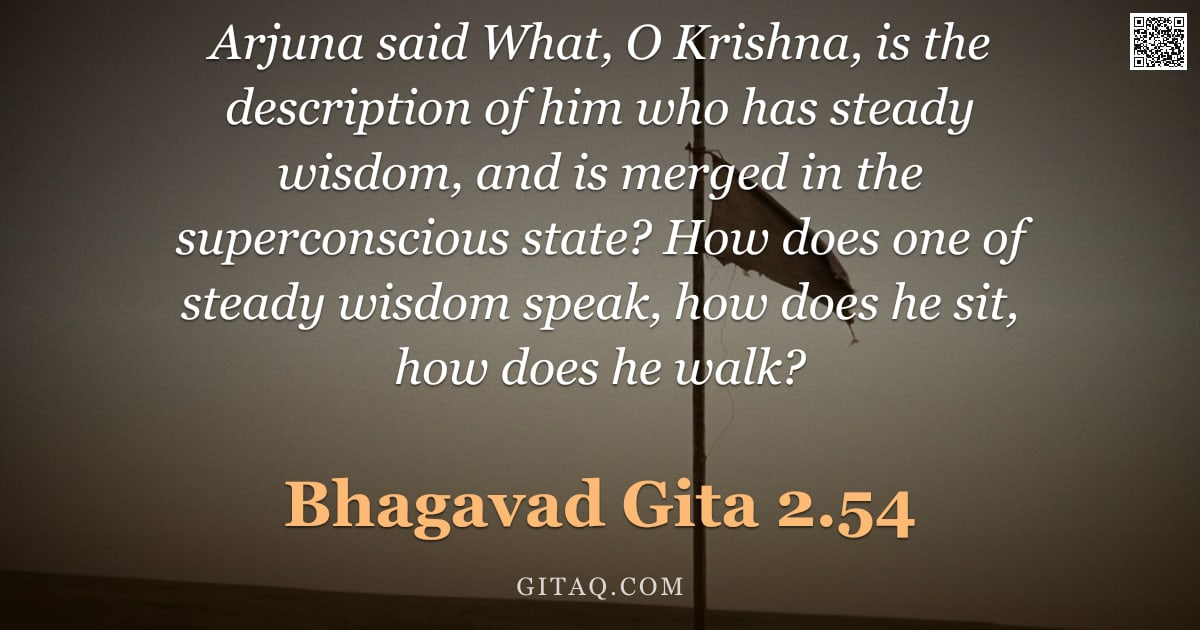
Arjuna asks Lord Krishna to describe the external behavior of someone who has achieved 'steady wisdom' or complete mental stability. He specifically wants to know how such a person speaks, sits, and walks in daily life. The key teaching is that true spiritual realization is not just an internal feeling but manifests clearly through one's actions and demeanor.
The Teaching Behind It
This verse belongs to the core of Jnana Yoga (the path of knowledge) within the Sankhya framework, focusing on the realization of the Self (Atman). It develops the concept of 'Sthitaprajna'—a state where one's intellect is steady and undisturbed by dualities like pleasure or pain. The verse bridges abstract spiritual theory with practical behavioral observation.
Word by Word
Classical Commentary
Where This Happens
This verse occurs in Chapter 2 of the Bhagavad Gita on the battlefield of Kurukshetra during the Mahabharata war. Arjuna has just listened to Krishna explain that the soul is eternal and cannot be killed, and he understands this intellectually but remains confused about how a wise person actually functions. He feels overwhelmed by the prospect of fighting his own kin and seeks concrete examples of what 'steady wisdom' looks like in action.
Living It Out Today
Imagine you are stuck in heavy traffic or dealing with an aggressive client at work; instead of reacting with immediate frustration, someone with steady wisdom remains calm and speaks gently. They do not let the external chaos dictate their internal state or cause them to lose focus on what needs to be done. This verse teaches us that true stability is visible when we maintain our composure and clarity during high-pressure situations.
Explained for Children
Imagine you are playing a video game with your friends, and suddenly someone gets really angry or upset because they lost; maybe they yell or cry. Arjuna is asking Krishna: 'What does the person who never loses their cool look like?' He wants to know if this super-calmed friend talks softly, sits quietly, or walks slowly. It's about how a wise person acts when everything around them feels chaotic.
Daily Reflection
You often feel pulled by every word spoken around you or swept away by your own fleeting thoughts, but true steadiness is not about becoming cold or detached. Instead, it is like standing firmly on solid ground while the storms of life rush past; your words become deliberate and your presence becomes a sanctuary for others. When you pause to speak from this place of inner stillness, even simple actions like walking or sitting carry a profound sense of peace that calms everyone around you.
A Practice for Today
Sit quietly and imagine your mind as a vast, still ocean where thoughts rise like waves but never disturb the deep water below them. As you breathe, silently ask yourself: 'In this moment of calm, how would I speak if my words came from that unshakable inner silence?' Allow the feeling of steady wisdom to settle in your posture and breath for a few minutes.
Key Teachings
- The Nature of Steady Wisdom
A person with steady wisdom (sthitaprajna) is not someone who lacks emotions, but one whose mind remains undisturbed by the dualities of pleasure and pain. This state represents a complete mastery over the senses, where the individual acts from an unshakeable inner foundation rather than reactive impulses. - The Manifestation in Action
Arjuna asks how such a person walks or speaks because their external behavior is often subtle and hard to distinguish from ordinary actions. The key lies in the internal quality of these movements; every step, word, and gesture flows naturally without attachment or anxiety. - The Question of Arjuna
Arjuna's inquiry highlights that a state of divine consciousness must be recognizable through its effects on the human psyche. He seeks to understand not just the theory, but the practical reality of how one lives when merged in superconsciousness. - The Transition from Theory to Practice
While Chapter 2 has established the philosophical knowledge (Sankhya), this verse marks the pivotal moment where Arjuna seeks to translate that theory into observable human behavior. It bridges the gap between knowing the truth and embodying it in daily life.
Themes
Related Verses
Read This Next
Recommended Reading
GitaQ earns from qualifying purchases as an Amazon Associate.