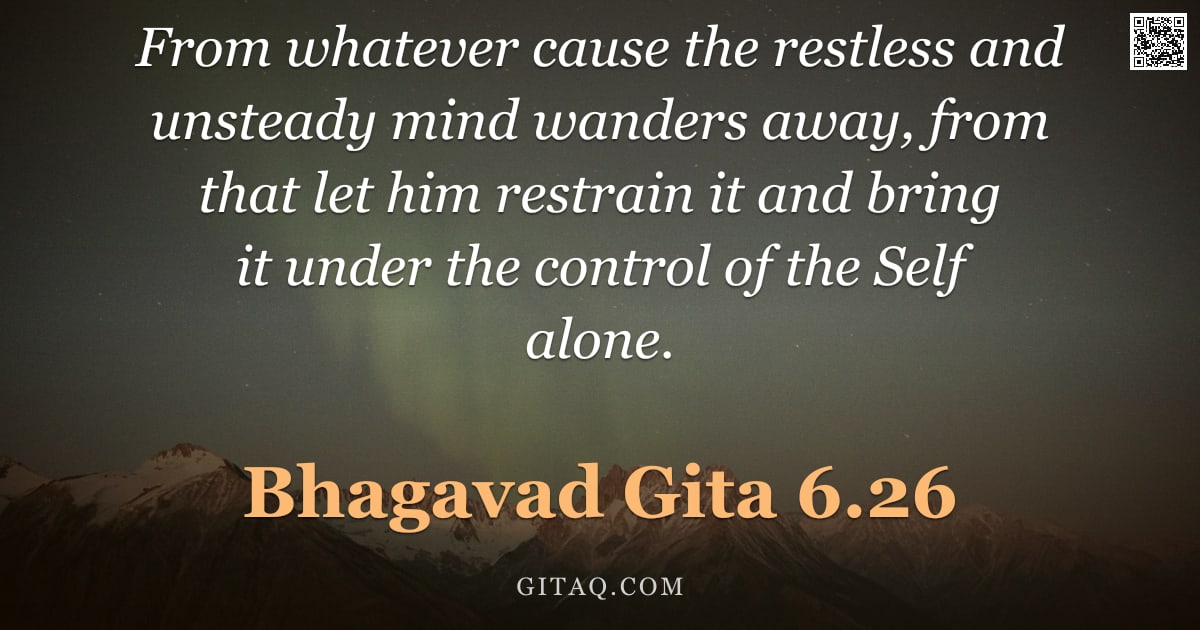
Bhagavad Gita 6.26
Dhyana Yoga · English Translation
यतो यतो निश्चरति मनश्चञ्चलमस्थिरम् | ततस्ततो नियम्यैतदात्मन्येव वशं नयेत् ||६-२६||
yato yato niścarati manaścañcalamasthiram . tatastato niyamyaitadātmanyeva vaśaṃ nayet ||6-26||
What Does This Verse Mean?
In this verse, Lord Krishna advises Arjuna on how to handle a wandering mind during meditation. He explains that whenever the restless and unsteady intellect drifts away from its focus due to any distraction, one must immediately bring it back under control of the higher Self or inner consciousness. The core teaching is not just about noticing distractions but actively restraining them repeatedly until the mind finds peace in the divine within.
The Teaching Behind It
This verse belongs specifically to Dhyana Yoga (the path of meditation) and complements Sankhya philosophy by addressing the practical control of Chitta (mind-stuff). It develops the concept that while the mind is naturally 'chanchala' (restless), it can be trained through repeated effort (abhyasa) and dispassion to reside in Atman, or the true Self.
Word by Word
Classical Commentary
Where This Happens
This teaching occurs during Chapter 6 of the Bhagavad Gita, where Krishna is guiding Arjuna through the specific techniques of Dhyana Yoga (meditation) after explaining the nature of action and knowledge. The conversation takes place on the battlefield of Kurukshetra amidst a massive army that cannot hear this private instruction between two cousins. Arjuna has just confessed to Krishna in verse 6.25-26's immediate context that his mind is extremely restless, making meditation feel impossible for him.
Living It Out Today
Consider a software developer working on a critical code fix while being bombarded by constant Slack notifications and email pings; their focus keeps slipping away from the task at hand. Instead of getting frustrated or quitting to scroll through social media, they practice this verse's method: noticing every time attention drifts to an alert and consciously choosing to return it solely to the screen in front of them. By repeatedly bringing the mind back without judgment during high-stress moments, mental clarity is restored, allowing for a difficult decision to be made with precision rather than panic.
Explained for Children
Imagine your mind is like a puppy that keeps running away from you whenever there is a squirrel outside. When it runs off, you don't get angry or give up; instead, you gently pick it up and bring it back to sit on your lap again and again. This verse teaches us to do the same with our thoughts: when they wander off playing games in their heads, we kindly but firmly guide them back to focusing on being calm inside.
Daily Reflection
I know how frustrating it feels when your mind seems determined to wander off just as you try to settle down; please remember this is not a failure but simply the nature of an untrained mind. The verse invites us to be kind companions to our own thoughts, gently guiding them back rather than scolding ourselves for losing focus each time. You are building a muscle called 'self-control,' and every single return to your center makes that connection between you and your true Self stronger.
A Practice for Today
When your mind drifts to worries about the past or anxieties about the future, gently acknowledge the distraction without judgment and immediately return your focus to the stillness of your inner Self. With every gentle pull back from wandering thoughts, you are practicing the art of bringing that restless energy under the control of your higher consciousness.
Key Teachings
- The Nature of Restlessness
Krishna acknowledges the mind as inherently restless (cañcalam) and unsteady, validating our struggle rather than dismissing it. Recognizing this natural tendency is the first step toward mastery, shifting us from frustration to patience. - The Mechanism of Restraint
Restraint (niyamya) implies a conscious act of pulling back or checking the mind whenever it wanders. This practice requires vigilance and immediate action, stopping the thought cycle before it takes root in distraction. - The Goal: Self-Abidance
The ultimate aim is not to suppress thoughts but to direct all mental activity toward the control of the Atman (the true Self). By anchoring awareness within, we transform chaos into a singular focus on our divine nature.
Themes
Related Verses
Read This Next
- 2.47 — Read this next to understand Krishna's instruction on detachment while performing action, which supports the mental discipline required for meditation.
- 3.30 — This verse reinforces surrendering all actions and thoughts to the Divine, helping stabilize a mind that feels overwhelmed by worldly concerns.
- 12.15 — This verse outlines the characteristics of a devotee whose mind is steady, providing an inspiring model for your own meditation practice.
Recommended Reading
GitaQ earns from qualifying purchases as an Amazon Associate.