Bhagavad Gita 6.28
Dhyana Yoga · English Translation
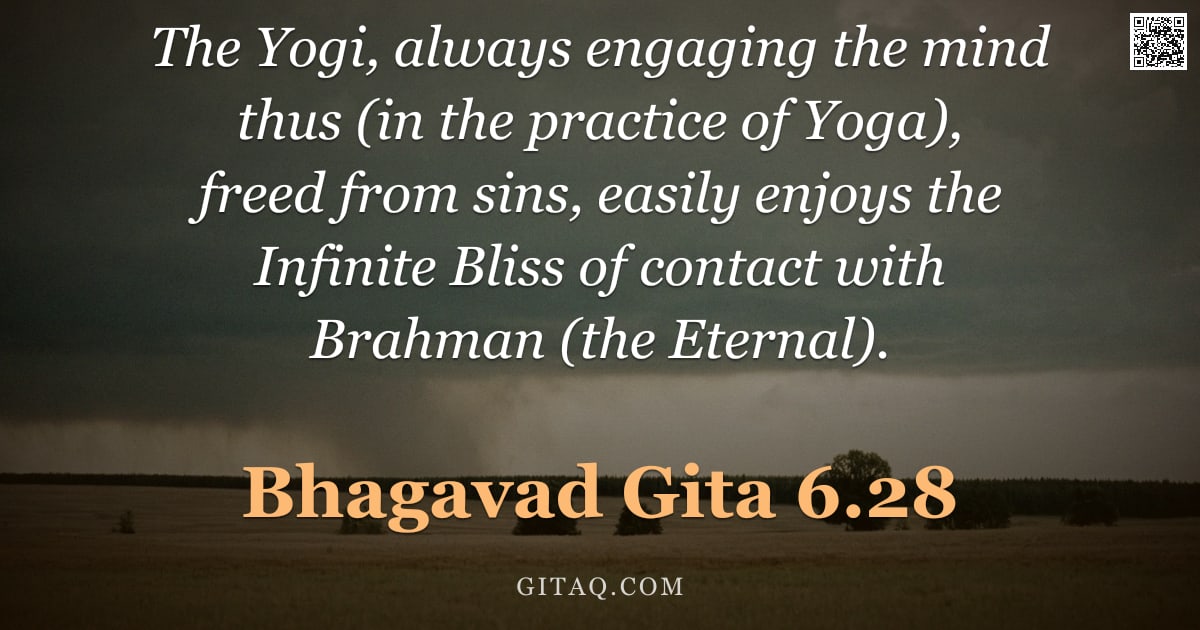
युञ्जन्नेवं सदात्मानं योगी विगतकल्मषः | सुखेन ब्रह्मसंस्पर्शमत्यन्तं सुखमश्नुते ||६-२८||
yuñjannevaṃ sadātmānaṃ yogī vigatakalmaṣaḥ . sukhena brahmasaṃsparśamatyantaṃ sukhamaśnute ||6-28||
What Does This Verse Mean?
In this verse, Lord Krishna describes the ultimate result of consistent meditation practice to Arjuna. He explains that a yogi who constantly focuses their mind on the self and remains free from negative thoughts eventually experiences profound inner peace. This state is described as an infinite bliss derived from direct spiritual connection with the divine reality known as Brahman.
The Teaching Behind It
This verse is the culmination of Dhyana Yoga (the path of meditation) and synthesizes elements of Sankhya philosophy regarding the distinction between the mind and the self. It develops the concept that sustained spiritual practice purifies the soul, leading to 'Brahmasaṃsparśa'—direct experiential contact with the Absolute Truth—which is defined as infinite bliss.
Word by Word
Classical Commentary
Where This Happens
This teaching occurs on the battlefield of Kurukshetra during the Mahabharata war, where Prince Arjuna has just received instructions from Krishna on how to perform selfless action (Karma Yoga) and control his mind. As Chapter 6 begins the detailed discussion on Dhyana Yoga (Meditation), Krishna is guiding a confused warrior who feels overwhelmed by duty and attachment. After explaining that true yoga requires balance in food, sleep, and activity, this verse serves as the climax of meditation practice, assuring Arjuna that persistence leads to spiritual liberation.
Living It Out Today
Consider a modern professional facing burnout from constant notifications and high-pressure deadlines; they might try mindfulness techniques for just five minutes daily. Over weeks or months of consistent practice without judging their wandering thoughts, this person stops reacting impulsively to stress triggers. Eventually, instead of feeling drained by external chaos, they access an inner reservoir of calm that allows them to make clear decisions even during a crisis.
Explained for Children
Imagine you are playing your favorite video game, but instead of getting frustrated when things go wrong or distracted by loud noises, you stay completely focused and calm for a long time. If you keep practicing this focus every single day without stopping, eventually something magical happens: you feel an amazing sense of happiness that comes from inside you, not from the screen or toys. This verse is like saying that if we practice being kind and quiet in our minds all the time, we will find a special joy that never runs out.
Daily Reflection
You do not need to be perfect today; simply showing up for your practice is enough to begin clearing away the mental clutter that weighs on you. As you settle into this quiet space, notice how the fear of failure fades and a profound sense of ease begins to rise from within. This peace is not something you must chase or earn through struggle, but a natural state waiting to be recognized once your mind becomes steady.
A Practice for Today
Close your eyes and gently bring your awareness back to the breath, visualizing yourself as a Yogi who has already shed all burdens of guilt or distraction. In this stillness, invite a sense of lightness that allows you to rest effortlessly in the connection with something far greater than your daily worries.
Key Teachings
- The Power of Consistent Practice
Krishna emphasizes that the Yogi who 'always engages' (sadā) in meditation transforms their very nature through repetition. This constancy is not about intensity, but about the unwavering continuity of returning to the divine focus. - Purification as a Prerequisite
The state of being 'freed from sins' (vigata-kalmaṣa) describes an internal cleansing where past karmic accumulations dissolve. This purification is the natural byproduct of sincere practice, creating the clear vessel necessary for spiritual reception. - The Bliss of Divine Union
The ultimate goal described here is 'Brahma-saṃsparśa,' or contact with the Absolute, which brings infinite happiness. This joy is not dependent on external circumstances but arises from the direct experience of unity with the Eternal.
Themes
Related Verses
Read This Next
- 2.47 — To establish the foundational principle of performing duty without attachment before diving deeper into specific results.
- 3.30 — To understand how offering all actions to Krishna serves as a method for purifying the mind and removing past karmas.
- 12.15 — To see the characteristics of one who has achieved this state of devotion and inner peace, inspiring further practice.
Recommended Reading
GitaQ earns from qualifying purchases as an Amazon Associate.