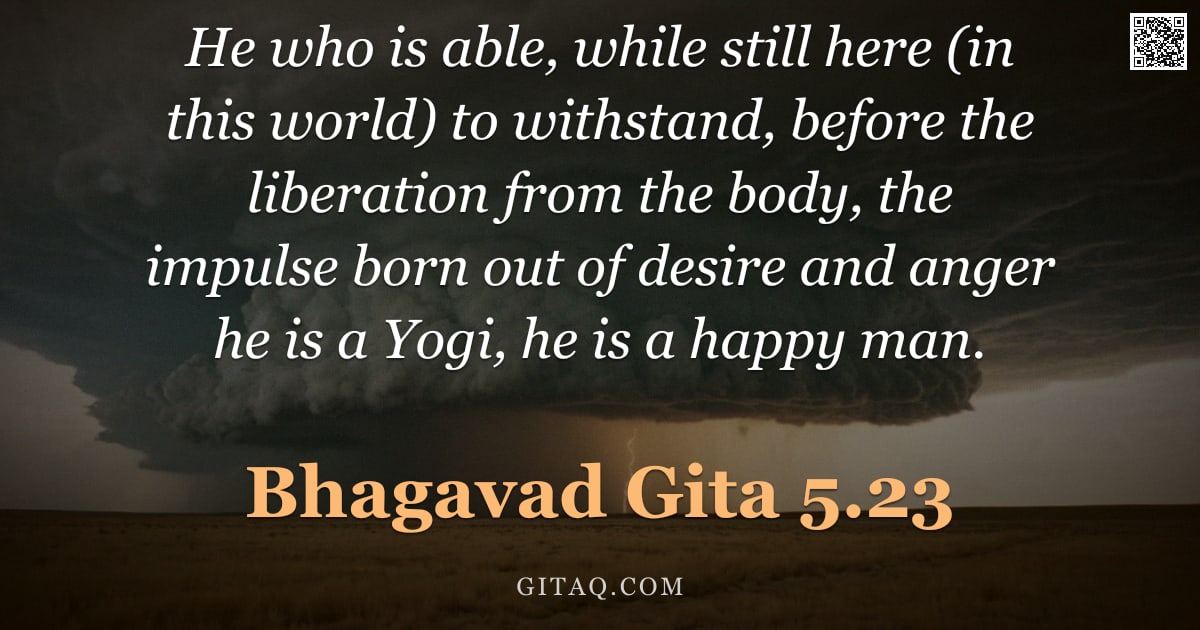
Bhagavad Gita 5.23
Karma Sanyasa Yoga · English Translation
शक्नोतीहैव यः सोढुं प्राक्शरीरविमोक्षणात् | कामक्रोधोद्भवं वेगं स युक्तः स सुखी नरः ||५-२३||
śaknotīhaiva yaḥ soḍhuṃ prākśarīravimokṣaṇāt . kāmakrodhodbhavaṃ vegaṃ sa yuktaḥ sa sukhī naraḥ ||5-23||
What Does This Verse Mean?
Lord Krishna tells Arjuna that true happiness and spiritual success are found by mastering one's own mind before death occurs. He teaches that anyone who can resist the sudden, powerful urges of desire and anger while still living in this world is a wise yogi. This ability to stay calm under emotional pressure leads directly to lasting inner peace.
The Teaching Behind It
This verse is a cornerstone of Karma Yoga, emphasizing self-mastery as the prerequisite for true renunciation (Sanyasa). It bridges the gap between external action and internal stability by teaching that one must conquer the 'impulse' born of desire and anger to realize the Self while still alive.
Word by Word
Classical Commentary
Where This Happens
This verse appears on the battlefield of Kurukshetra during the Mahabharata, where Lord Krishna is instructing his friend Arjuna. At this point in Chapter 5, Krishna has just explained that renouncing action isn't about stopping work but acting without attachment to results. He sees Arjuna still struggling with the intense emotions triggered by fighting against his own kinsmen and offers a practical method for finding stability.
Living It Out Today
Consider a modern scenario where you receive unfair criticism from your boss in a high-stakes meeting, triggering an immediate surge of anger or fear of failure. Instead of snapping back defensively or spiraling into anxiety, this teaching encourages pausing to observe the impulse without letting it control your reaction. By enduring that initial storm calmly and responding with clarity rather than emotion, you maintain your professional reputation and inner happiness.
Explained for Children
Imagine your feelings like big waves crashing on the beach; sometimes they are angry or want things too much. Krishna says that being really strong doesn't mean pushing those waves away, but standing steady in the sand so you don't get knocked over when a wave hits. If you can stay calm and happy even when you feel super mad or very greedy for something, then you have won an inner victory.
Daily Reflection
When anger or desire rises up like a sudden wave, remember that you have the power to stand firm on solid ground instead of being swept away. True freedom begins right here, while you still breathe and live, by refusing to let those fleeting urges dictate your actions. By mastering these internal storms now, you cultivate an unshakeable peace that no external event can disturb.
A Practice for Today
Sit quietly and observe the first spark of irritation or craving that arises today without acting on it, holding a mental space between feeling and reaction. Imagine this moment as a shield you are forging before liberation comes, finding your true happiness not in changing circumstances but in mastering these internal impulses.
Key Teachings
- The Test of Timing
This verse emphasizes 'ihaiva' (here and now), teaching us to find freedom within our current life rather than waiting for death or a future state. The opportunity for spiritual mastery is immediate, present in every daily challenge we face. - The Root of Suffering
Krishna identifies desire and anger as the twin forces driving our suffering, noting that one inevitably fuels the other into a destructive impulse. Recognizing this origin allows us to address the root cause rather than just treating the symptoms of our emotional reactions. - The Definition of Success
A true Yogi is defined not by supernatural powers but by their ability to withstand internal turbulence before physical liberation occurs. The verse equates this mastery with being 'sukhi' or happy, suggesting that inner stability is the highest form of human joy. - The Path to Happiness
Happiness is presented as a direct result of self-control over the impulses born from desire and anger. By restraining these forces before leaving the body, one secures a state of peace that endures beyond physical existence.
Themes
Related Verses
Read This Next
Recommended Reading
GitaQ earns from qualifying purchases as an Amazon Associate.