Bhagavad Gita 12.18
Bhakti Yoga · English Translation
समः शत्रौ च मित्रे च तथा मानापमानयोः | शीतोष्णसुखदुःखेषु समः सङ्गविवर्जितः ||१२-१८||
samaḥ śatrau ca mitre ca tathā mānāpamānayoḥ . śītoṣṇasukhaduḥkheṣu samaḥ saṅgavivarjitaḥ ||12-18||
What Does This Verse Mean?
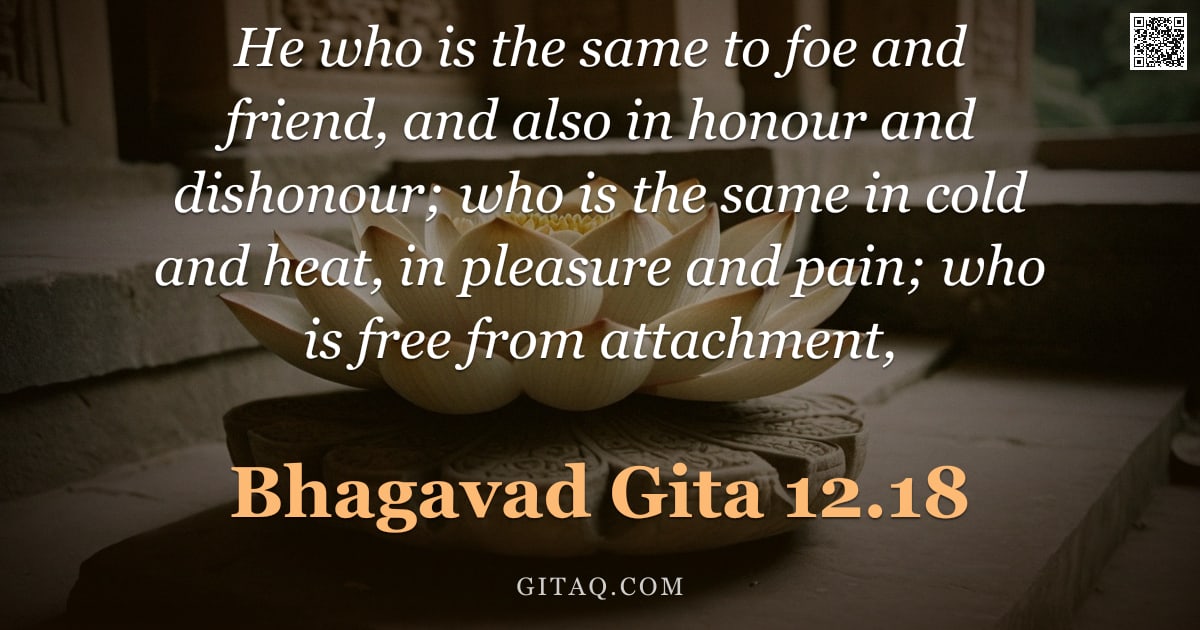
In this verse, Lord Krishna describes the essential qualities of a true devotee who is dear to him. He explains that such a person maintains perfect equanimity whether facing friends or enemies, and remains equally balanced in experiences like cold versus heat, pleasure versus pain. The key teaching is to live without attachment to outcomes or external validation, staying mentally steady regardless of life's changing circumstances.
The Teaching Behind It
This verse synthesizes the principles of Karma Yoga (action without attachment) with Bhakti Yoga (devotion), illustrating that true devotion manifests as mental steadiness. It develops the concept of 'Sama' (equanimity), a state where the mind is free from dualities like honor and dishonor, serving as the foundation for higher meditation and realization.
Word by Word
Where This Happens
This verse occurs during the Bhagavad Gita's discourse on Chapter 12, where Krishna is guiding Arjuna through 'Bhakti Yoga,' the path of devotion. It follows a discussion distinguishing between those who worship the formless absolute and those who focus their love on a personal deity. At this moment in the Mahabharata narrative, Arjuna has just expressed his confusion about which spiritual practice is superior, prompting Krishna to outline the practical character traits that define an ideal devotee.
Living It Out Today
Consider a modern professional facing a sudden job loss or a harsh reprimand from their boss. Instead of spiraling into anxiety or anger (duhkha) or becoming arrogant if praised for a recent success (sukha), they maintain inner stability by recognizing that these are temporary external events, not reflections of their self-worth. This equanimity allows them to make clear-headed decisions about their next career move without being clouded by emotional highs and lows.
Explained for Children
Imagine you are playing a game where sometimes your team wins big (pleasure) and other times they lose badly (pain). A wise person doesn't get too excited when winning or too sad when losing; they keep smiling calmly in both moments. This verse teaches us to be like that steady player, not getting upset if someone says something nice about you or mean things, but staying happy inside no matter what happens.
Daily Reflection
Today, I invite you to notice how often your happiness depends on external circumstances like others' opinions or physical comfort. When faced with difficulty or flattery, try to pause and remember that true peace comes from being equal-minded toward all experiences rather than chasing one over the other. This shift in perspective allows you to walk through your day as a steady witness, free from the exhausting cycle of craving pleasure and fearing pain.
A Practice for Today
Close your eyes and visualize standing calmly between two opposing forces, such as praise and blame or heat and cold, feeling completely still at the center of both without being pulled toward either side. Allow this inner stability to become a quiet sanctuary where you can observe life's fluctuations while remaining untouched by them.
Key Teachings
- Equanimity Toward People
The verse instructs us to treat friends and enemies with the same balanced regard, recognizing that both are equally part of our spiritual journey. This impartiality dissolves the ego's tendency to cling to approval or harbor resentment against opposition. - Transcending Sensory Extremes
True devotion involves maintaining inner balance amidst contrasting physical sensations like heat and cold, as well as pleasure and pain. By not being swayed by these dualities, the devotee cultivates a mind that is robust enough to sustain deep spiritual practice. - Detachment from Attachment
The phrase 'sanga-vivarjitaḥ' calls for renouncing selfish attachment and excessive dependency on specific outcomes or relationships. This freedom allows the heart to remain open and devoted without being bound by possessive desires.
Themes
Related Verses
Read This Next
- 2.47 — This verse establishes the foundational principle of acting without attachment to results, which supports the equanimity described in chapter 12.
- 3.30 — It expands on dedicating all actions and fruits to the Divine, a necessary practice for maintaining equal vision toward friends and foes.
- 12.15 — Since this is part of the same chapter on Bhakti Yoga, reading verse 12.15 provides further context on how the devotee becomes dear to Krishna through non-harming and equality.
Recommended Reading
GitaQ earns from qualifying purchases as an Amazon Associate.