Bhagavad Gita 12.17
Bhakti Yoga · English Translation
यो न हृष्यति न द्वेष्टि न शोचति न काङ्क्षति | शुभाशुभपरित्यागी भक्तिमान्यः स मे प्रियः ||१२-१७||
yo na hṛṣyati na dveṣṭi na śocati na kāṅkṣati . śubhāśubhaparityāgī bhaktimānyaḥ sa me priyaḥ ||12-17||
What Does This Verse Mean?
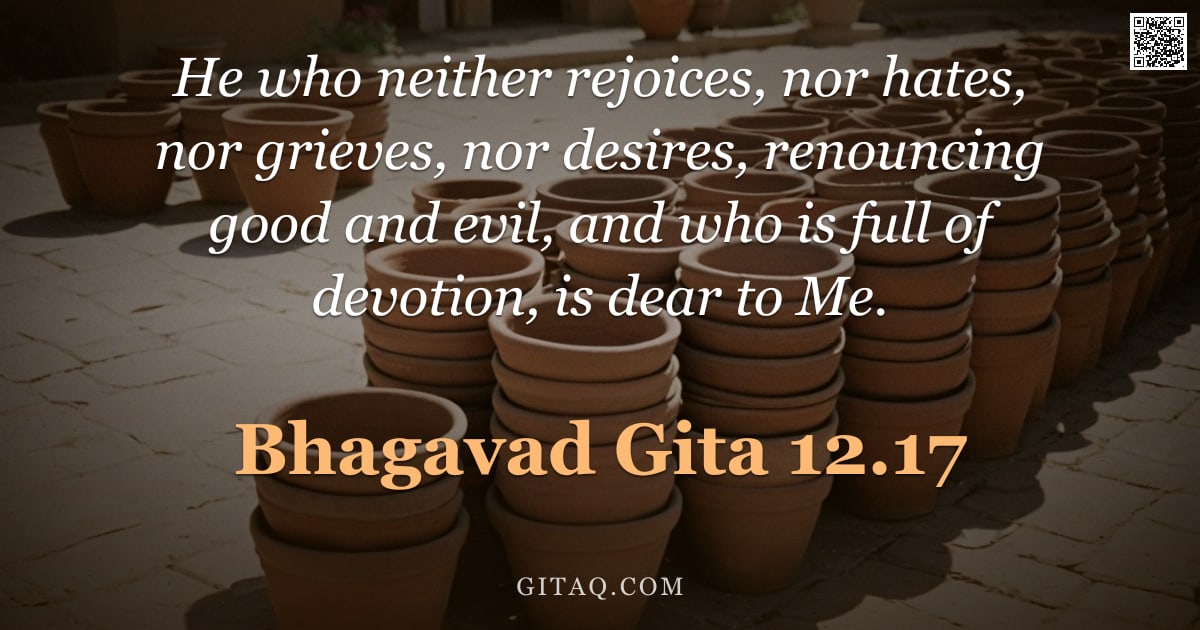
In this verse, Lord Krishna tells Arjuna that the person he holds most dear is one who remains balanced through all of life's fluctuations. This ideal devotee does not get overly excited by good times nor depressed by bad ones; they simply accept every situation without attachment to specific outcomes like 'good' or 'evil'. By renouncing these dualities and maintaining steady devotion, such a person achieves the state Krishna describes as being dear to Him.
The Teaching Behind It
This verse synthesizes the principles of Karma Yoga (action without attachment) and Bhakti Yoga (devotion), emphasizing that true devotion requires a mind free from the dualities of pleasure and pain. It develops the concept of 'Uparati' or mental renunciation, where one transcends the binary nature of good and evil to realize the equanimity required for spiritual union with the Divine.
Word by Word
Classical Commentary
Where This Happens
This teaching occurs during Krishna's dialogue with Arjuna on the battlefield of Kurukshetra, specifically within Chapter 12 which focuses on Bhakti Yoga. After describing various forms of devotion and meditation in previous verses, Krishna is now summarizing the qualities that define a true devotee who has mastered their emotions. At this moment, Arjuna is seeking to understand how one can effectively practice devotion while remaining engaged in the world's duties amidst such intense emotional turmoil.
Living It Out Today
Consider a professional facing an unexpected project failure at work; instead of spiraling into self-loathing or blaming others (hating), they calmly analyze what went wrong without losing their sense of worth. Simultaneously, when that same person receives a sudden promotion or bonus the next day, they accept it with gratitude but do not become arrogant or overly attached to this new status. By maintaining this emotional equilibrium between success and failure, they reduce stress and make clearer decisions based on duty rather than fleeting feelings.
Explained for Children
Imagine you are playing your favorite game with friends. Sometimes you win, but sometimes you lose; maybe someone gets hurt, or everything goes smoothly. This verse teaches us about a special kind of friend who doesn't get crazy happy when they win, and doesn't cry or get angry when things go wrong. They just keep playing fairly because they love the game itself, not just winning it, making them everyone's favorite player.
Daily Reflection
Today, imagine holding your heart steady like an ancient mountain while life's weather shifts around you in storms and sunshine. When you catch yourself craving outcomes or resenting obstacles, gently remind yourself that true peace comes from releasing the grip on both good and bad results. This balance is not about being cold or indifferent, but rather a deep freedom where your devotion remains steady regardless of external circumstances.
A Practice for Today
Close your eyes and notice where you are currently rejoicing or grieving over the events of this day; observe these reactions without judgment, simply as passing clouds. Silently breathe into a state of inner stillness that remains undisturbed by whether things go well or poorly.
Key Teachings
- Equanimity in Suffering and Joy
The verse teaches that the devotee does not swing between elation and despair based on changing fortunes. By refusing to hate or grieve, one maintains a calm mind that serves as a stable vessel for spiritual practice. - Renunciation of Dualities
True devotion requires letting go of the obsession with 'good' and 'bad' outcomes. The seeker accepts all experiences as part of the divine play without attachment to specific results. - The Heart's Devotional Anchor
Even while practicing detachment, the devotee remains fully engaged in love for the Divine. This unique balance makes them dear to God because their focus is fixed on Him rather than fluctuating worldly conditions.
Themes
Related Verses
Read This Next
- 2.47 — This verse establishes the fundamental principle of performing duty without attachment to results, which is necessary for renouncing good and evil.
- 3.30 — Here Krishna asks Arjuna to surrender all actions to Him, illustrating how devotion transforms one's relationship with outcomes.
- 12.15 — This preceding verse describes the devotee who does not agitate others and is free from agitation, setting the context for 12.17.
Recommended Reading
GitaQ earns from qualifying purchases as an Amazon Associate.