Bhagavad Gita 3.27
Karma Yoga · English Translation
प्रकृतेः क्रियमाणानि गुणैः कर्माणि सर्वशः | अहङ्कारविमूढात्मा कर्ताहमिति मन्यते ||३-२७||
prakṛteḥ kriyamāṇāni guṇaiḥ karmāṇi sarvaśaḥ . ahaṅkāravimūḍhātmā kartāhamiti manyate ||3-27||
What Does This Verse Mean?
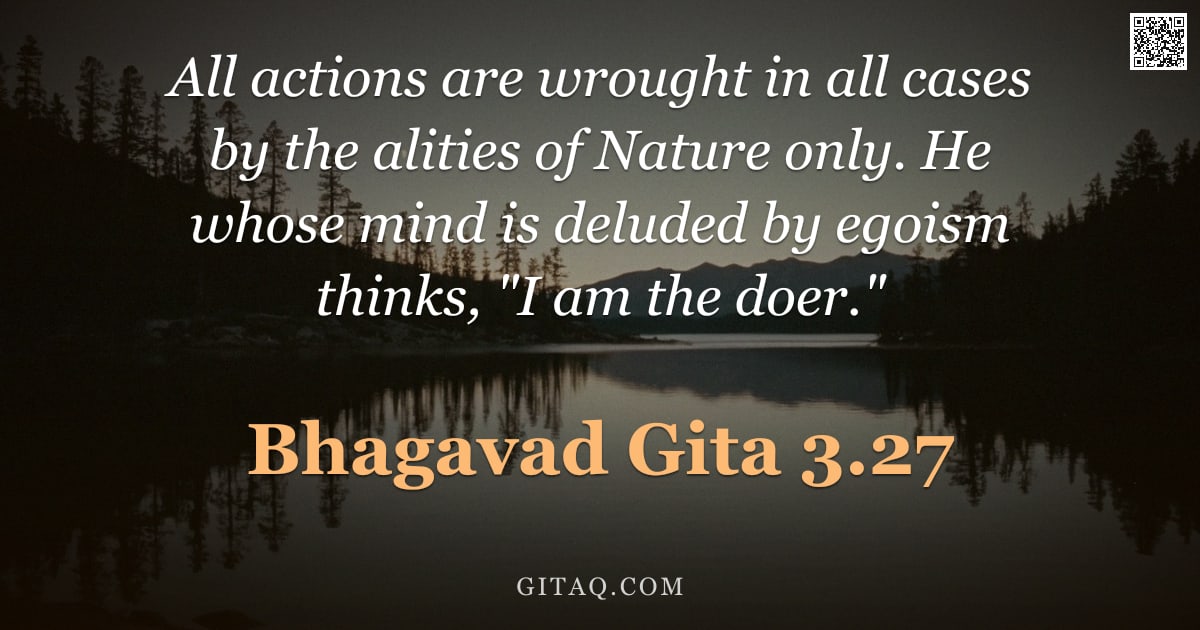
In this verse, Krishna explains to Arjuna that all actions are actually performed by the three qualities (gunas) of nature working together, not by an independent self. However, when a person is blinded by egoism, they mistakenly believe 'I am the doer' and claim full ownership of their deeds. The key teaching is that true wisdom involves recognizing this natural process rather than getting trapped in false pride or guilt over outcomes.
The Teaching Behind It
This verse is central to the philosophy of Karma Yoga and Sankhya, specifically developing the concept that actions are inevitable results of the interaction between the gunas (qualities) of material nature. It establishes the foundation for 'Nishkama Karma' by distinguishing between the body-mind complex as the instrument of action and the true Self (Atman) which is merely a witness.
Word by Word
Classical Commentary
Where This Happens
This verse occurs during the Bhagavad Gita dialogue on the battlefield of Kurukshetra, where Prince Arjuna is overwhelmed by grief and refusing to fight his relatives. Krishna has just begun teaching him about Karma Yoga (the path of selfless action) after explaining that the soul is eternal and distinct from the body. As Arjuna struggles with the idea of killing for duty versus personal attachment, this verse serves as a critical correction to his tendency to view himself solely as an independent actor responsible for violence.
Living It Out Today
Consider a project manager who faces a sudden deadline crisis; instead of spiraling into 'I failed because I am incompetent' or taking all credit if it succeeds, they realize the outcome depends on their team's skills, market conditions, and timing. By understanding that these factors are like nature's qualities acting together, they can focus on doing their specific duty with excellence without being paralyzed by ego-based anxiety. This shift allows them to make clear-headed decisions under pressure rather than reacting from a place of self-blame or arrogance.
Explained for Children
Imagine you are playing with building blocks: your hands move them because of gravity, the friction between wood, and the force from your muscles—all working together naturally. But if you think 'Only my hand did it' and ignore how everything else helped, that's like being confused by thinking you control every single thing in life on your own. Krishna teaches us to see clearly that many forces are at work behind our actions, so we can stay calm whether things go well or not.
Daily Reflection
You often feel like the captain steering your own ship, believing every success and failure rests solely on your shoulders. Yet today, try to notice how much of what happens around you is driven by circumstances, habits, and energies beyond your control. When you soften that grip of egoism, you may find a surprising lightness in simply witnessing life unfold without the burden of false ownership.
A Practice for Today
Sit quietly and observe your daily actions as if watching clouds pass across the sky, noticing how thoughts of 'I am doing this' arise from a place of identification rather than truth. Gently release the label of the doer to see that action is simply the interplay of forces moving through you.
Key Teachings
- The Illusion of Agency
Ego acts as a veil that blinds us to the true nature of reality, making us believe we are independent actors. This delusion causes suffering because it attributes all outcomes solely to our personal will rather than natural laws. - Nature's Inevitability
Every action is actually performed by the three gunas—sattva, rajas, and tamas—which are modes of material nature. Understanding this helps us see that we do not create actions; rather, our existence allows these forces to manifest. - Freedom from Ego
True spiritual progress begins when the mind is no longer deluded by the 'I am the doer' thought. By realizing that nature performs all work, one can act with detachment and clarity rather than ego-driven anxiety.
Themes
Related Verses
Read This Next
- 2.47 — This verse establishes the foundational principle of performing duty without attachment to results, which is necessary before understanding that one cannot even be the true doer.
- 3.30 — Following this analysis of ego, Krishna instructs Arjuna on how to specifically surrender all actions and their fruits to Him as a practical application of non-doership.
- 12.15 — This verse describes the qualities of one who has transcended egoism, offering a portrait of the person who no longer thinks 'I am the doer' but remains steady in wisdom.
Recommended Reading
GitaQ earns from qualifying purchases as an Amazon Associate.