Bhagavad Gita 3.28
Karma Yoga · English Translation
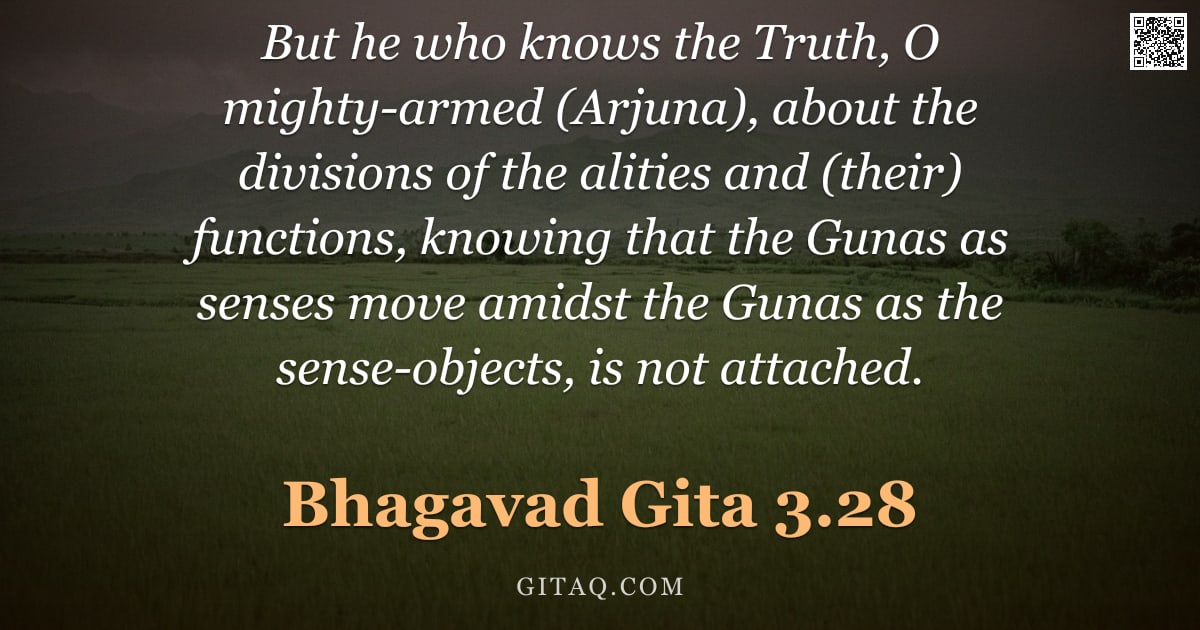
तत्त्ववित्तु महाबाहो गुणकर्मविभागयोः | गुणा गुणेषु वर्तन्त इति मत्वा न सज्जते ||३-२८||
tattvavittu mahābāho guṇakarmavibhāgayoḥ . guṇā guṇeṣu vartanta iti matvā na sajjate ||3-28||
What Does This Verse Mean?
In this verse, Lord Krishna addresses Arjuna as the 'mighty-armed' warrior to explain a fundamental truth about human nature. He teaches that those who truly understand reality recognize that only the three qualities (Gunras) interact with each other through our senses and objects of perception. Because they realize that their true self is distinct from these changing interactions, wise people do not become attached or entangled in the results of actions.
The Teaching Behind It
This verse sits at the intersection of Karma Yoga and Sankhya philosophy, specifically developing the concept of Vairagya (dispassion) through Jnana (knowledge). It establishes that true detachment comes not from avoiding action, but from correctly identifying the Self as distinct from the sensory machinery of Prakriti (nature). This realization allows one to act in the world without being bound by the dualities of pleasure and pain.
Word by Word
Classical Commentary
Where This Happens
This verse occurs on the battlefield of Kurukshetra within the epic Mahababarata, where Lord Krishna is guiding his friend and cousin Arjuna. Just before this moment, Arjuna was overwhelmed by confusion and grief, wishing to abandon his duty as a warrior due to emotional attachment to fighting his relatives. Krishna has been dismantling Arjuna's ego-based arguments with the philosophy of Karma Yoga, explaining that action performed without selfish desire is superior to inaction.
Living It Out Today
Consider a modern manager facing an unexpected market crash where their team must make painful layoffs; if they view this purely as 'bad luck' hitting them personally, they will suffer deeply. However, applying the wisdom of this verse, the manager recognizes that economic fluctuations are merely external forces (Gunras) interacting with industry conditions. By maintaining a clear mind and understanding that their self-worth is separate from these temporary business outcomes, they can make decisive, fair decisions without being paralyzed by anxiety or attachment to specific results.
Explained for Children
Imagine you are playing a video game where your character fights monsters made of fire, ice, or lightning. The monsters (the qualities) fight each other and interact with your controller buttons, but *you* sitting on the couch aren't actually burning cold from the screen. Krishna teaches us that we are like the player watching the game: our senses meet different things every day, just like characters fighting in a story, but if you know you are safe behind the scenes, you won't get too upset or scared when the monsters clash.
Daily Reflection
Today, imagine stepping back from the drama of your own reactions to see the mechanics at work behind them. You might find that when anger or desire strikes, it is simply a movement of one quality interacting with another, not a personal attack on you. By holding this distance as an observer rather than getting lost in the participant's role, you discover a deep peace where attachment cannot take root.
A Practice for Today
Sit quietly and observe your senses interacting with objects of the world, recognizing that it is merely the Gunas moving among other Gunas. When a thought or sensation arises, gently remind yourself that you are not the actor in this dance, but the silent witness watching the play unfold.
Key Teachings
- The Observer vs. The Actor
True wisdom lies in distinguishing between the self and the body-mind complex that acts under the influence of nature's three modes. - Gunas Interacting with Gunas
Sensory experiences are simply one quality (like passion or inertia) interacting with another, devoid of any permanent 'doer' at their core. - Freedom from Attachment
When you realize that actions happen spontaneously due to these natural laws, the ego's claim over results dissolves naturally and completely.
Themes
Related Verses
Read This Next
- 2.47 — To understand the foundational principle of performing action without attachment to results.
- 3.30 — To learn how Krishna explicitly instructs Arjuna to offer all actions and their fruits as a sacrifice.
- 12.15 — To see the qualities of one who is dear to the Divine, which are cultivated by such detached wisdom.
Recommended Reading
GitaQ earns from qualifying purchases as an Amazon Associate.