Bhagavad Gita 3.26
Karma Yoga · English Translation
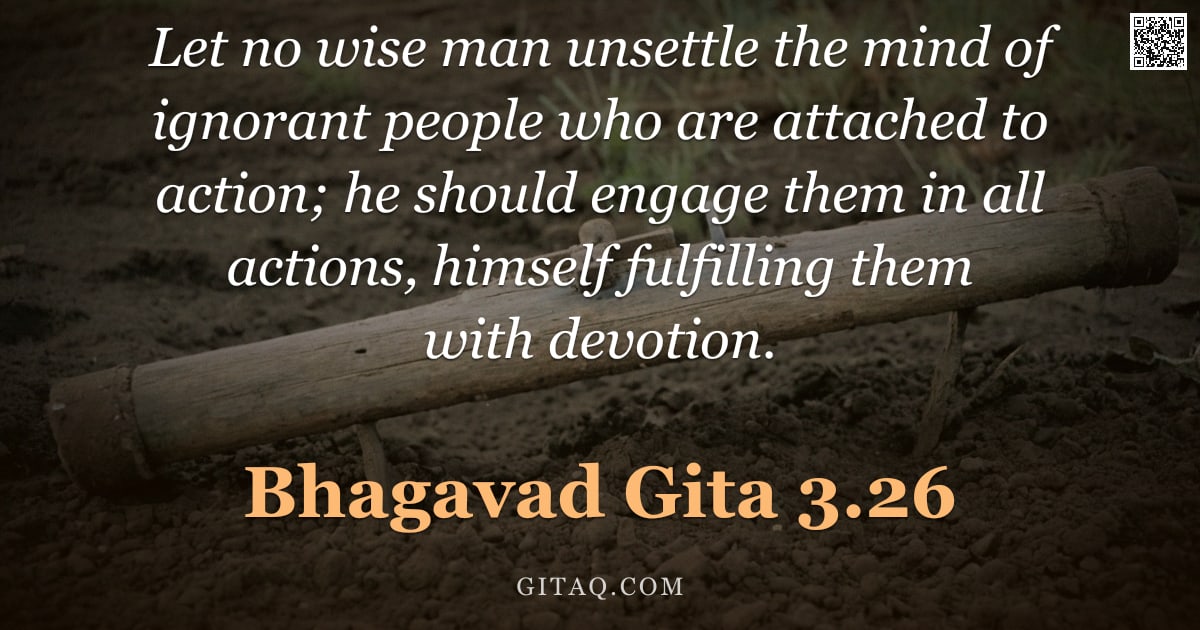
न बुद्धिभेदं जनयेदज्ञानां कर्मसङ्गिनाम् | जोषयेत्सर्वकर्माणि विद्वान्युक्तः समाचरन् ||३-२६||
na buddhibhedaṃ janayedajñānāṃ karmasaṅginām . joṣayetsarvakarmāṇi vidvānyuktaḥ samācaran ||3-26||
What Does This Verse Mean?
In this verse, Krishna advises Arjuna that a wise person should never try to forcefully shake the faith of those who are still learning and attached to doing work for results. Instead of preaching abstract philosophy or criticizing their actions, one must lead by example—performing duties with devotion while gently guiding others to join in. The core teaching is about preserving harmony and encouraging spiritual growth through positive action rather than intellectual confrontation.
The Teaching Behind It
This teaching is central to Karma Yoga, specifically the principle of 'Sama-darshana' or seeing all beings equally while maintaining one's own spiritual equilibrium. It develops the concept that wisdom involves not just knowing the truth but having the tact to apply it according to another person's capacity (adhikara), ensuring that higher knowledge does not become a source of confusion for beginners.
Word by Word
Classical Commentary
Where This Happens
This verse occurs on the battlefield of Kurukshetra during a moment when Arjuna has just heard Krishna's initial teachings on duty and detached action. Having struggled with confusion about fighting his own kin, Arjuna now seeks guidance on how to interact with others who might be confused or still attached to worldly results. Krishna addresses him as the 'wise one' (vidvan), instructing that a leader must understand the mental state of followers before attempting to elevate them spiritually.
Living It Out Today
Consider a new manager joining a team where employees are used to working for bonuses and fear change; if they immediately demand radical productivity changes without explanation, morale will crash. Instead, this verse suggests the manager should continue doing their own work with dedication while quietly demonstrating efficiency, earning trust through action rather than lectures on 'detachment.' This approach allows hesitant colleagues to observe the benefits of a new method and gradually adopt it themselves.
Explained for Children
Imagine you are a senior scout leader who knows the perfect way to build a fort, but your new junior scouts just want to stack rocks because they think it's fun. If you tell them 'That's wrong, do what I say,' they might feel sad and stop playing altogether. Instead, you join in their game of stacking rocks, show them how strong the pile can get by adding more carefully, and slowly teach them better techniques while having fun together.
Daily Reflection
Today, notice how often you feel compelled to lecture those who are still learning or deeply attached to their methods. Instead of trying to pull them out of their current state with harsh words, consider meeting them where they are and inviting them gently into shared purpose. Your presence as a steady example is far more powerful than any argument you could win.
A Practice for Today
Sit quietly and observe where your urge to correct others stems from a need for control versus genuine wisdom. Visualize yourself as a steady lamp that illuminates the path without extinguishing another's light, allowing them to find their own way through action.
Key Teachings
- The Duty of the Wise
A realized soul does not use their superior understanding to destabilize or confuse those who are still new on the path. True wisdom involves preserving the peace and momentum of others rather than asserting intellectual dominance. - Leading by Example
The most effective way to guide attachment is not through argument but through one's own engaged, devoted practice. When a wise person performs actions with full awareness and devotion, they naturally inspire others to follow suit without force. - Compassionate Engagement
Rather than isolating oneself from the world of action due to its complexity, one must engage in all activities while maintaining inner detachment. This approach allows the wise person to uplift everyone around them by participating fully yet without ego.
Themes
Related Verses
Read This Next
- 2.47 — Read this to understand the foundational principle of performing action without attachment, which sets the stage for Krishna's instruction on how to handle ignorance.
- 3.30 — This verse expands on the method described in 3.26 by instructing you to surrender all actions to the Divine as a form of perfect devotion.
- 12.15 — Read this next to see how one who is not disturbed and does not disturb others becomes dear to Krishna, completing the picture of gentle guidance.
Recommended Reading
GitaQ earns from qualifying purchases as an Amazon Associate.