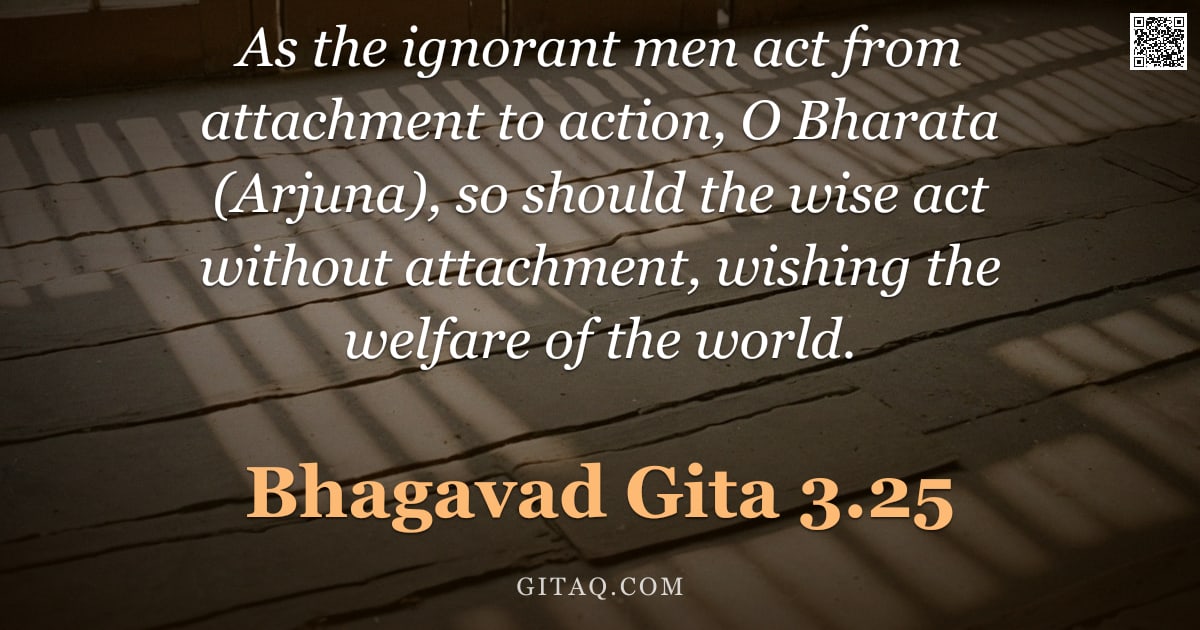
Bhagavad Gita 3.25
Karma Yoga · English Translation
सक्ताः कर्मण्यविद्वांसो यथा कुर्वन्ति भारत | कुर्याद्विद्वांस्तथासक्तश्चिकीर्षुर्लोकसंग्रहम् ||३-२५||
saktāḥ karmaṇyavidvāṃso yathā kurvanti bhārata . kuryādvidvāṃstathāsaktaścikīrṣurlokasaṃgraham ||3-25||
What Does This Verse Mean?
In this verse, Lord Krishna advises Arjuna on how a wise person should conduct themselves compared to an ignorant one. He explains that while uneducated people act with strong attachment and desire for results, the enlightened must perform their duties without such attachment. The key teaching is that wisdom involves acting selflessly not just for personal gain, but specifically to set a positive example and ensure the welfare of society.
The Teaching Behind It
This verse is central to Karma Yoga, the path of selfless action, which integrates Jnana (knowledge) with Bhakti (devotion). It develops the concept that true wisdom necessitates *Loka-Sangraha*, or the welfare of all beings, transforming individual duty into a cosmic responsibility rather than mere ritualistic observance.
Word by Word
Classical Commentary
Where This Happens
This verse occurs during the dialogue on the battlefield of Kurukshetra in the Mahabharata epic. Lord Krishna is speaking to Arjuna, who has just laid down his weapons in despair after seeing his relatives as enemies. After explaining the nature of action and duty earlier in Chapter 3, Krishna uses this analogy to show that even though he (Krishna) knows the ultimate truth, he still acts for the sake of order; thus, Arjuna must not withdraw from his necessary role.
Living It Out Today
Consider a senior manager who has mastered their job and understands how it impacts the whole company. Instead of hoarding knowledge or acting only to secure a bonus (the 'ignorant' approach), they actively mentor junior staff, streamline processes for team success, and lead by example without demanding credit. This shifts their mindset from personal anxiety about outcomes to genuine dedication to the organization's health.
Explained for Children
Imagine you see someone painting beautifully in public; they are having so much fun that others want to try it too! If a smart kid saw this, they wouldn't stop to ask 'What do I get out of this?' but would join in happily just because the activity is good for everyone. Krishna says grown-ups who know better should act like that happy painter: doing their best work without worrying about rewards, so others feel inspired and the whole world becomes a nicer place.
Daily Reflection
You often worry about whether your efforts will yield the specific outcome you desire, yet this verse invites you to shift from attachment to intentionality. Like an artist who paints not just for a reward but because art brings joy and beauty into the world, you are called to act with wisdom while caring deeply for others. When you let go of personal gain as your primary motivator, your work naturally becomes a force that uplifts everyone around you.
A Practice for Today
Sit quietly and observe your own actions today, noticing where you feel attached to the results before they even happen. Imagine performing that same action with a heart open for the welfare of all, releasing the grip on 'my' success while fully engaging in the work itself.
Key Teachings
- The Paradox of Action
Krishna contrasts the behavior of the ignorant, who act out of selfish attachment, with the wise, who engage in action without such binding desires. This teaches that true wisdom lies not in abandoning work, but in changing one's relationship to it. - Loka-Samgraha as Motivation
The defining characteristic of a sage is 'lokasaṃgraham,' or the welfare and cohesion of the world. Every action becomes an offering when performed with this altruistic intent rather than for personal gain. - Leading by Example
The wise must act as role models to guide others, preventing society from descending into selfishness or inaction due to misunderstanding. By demonstrating detached yet purposeful action, they inspire the ignorant to follow a higher path.
Themes
Related Verses
Read This Next
- 2.47 — This foundational verse defines 'karmanye vadhikaraste' (right to action alone), establishing the principle of detachment that this verse builds upon.
- 3.30 — Following immediately after, this verse instructs Arjuna to offer all actions to Krishna, providing the spiritual mechanism for maintaining attachment-free work.
- 12.15 — This describes the qualities of a devotee who is dear to Krishna because they do not agitate others and remain happy, embodying the spirit of Loka-Samgraha.
Recommended Reading
GitaQ earns from qualifying purchases as an Amazon Associate.