Bhagavad Gita 3.24
Karma Yoga · English Translation
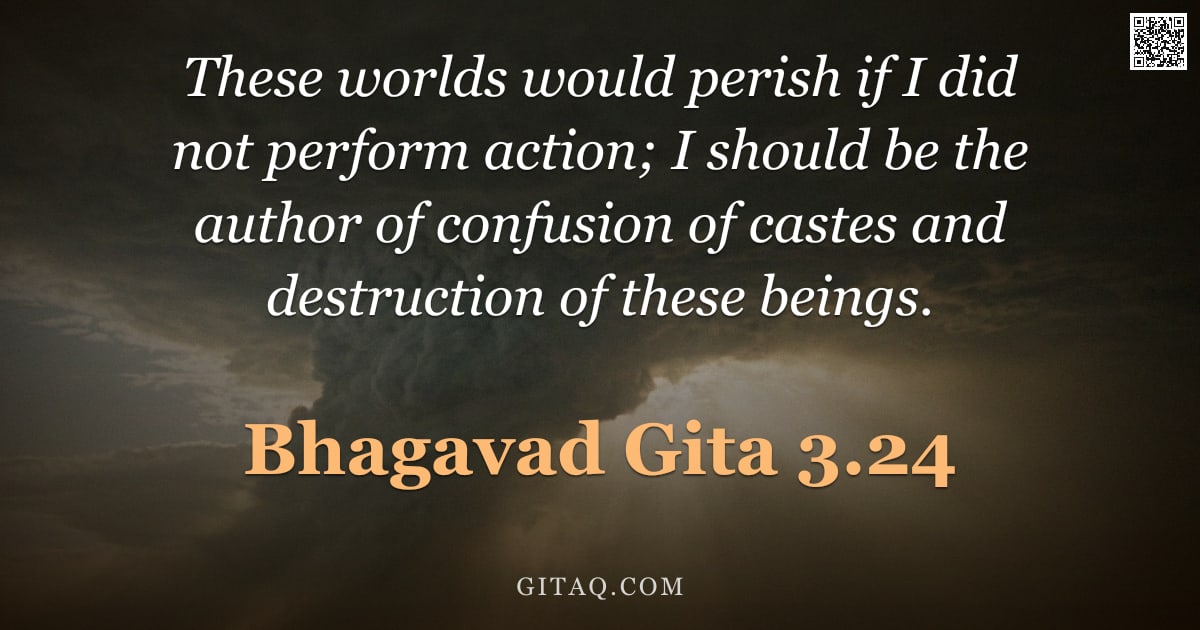
उत्सीदेयुरिमे लोका न कुर्यां कर्म चेदहम् | सङ्करस्य च कर्ता स्यामुपहन्यामिमाः प्रजाः ||३-२४||
utsīdeyurime lokā na kuryāṃ karma cedaham . saṅkarasya ca kartā syāmupahanyāmimāḥ prajāḥ ||3-24||
What Does This Verse Mean?
In this verse, Lord Krishna speaks to Arjuna about the critical importance of performing one's duty without attachment to results. He explains that if he were to stop working and remain inactive due to his own preferences, society would collapse into chaos as people lose their sense of order. The key teaching is that a leader or any individual must act responsibly because inaction by those who set an example leads to the destruction of everyone around them.
The Teaching Behind It
This verse belongs to the core teaching of Karma Yoga (the path of selfless action) as expounded in Chapter 3. It develops the concept of 'Loka-sangraha' or holding the world together, establishing that one's duty is not just for personal liberation but for maintaining cosmic and social order through example.
Word by Word
Classical Commentary
Where This Happens
This verse occurs on the battlefield of Kurukshetra during a momentary silence after Krishna has just described his own divine form (Vishvarupa) in Chapter 11, or more likely immediately following Arjuna's refusal to fight and subsequent questioning of duty. The speaker is Lord Krishna addressing Prince Arjuna, who has dropped his bow and fallen into deep despair and confusion about fighting his cousins. At this point, Arjuna believes that renouncing action entirely is the only way to avoid sin, prompting Krishna to counter with a pragmatic argument: even divine figures must act for the welfare of the world.
Living It Out Today
Consider a senior manager at a company who feels overwhelmed by a crisis and wishes to step back or quit immediately. If this leader withdraws their energy and stops guiding the team during a critical project, it will cause panic among junior employees, leading to missed deadlines and potential job losses for many families. Instead of hiding from responsibility due to personal fatigue, they must model resilience and continue working through the difficulty, showing that steady action is necessary even when emotions are high.
Explained for Children
Imagine you are the captain of a school bus, and all your students look up to you to get to school safely every day. If the captain decided to sit down and stop driving just because they felt like it, where would the kids go? They might miss their classes or get lost! Lord Krishna is saying that even though he could rest, if he stopped doing his work of helping people learn how to be good, everyone else would become confused and things would fall apart. So, we must do our jobs well because others are watching us.
Daily Reflection
You often feel small when faced with the magnitude of problems in the world, yet this verse reminds you that even one person's conscious action is a pillar preventing collapse. When you hesitate to do your duty because it seems insignificant, remember that silence and withdrawal can lead to confusion for many others. Your commitment to right action today is an act of love that sustains life itself.
A Practice for Today
Sit quietly and visualize your daily duties not as burdens, but as the very threads that hold the fabric of society together. Offer to perform these actions with full dedication, trusting that your sincere effort helps prevent chaos in the world around you.
Key Teachings
- The Weight of Leadership
Great leaders set the standard by which society functions; if they withdraw from duty, it creates a vacuum filled with disorder. The verse illustrates that inaction is not neutral but actively destructive to the social order. - Action as Preservation
Performing one's prescribed duties (svadharma) is essential for maintaining cosmic and social balance, known as dharma. Without this consistent flow of righteous action, the structures that protect humanity would crumble into confusion. - Selfless Motivation
The speaker acts not out of personal desire but to prevent 'sankara' or the mixing and destruction of all beings. True devotion involves taking responsibility for the welfare of others through one's own active engagement with life. - The Necessity of Engagement
Renunciation does not mean physical withdrawal; it means acting without attachment to personal gain for the sake of universal welfare. To leave one's post is to risk the collapse of everything we hold dear.
Themes
Related Verses
Read This Next
- 2.47 — This verse establishes the fundamental principle of acting without attachment to results, which is necessary before one can act for the welfare of others.
- 3.30 — Following this thought process, Krishna instructs Arjuna to surrender all actions to Him, deepening the motivation from social duty to divine offering.
- 12.15 — This verse describes the qualities of a beloved devotee who is not disturbed by worldly chaos and does not cause disturbance in others, embodying the fruit of this teaching.
Recommended Reading
GitaQ earns from qualifying purchases as an Amazon Associate.