Bhagavad Gita 6.9
Dhyana Yoga · English Translation
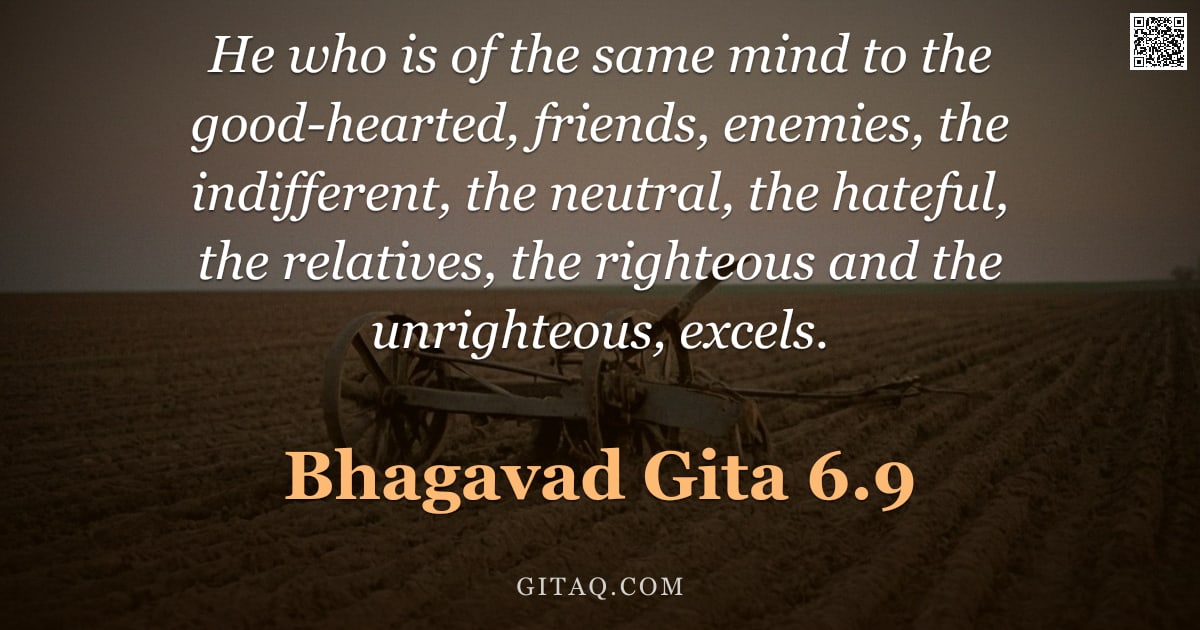
सुहृन्मित्रार्युदासीनमध्यस्थद्वेष्यबन्धुषु | साधुष्वपि च पापेषु समबुद्धिर्विशिष्यते ||६-९||
suhṛnmitrāryudāsīnamadhyasthadveṣyabandhuṣu . sādhuṣvapi ca pāpeṣu samabuddhirviśiṣyate ||6-9||
What Does This Verse Mean?
In this verse, Lord Krishna describes the essential quality of a perfect yogi who has mastered meditation. He teaches that such a person maintains an equal and balanced mind toward everyone—whether they are friends or enemies, kind people or those acting unrighteously, relatives or strangers. The core teaching is that true spiritual advancement requires transcending personal likes and dislikes to see the divine essence equally in all beings.
The Teaching Behind It
This verse is a cornerstone of Dhyana Yoga (the path of meditation) which integrates principles from Sankhya philosophy regarding the distinction between the observer and the observed. It develops the concept of 'Samabuddhi' (equanimity), asserting that true wisdom arises when one perceives the same eternal Self in all beings, thereby transcending the dualities of love and hate.
Word by Word
Classical Commentary
Where This Happens
This teaching occurs in Chapter 6 of the Bhagavad Gita during the intense dialogue between Lord Krishna and Prince Arjuna on the battlefield of Kurukshetra. After explaining various methods of meditation (Dhyana Yoga), Krishna is now detailing the specific character traits required for a practitioner to succeed. At this moment, Arjuna feels overwhelmed by the prospect of facing his own relatives as enemies in war; Krishna uses this verse to guide him toward an inner state where external relationships no longer cause emotional turbulence.
Living It Out Today
Consider a manager who must make a difficult decision regarding a long-term employee they dislike personally versus a talented newcomer they admire. A person with the 'equal mind' described here will evaluate both individuals solely on their work performance and current needs, ignoring personal affection or resentment. This approach prevents bias in hiring, firing, or conflict resolution, leading to fairer outcomes that reduce workplace anxiety and foster trust among all team members.
Explained for Children
Imagine you have a superpower where your heart feels just as happy whether someone gives you a hug (a friend) or bumps into you on purpose (an enemy). This verse is like saying that when we learn to love everyone fairly—whether they are nice, mean, new, or old—we become special and strong inside. Just like the sun shines its light on both flowers and rocks without choosing which one gets more warmth, a wise person treats every single person with equal kindness.
Daily Reflection
Today, I invite you to notice where your mind naturally drifts into judgment or favor based on who is standing before you. True freedom isn't about ignoring differences between people, but rather finding that unshakeable center within yourself that remains constant regardless of how others treat you. When you stop reacting with fear to the 'enemy' or blind attachment to the 'friend,' you discover a quiet strength that no external circumstance can disturb.
A Practice for Today
Sit quietly and gently bring to mind three people from your life representing different poles of emotion: a friend you love, an enemy who has hurt you, and someone entirely neutral whom you have never met. Visualize holding the same steady warmth in your heart for all three simultaneously, refusing to let their identities change the quality of your internal peace.
Key Teachings
- The Equality of Perception
This verse establishes that spiritual maturity is measured not by how we treat those who please us, but by our equanimity toward all beings. The wise person sees the same divine consciousness in a loved one as they do in an adversary. - Transcending Dualities
Human suffering often arises from clinging to 'liking' and aversion to 'disliking'; this teaching calls for rising above these binary reactions. By maintaining a balanced mind toward the righteous, unrighteous, friends, and foes alike, one transcends the oscillation of joy and sorrow. - The Mark of Excellence
To 'excel' or stand out in spiritual practice is defined by this specific capacity for sameness of mind. It is not a passive indifference but an active, conscious choice to hold the heart open and steady amidst the chaos of conflicting relationships. - The Scope of Neutrality
The verse lists a comprehensive range of human archetypes—from 'suhṛt' (well-wishers) to 'dveṣya' (hateful ones)—to ensure no relationship is excluded from the practice. Even those who are indifferent or neutral serve as crucial tests for maintaining this balanced state.
Themes
Related Verses
Read This Next
- 2.48 — This verse defines 'yoga' as equanimity (samatvam), providing the philosophical foundation for maintaining balance described in chapter 6.
- 3.30 — It offers a practical method of offering all actions to the Divine, which helps dissolve personal bias and attachment toward specific outcomes or people.
- 12.15 — Krishna describes the qualities of His dear devotee who is equal-minded in happiness and distress, directly echoing the theme of this verse.
Recommended Reading
GitaQ earns from qualifying purchases as an Amazon Associate.