Bhagavad Gita 18.20
Moksha Sanyasa Yoga · English Translation
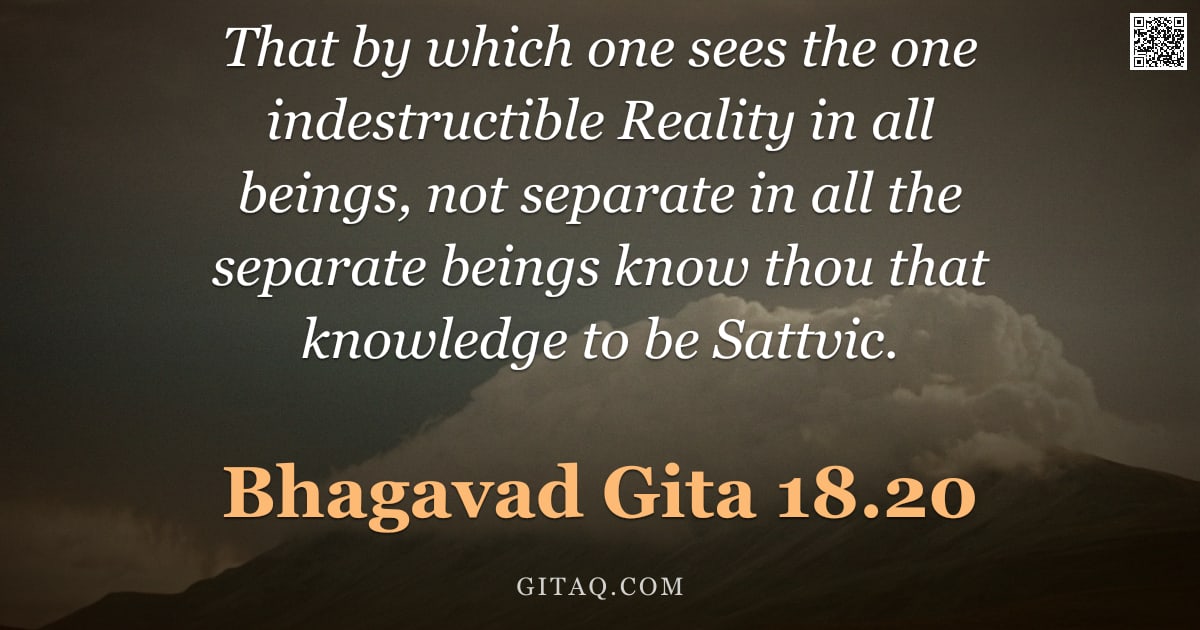
सर्वभूतेषु येनैकं भावमव्ययमीक्षते | अविभक्तं विभक्तेषु तज्ज्ञानं विद्धि सात्त्विकम् ||१८-२०||
sarvabhūteṣu yenaikaṃ bhāvamavyayamīkṣate . avibhaktaṃ vibhakteṣu tajjñānaṃ viddhi sāttvikam ||18-20||
What Does This Verse Mean?
Lord Krishna is teaching Arjuna about the highest form of pure knowledge during their conversation on the battlefield. He explains that true wisdom sees a single, unchanging divine presence within every living being, regardless of how different they appear externally. This perspective allows one to recognize the underlying unity in all diversity without getting confused by superficial separation.
The Teaching Behind It
This verse is a cornerstone of Jnana Yoga (the path of knowledge) and reflects the non-dualistic philosophy of Advaita Vedanta found within the Gita. It develops the concept that while material reality appears as many separate forms, the spiritual essence (Brahman) remains one indivisible whole.
Word by Word
Classical Commentary
Where This Happens
This verse appears near the end of Lord Krishna's discourse on the battlefield of Kurukshetra as he concludes his teachings to Prince Arjuna. After explaining various types of renunciation and knowledge throughout Chapter 18, Krishna is now categorizing different kinds of wisdom based on their spiritual quality (gunas). At this moment, Arjuna has just received instructions on duty and detachment but still seeks clarity on how true understanding transforms the way one perceives reality.
Living It Out Today
When you are stuck in a heated argument with a coworker over a project mistake, apply this verse by looking past their angry words to see the same human desire for success and dignity that you feel inside yourself. Instead of reacting to them as an enemy or obstacle, view their frustration as a temporary shadow covering the same 'indestructible reality' they share with you. This shift in perspective turns a conflict into an opportunity for empathy, allowing you to respond calmly rather than defensively.
Explained for Children
Imagine you have many different toys: some are made of plastic, some of wood, and some of metal. Even though they look very different on the outside, deep down inside them is a tiny spark from the same sun that warms us all. This verse teaches us to see that special spark in every person we meet—whether it's your best friend or someone you don't know yet—and realize that at heart, everyone shares the same beautiful light.
Daily Reflection
Today, I invite you to pause whenever you feel separated from someone or something by your own judgments or fears. Remember that this sense of division is an illusion; beneath every distinct form beats the same indestructible heart. When you view others through this lens of unity, resentment softens and a natural compassion arises.
A Practice for Today
Close your eyes and gently scan the room, looking at each person or object as a unique expression of one single, unchanging consciousness. As you breathe deeply, silently affirm that the life force within yourself is identical to the divine essence pulsing in everything else around you.
Key Teachings
- The Illusion of Separation
Our ordinary perception divides reality into isolated fragments, but true wisdom reveals the underlying oneness that binds all existence. The divine is not scattered or lost in parts; it remains whole and undivided even while appearing within multiple forms. - The Nature of Sattvic Knowledge
This specific vision belongs to 'Sattva,' the quality of purity, clarity, and harmony that perceives reality as it truly is. Unlike knowledge based on ego or passion which seeks distinction, this wisdom sees the eternal Self in all creatures. - The Indestructible Reality
While bodies change and forms dissolve, the essence perceived within them remains indestructible and unchanging. Recognizing this timeless core transforms how we relate to life's transient events with equanimity and reverence.
Themes
Related Verses
Read This Next
- 2.47 — To understand how to act without attachment while perceiving this oneness, as described by Krishna's instruction on duty.
- 3.30 — This verse complements the theme of renunciation (Sanyasa) and offers a practical method for dedicating actions to the divine while seeing unity.
- 12.15 — To see how one who is established in this vision becomes dear to all beings, as they are free from distressing desires and aversions.
Recommended Reading
GitaQ earns from qualifying purchases as an Amazon Associate.