Bhagavad Gita 18.19
Moksha Sanyasa Yoga · English Translation
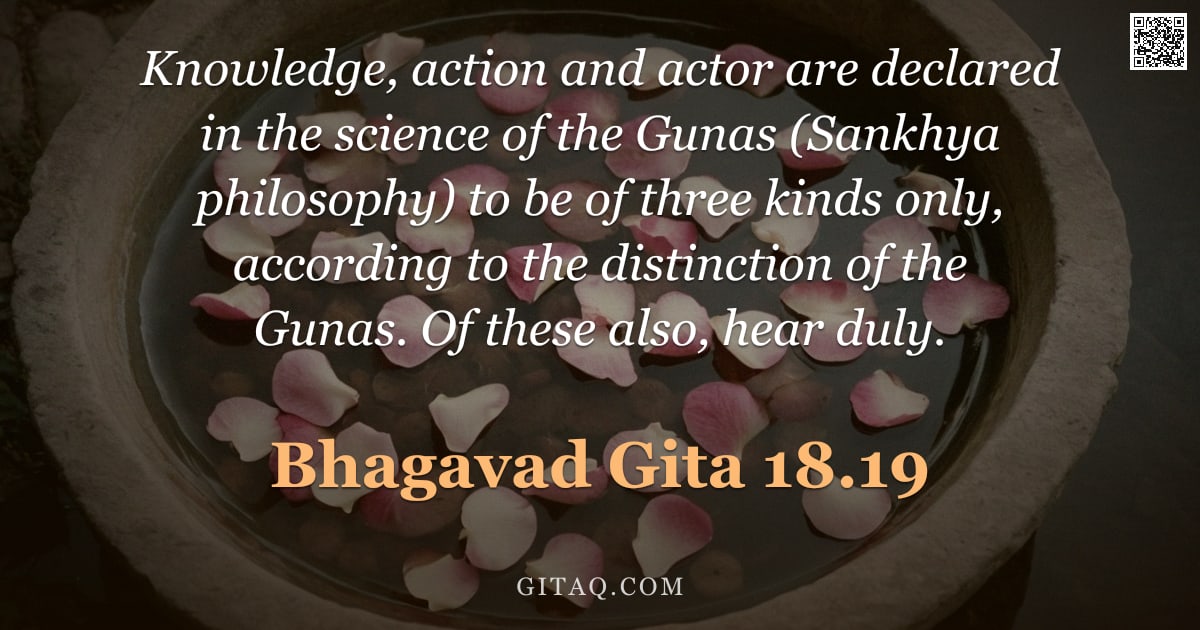
ज्ञानं कर्म च कर्ताच त्रिधैव गुणभेदतः | प्रोच्यते गुणसङ्ख्याने यथावच्छृणु तान्यपि ||१८-१९||
jñānaṃ karma ca kartāca tridhaiva guṇabhedataḥ . procyate guṇasaṅkhyāne yathāvacchṛṇu tānyapi ||18-19||
What Does This Verse Mean?
In this verse, Lord Krishna is speaking to Arjuna on the battlefield of Kurukshetra, continuing his detailed classification of spiritual practices. He explains that just as there are three types of knowledge and action based on human nature (the Gunas), every person who acts or learns must be understood through these same distinctions. The key teaching here is a preview: Krishna has categorized wisdom and deeds into 'Sattvic' (pure), 'Rajasic' (passionate), and 'Tamasic' (ignorant) modes, and he invites Arjuna to listen closely as he elaborates on each.
The Teaching Behind It
This verse belongs primarily to the Sankhya philosophy strand within the Gita, specifically focusing on Gunas (the three modes of material nature). It serves as the structural bridge between Jnana Yoga (the path of knowledge) and Karma Yoga (the path of action), establishing that both wisdom and deeds are categorized by these same three qualities.
Word by Word
Classical Commentary
Where This Happens
This verse occurs during Chapter 18, known as 'Moksha Sanyasa Yoga,' where Krishna is concluding his teachings after Arjuna has agreed to fight. Having just explained the concept of renunciation and its different forms, Krishna pauses here to structure his final summary regarding human nature. The listener, Arjuna, is in a state of deep receptivity but also confusion about how to distinguish between true spiritual knowledge and mere intellectual activity amidst the chaos of war.
Living It Out Today
Consider a manager facing a tough decision on whether to lay off staff during an economic downturn. They might approach this with Sattvic clarity (seeking the right balance for everyone's long-term good), Rajasic agitation (acting out of fear or personal ambition to save their own bonus), or Tamasic ignorance (avoiding the issue entirely due to laziness). By applying Krishna's framework, one can diagnose which 'mode' is driving their current thinking and consciously shift toward a decision rooted in pure wisdom rather than emotional reactivity.
Explained for Children
Imagine you are eating a meal. Sometimes the food makes you feel fresh and happy, sometimes it makes you very energetic but maybe too restless, and other times it might make you sleepy or sick. This verse is like saying that everything we do—like learning new things or helping others—is also made of three different kinds of 'ingredients' in our hearts. Krishna wants to tell Arjuna that before he can teach him how to be the best version of himself, they first need to understand which kind of ingredients are being used when people learn or act.
Daily Reflection
Today, you might notice that even your most noble intentions can be subtly tainted by a need for recognition or a hidden reluctance. It is easy to mistake this inner noise for who you truly are, but remember that knowledge and action change while your true self remains steady. By observing these three layers—what you know, what you do, and the 'I' behind it—you begin to see the mechanics of your own mind clearly.
A Practice for Today
Sit quietly and observe how your current knowledge, actions, or sense of self feels colored by restlessness (Rajas), inertia (Tamas), or clarity (Sattva). Ask yourself: 'Is my understanding clouded by emotion? Is my action driven by fear or desire?' Gently shift your attention to the pure awareness behind these shifting qualities.
Key Teachings
- The Threefold Nature of Existence
Krishna reveals that knowledge, action, and the agent are not monolithic but exist in three distinct modes based on the Gunas. This classification helps us diagnose whether our spiritual practices or daily duties are rooted in clarity, passion, or ignorance. - The Science of Classification
By categorizing these elements according to Sankhya philosophy, we gain a practical tool for self-analysis rather than just abstract theory. Understanding the specific type of knowledge or action allows us to consciously transcend limitations and move toward purity. - The Call to Discernment
Krishna invites Arjuna (and you) to listen closely because recognizing these distinctions is the first step toward liberation. Without this discernment, we remain trapped in cycles of behavior driven by unconscious impulses rather than conscious choice.
Themes
Related Verses
Read This Next
- 2.47 — Read this next to understand how Krishna defines duty without attachment, which sets the stage for analyzing the quality of action in verse 19.
- 3.30 — This verse elaborates on surrendering all actions as an offering, providing a practical method to purify the 'actor' mentioned in this chapter.
- 12.15 — Read this to see how one who is free from agitation and envy embodies the highest Sattvic qualities of knowledge and action described here.
Recommended Reading
GitaQ earns from qualifying purchases as an Amazon Associate.