Bhagavad Gita 18.18
Moksha Sanyasa Yoga · English Translation
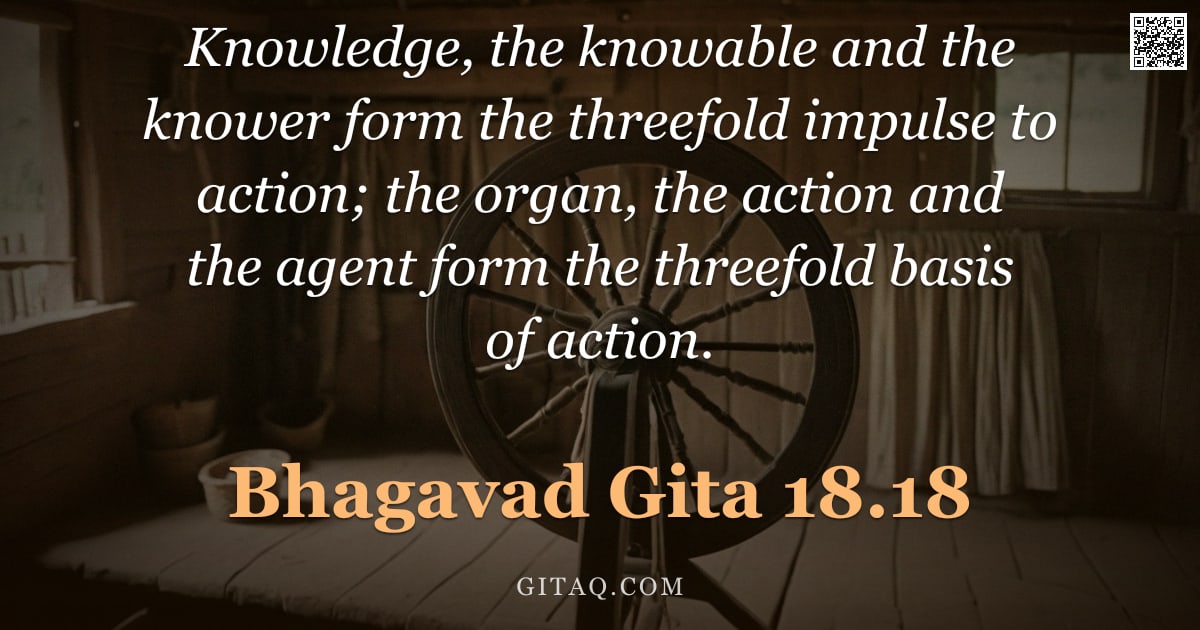
ज्ञानं ज्ञेयं परिज्ञाता त्रिविधा कर्मचोदना | करणं कर्म कर्तेति त्रिविधः कर्मसंग्रहः ||१८-१८||
jñānaṃ jñeyaṃ parijñātā trividhā karmacodanā . karaṇaṃ karma karteti trividhaḥ karmasaṃgrahaḥ ||18-18||
What Does This Verse Mean?
In this verse, Lord Krishna explains to Arjuna that every action begins with three components: the knowledge of what needs doing, understanding the goal or object of that action, and the person who intends to perform it. He further clarifies that any specific act involves a tool used (the organ), the actual deed being done, and the individual performing the duty. The core teaching is that true wisdom requires recognizing how these three elements combine to create an impulse for action, rather than just seeing the result of the work.
The Teaching Behind It
This verse belongs to the synthesis of Karma Yoga (the yoga of action) and Jnana Yoga (the path of knowledge), serving as a diagnostic tool for analyzing human activity. It develops the concept that one cannot engage in 'action' without simultaneously engaging with specific cognitive and physical dimensions, setting the stage for understanding how actions are influenced by the three gunas.
Word by Word
Classical Commentary
Where This Happens
This verse appears in Chapter 18, the final chapter known as 'Moksha Sanyasa Yoga,' where Lord Krishna concludes his teachings on duty and liberation to Prince Arjuna on the battlefield of Kurukshetra. Just prior to this shloka, Krishna has been analyzing the three types of knowledge, action, and doers based on the modes of nature (goodness, passion, ignorance). Arjuna is in a state of deep contemplation after hearing about renunciation, seeking clarity on how these abstract concepts apply to his immediate duty as a warrior. This verse serves as a foundational framework before Krishna moves into the ultimate conclusion of surrender.
Living It Out Today
Consider a project manager facing a critical deadline: they must first understand the technical requirements (knowledge), identify the specific product deliverable needed (the knowable), and possess the confidence to lead the team (knower). If any one of these is missing—perhaps the data is wrong, or the tool fails—they cannot effectively execute the task. By consciously aligning their understanding, tools, and sense of self with the work at hand, they transform anxiety into focused action.
Explained for Children
Imagine you want to build a sandcastle at the beach. First, you need to know *how* to make it (knowledge), then you look at the empty spot on the shore where you will put it (the thing being known), and finally, you are the one deciding to do it (you!). Just like that building a castle needs your shovel, the sandcastle itself, and YOU doing the work. Krishna is telling us that everything we do happens because of these three parts working together.
Daily Reflection
Today, pause to see if you are trapped in the illusion that 'I' am doing this alone, when actually it is just knowledge meeting the object through your senses. You might find peace by shifting from claiming credit for actions to simply witnessing them as a natural flow of energy and intellect. When you stop identifying so tightly with being the sole agent or the instrument, the weight of obligation lifts, leaving room for true freedom.
A Practice for Today
Begin by observing your mind as it categorizes everything into three roles: the teacher, the subject being taught, and you yourself learning; this is how knowledge shapes your reality today. Next, notice where action arises from a sense of duty (karma), an instrument like your hands or voice, and the doer who claims ownership of the result.
Key Teachings
- The Triad of Knowledge
True action begins not just with doing, but with a complete understanding involving what is known (jneya), how it is known (jnana), and the knower themselves. Without this threefold clarity, our actions are blind and often lead to confusion rather than liberation. - The Mechanics of Action
Every act in the world consists of a distinct interplay between the instrument (karanam), the action itself (karma), and the agent performing it (kartā). Recognizing these three components helps us see that no single part is permanent or independent. - Freedom from Ownership
By analyzing the 'threefold basis of action,' we realize that claiming sole ownership over results creates bondage. The Gita invites us to perform duties by aligning with these components without egoistic attachment, allowing actions to flow naturally.
Themes
Related Verses
Read This Next
- 2.47 — Read this next to understand Krishna's instruction on performing duty without attachment to results, which flows naturally from analyzing the agent of action.
- 3.30 — This verse offers a practical method for surrendering all actions and their fruits to the Divine, deepening the understanding of the 'agent' discussed in 18.18.
- 12.15 — Conclude your study by reading about the qualities of a devotee who is free from ego and envy, embodying the true nature of a liberated knower.
Recommended Reading
GitaQ earns from qualifying purchases as an Amazon Associate.