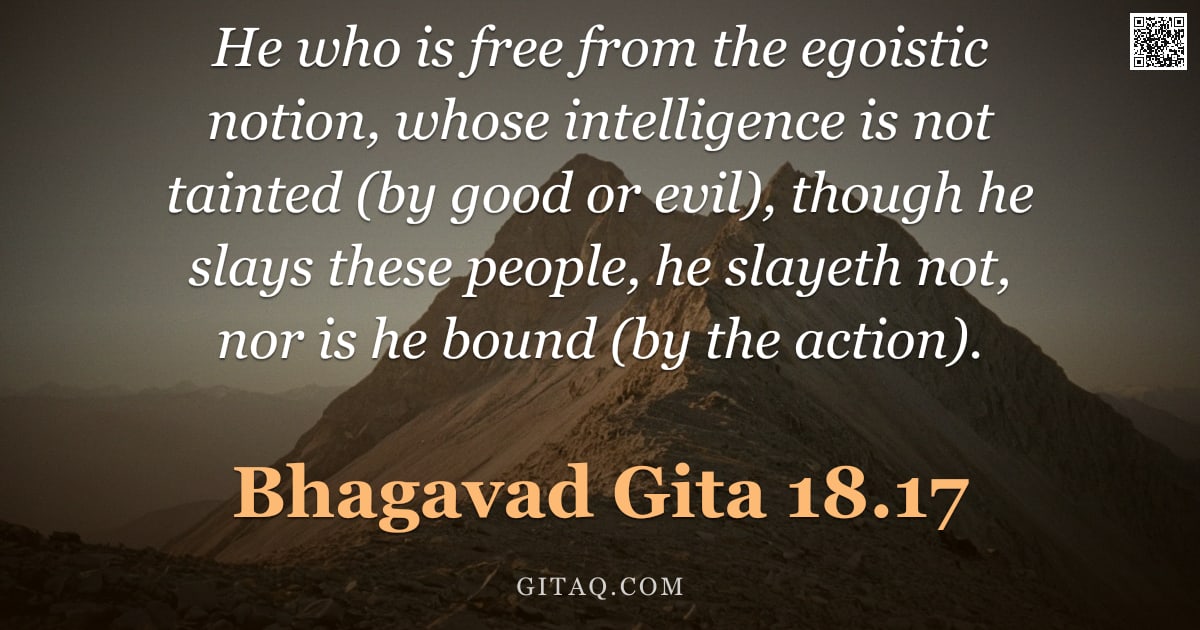
Bhagavad Gita 18.17
Moksha Sanyasa Yoga · English Translation
यस्य नाहंकृतो भावो बुद्धिर्यस्य न लिप्यते | हत्वाऽपि स इमाँल्लोकान्न हन्ति न निबध्यते ||१८-१७||
yasya nāhaṃkṛto bhāvo buddhiryasya na lipyate . hatvā.api sa imā.Nllokānna hanti na nibadhyate ||18-17||
What Does This Verse Mean?
In this verse, Lord Krishna tells Arjuna that a person who has completely eliminated ego and whose intellect remains steady regardless of outcomes is truly free from the cycle of action and reaction. Even if such a wise soul performs an act as significant as ending lives in battle, they do not commit sin nor become bound by karma because they see themselves merely as an instrument rather than the doer. The core teaching here is that freedom comes from acting without the sense of 'I am doing this' or claiming ownership over the results.
The Teaching Behind It
This verse synthesizes Karma Yoga and Jnana (Knowledge) Yoga by asserting that detachment from the ego is the key to liberating oneself from the law of karma. It develops the concept of 'Nishkama Karma' where action performed without a sense of doership does not generate new karmic bonds, allowing one to act in the world while remaining spiritually free.
Word by Word
Classical Commentary
Where This Happens
This verse appears at the end of Chapter 18 during the climax on the battlefield of Kurukshetra, where Krishna is concluding his teachings to Arjuna. Just before this, Krishna has explained that renunciation does not mean abandoning one's duty but performing it without attachment; he now uses the extreme example of killing in war to illustrate a point about spiritual freedom. Arjuda is still grappling with the horror of fighting and potentially killing his own relatives, fearing eternal sin for what he must do.
Living It Out Today
Consider a manager who must fire an employee due to severe performance issues that threaten the company's survival; this decision causes anxiety because they fear being seen as 'bad' or holding personal responsibility. If the manager acts with pure intent and without ego, viewing themselves strictly as fulfilling their duty rather than making a judgment on another person's worth, they can execute the task without guilt or mental burden. They understand that the action was necessary for the greater good of the organization, not an expression of their own anger or desire to control.
Explained for Children
Imagine you are a superhero who helps people, but instead of thinking 'Look what I did!', you just say 'The universe needed help today.' If you have no ego and your mind stays calm whether things go well or poorly, then even if you make big changes in the world, it doesn't stick to you like sticky tape. You can do hard jobs without getting scared about making mistakes because you know you are just a helper, not the boss of everything.
Daily Reflection
Today, you might find yourself feeling burdened by responsibilities that seem entirely yours alone to carry. Remember that true freedom isn't about avoiding action, but acting without the heavy weight of ego claiming ownership over the deed or its consequences. When you serve others with a pure heart while releasing attachment to praise or blame, you discover an inner lightness where no sin can stick and no bond can form.
A Practice for Today
Close your eyes and gently release the grip of 'I did this' or 'this happened to me,' visualizing yourself as a clear mirror reflecting actions without staining. Invite your awareness into that space where intelligence acts but remains untouched by the results, offering every outcome back to the universal flow.
Key Teachings
- The Dissolution of Ego
The verse identifies 'ahamkara' (ego) as the root cause of bondage, teaching that one must transcend the false sense of being the sole doer. When the ego is absent, actions cease to be personal claims and become natural expressions of cosmic duty. - The Purity of Intelligence
A purified intellect ('buddhi') stands beyond dualities like good and evil, seeing the underlying unity in all beings. This clarity ensures that even drastic actions are performed with equanimity, leaving no karmic residue to taint the soul. - Action Without Binding
The paradox of liberation is revealed: one can engage fully in the world's drama without being entangled by it. Just as a bird flies through water without getting wet, the enlightened sage performs necessary actions like slaying an enemy without creating new chains.
Themes
Related Verses
Read This Next
- 2.47 — Read this to understand the foundational principle of performing duty without attachment to results.
- 3.30 — This verse expands on surrendering all actions to the Divine, a key step in dissolving egoistic ownership.
- 12.15 — Read this to see how one who is not disturbed by others and does not disturb them embodies the state of non-binding action described here.
Recommended Reading
GitaQ earns from qualifying purchases as an Amazon Associate.