Bhagavad Gita 6.8
Dhyana Yoga · English Translation
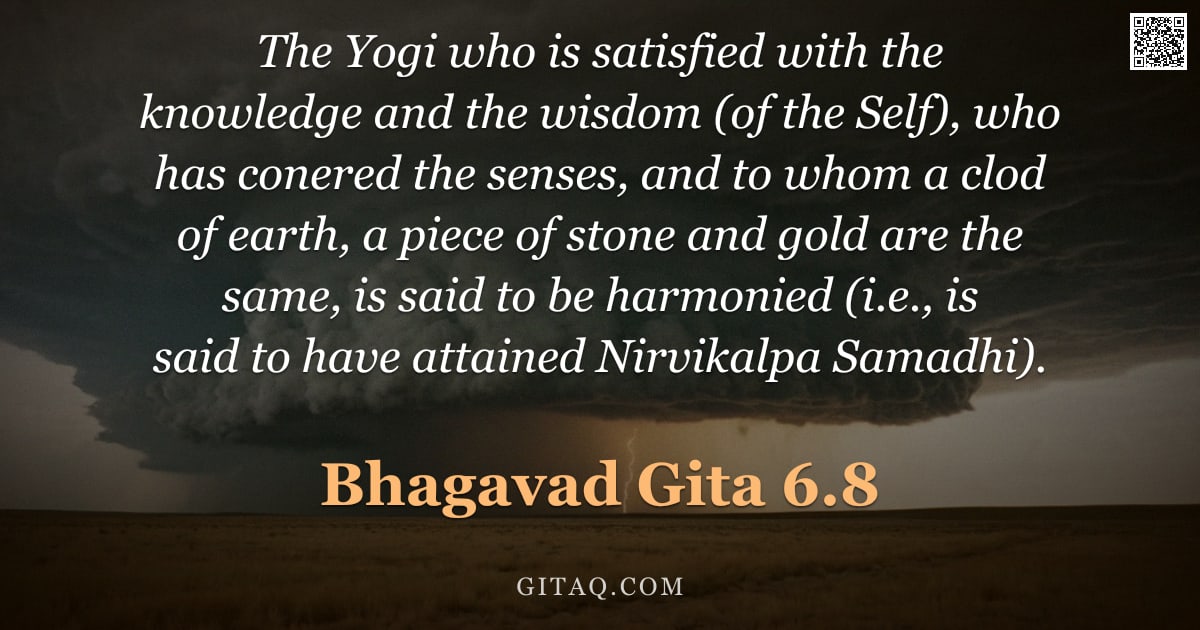
ज्ञानविज्ञानतृप्तात्मा कूटस्थो विजितेन्द्रियः | युक्त इत्युच्यते योगी समलोष्टाश्मकाञ्चनः ||६-८||
jñānavijñānatṛptātmā kūṭastho vijitendriyaḥ . yukta ityucyate yogī samaloṣṭāśmakāñcanaḥ ||6-8||
What Does This Verse Mean?
In this verse, Lord Krishna describes the ideal state of a yogi who has achieved deep inner peace through self-realization. Such a person is fully content with their own wisdom and has completely mastered their senses, remaining unshaken by external circumstances. To them, all material objects—whether humble earth or precious gold—are seen as equal because they recognize that true value lies in the eternal Self, not in temporary possessions.
The Teaching Behind It
This verse belongs primarily to the Dhyana Yoga (Path of Meditation) and Jnana Yoga (Path of Knowledge), specifically illustrating the state of 'Samadhi' where duality ceases. It develops the concept of 'Sama-darshina', or seeing with equal vision, which is a prerequisite for true liberation as it dissolves the ego's attachment to material distinctions.
Word by Word
Classical Commentary
Where This Happens
This verse appears in Chapter 6 of the Bhagavad Gita, where Lord Krishna is instructing Prince Arjuna on the science of meditation (Dhyana Yoga) amidst the battlefield of Kurukshetra. After guiding Arjuna through his initial doubts and explaining various paths like Karma Yoga and Jnana Yoga, Krishna now details the specific qualities of a person who has perfected this meditative practice. At this moment in the narrative, Arjuna is seeking to understand how one can stabilize their mind amidst the chaos of war and life.
Living It Out Today
Consider a professional facing an unexpected layoff or a sudden market crash that devalues their portfolio; instead of spiraling into anxiety over lost wealth, they maintain equanimity by focusing on their core skills and intrinsic worth. Similarly, in family disputes where one person is treated with extreme respect while another is ignored, the wise individual responds to both with equal kindness and calmness, refusing to be swayed by flattery or insults. This mindset allows a leader to make fair decisions based solely on merit rather than being influenced by who offers gifts or how much they are valued socially.
Explained for Children
Imagine you have a magical crystal ball that shows you how amazing and special every person is inside, no matter what they are wearing. A wise yogi sees everything this way: a pile of dirt, a hard rock, and a shiny gold coin all look equally valuable to them because the treasure isn't in the object itself, but in the peace within their own heart. This means they don't get too happy or too sad when they find something expensive; instead, they stay calm and balanced just like you do when you are playing your favorite game.
Daily Reflection
Today, I invite you to pause and notice how often your peace depends on external circumstances shifting just so. When a difficult situation arises or an opportunity for gain appears, try to see both with the same steady gaze of the sage who finds gold equal to stone. This is not about indifference, but about discovering that your inner worth remains intact regardless of what you hold in your hands.
A Practice for Today
Sit quietly and gently bring your awareness to the distinction between objects you crave—like gold—and those you find ordinary, like a stone or clod of earth. Visualize holding these items in your mind with equal stillness, recognizing that their true value lies not in their material form but in the unchanging consciousness observing them.
Key Teachings
- Satiation Through Self-Knowledge
True contentment arises only from the realization of one's own nature as eternal consciousness, not from acquiring more material possessions. The verse establishes that 'satisfaction' is a byproduct of wisdom (jnana) rather than sensory fulfillment. - Mastery Over Sensory Impulses
Before one can view the world with equality, they must first conquer the restless senses that pull them toward pleasure and away from pain. This internal discipline is the prerequisite for seeing the self beyond the fluctuations of desire. - The Vision of Absolute Equality
To a realized yogi, distinctions like gold versus stone dissolve because they perceive the same Self in all matter. This equality signifies that one has transcended the ego's tendency to judge value based on social or material standards.
Themes
Related Verses
Read This Next
- 2.47 — To understand the foundational instruction on performing duty without attachment to results, which prepares the ground for this state of equality.
- 3.30 — This verse complements the theme by instructing one to offer all actions and their fruits to the Divine, further dissolving personal greed.
- 12.15 — To explore how a devotee who is not disturbed by others' desires or jealous of anyone else perfectly embodies the quality of being 'samaloṣṭāśmakāñcanaḥ.'
Recommended Reading
GitaQ earns from qualifying purchases as an Amazon Associate.