Bhagavad Gita 2.15
Sankhya Yoga · English Translation
यं हि न व्यथयन्त्येते पुरुषं पुरुषर्षभ | समदुःखसुखं धीरं सोऽमृतत्वाय कल्पते ||२-१५||
yaṃ hi na vyathayantyete puruṣaṃ puruṣarṣabha . samaduḥkhasukhaṃ dhīraṃ so.amṛtatvāya kalpate ||2-15||
What Does This Verse Mean?
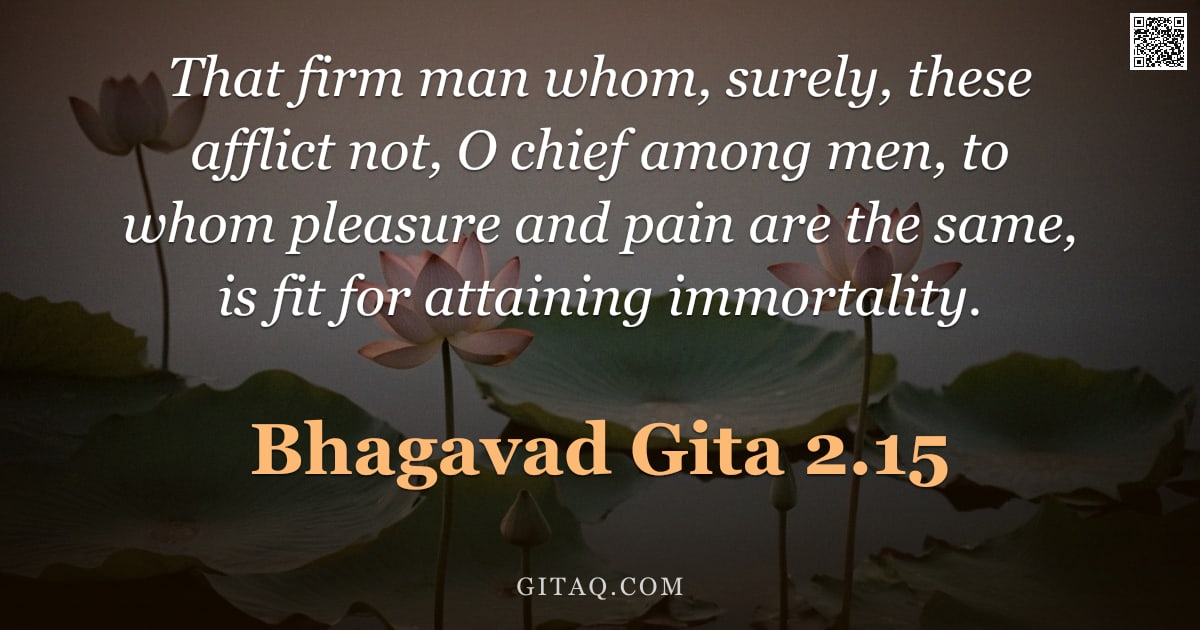
In this verse, Lord Krishna addresses Arjuna as the 'best of men' and describes the ideal state of a wise person. He teaches that true wisdom is shown when one remains unshaken by either pleasure or pain, treating them with equal composure. Such a balanced mind is considered fit for attaining liberation from the cycle of birth and death.
The Teaching Behind It
This verse belongs to the core teaching of Sankhya Yoga (the path of knowledge) within Chapter 2, focusing on the nature of the Atman (Self). It develops the concept of 'Samaduhkhasukham' (equanimity), illustrating that a realized soul understands the transient nature of sensory experiences and remains rooted in their true identity beyond dualities.
Word by Word
Classical Commentary
Where This Happens
This verse appears in Chapter 2 of the Bhagavad Gita during the critical moment on the battlefield of Kurukshetra. Krishna is speaking to Arjuna, who has just collapsed into despair, refusing to fight his own relatives and teachers due to overwhelming grief and fear. After briefly explaining that death affects only the body and not the eternal soul, Krishna now identifies the specific qualities—equanimity in pleasure and pain—that define a truly wise warrior ready for spiritual liberation.
Living It Out Today
Consider a professional who receives sudden negative feedback on a major project or faces an unexpected promotion. Instead of spiraling into anxiety over the criticism or becoming arrogant with the praise, they maintain their focus on doing quality work regardless of the outcome. By staying steady in these emotional fluctuations, they make clearer decisions and avoid burnout, demonstrating that inner stability is more valuable than temporary external success.
Explained for Children
Imagine you are playing in the rain without an umbrella; some days it's just drizzling (good), other times it pours hard (bad). A wise person doesn't get too excited when it stops or too sad when it starts, they just put on their boots and keep enjoying the game. Krishna says that if you can stay calm whether things are happy or sad like this rain, your heart becomes strong enough to reach a place of perfect peace forever.
Daily Reflection
Today, try to notice when your mind reacts strongly to praise or criticism, treating both with equal indifference rather than seeking one and avoiding the other. This balance is not about suppressing emotions but realizing that your true self exists beyond these fleeting waves of pleasure and pain. When you find yourself shaken by life's ups and downs, gently remind yourself that this steadiness is the very path to inner freedom.
A Practice for Today
Close your eyes and recall a recent moment of pleasant surprise or sudden discomfort; observe how the sensation arises, peaks, and fades without altering who you truly are beneath it. Visualize yourself as a steady mountain that remains unmoved whether rain falls upon its slopes or sun warms them.
Key Teachings
- The Nature of True Steadfastness
Krishna defines a 'dheera' or wise person not by their lack of feeling, but by their immunity to the dualities of pleasure and pain. Such steadiness arises from understanding that external circumstances are transient forces that cannot touch the eternal soul. - The Gateway to Immortality
Emotional equanimity is described as the specific qualification required for 'amritatva' or liberation. One must master the mind's reaction to sensory input before they can transcend the cycle of birth and death. - Transcending Dualities
The verse instructs us to view happiness and distress as equal, recognizing them as temporary weather patterns rather than permanent states. By refusing to be swayed by either extreme, the seeker stabilizes their consciousness in its divine nature.
Themes
Related Verses
Read This Next
- 2.47 — This verse expands on the previous teaching by instructing Arjuna to act without attachment to results, which is the practical application of remaining steady amidst outcomes.
- 3.30 — Read this next to see how one dedicates all actions to the Divine as a further method for maintaining equanimity and freedom from anxiety.
- 12.15 — This verse describes the qualities of a dear devotee who is not disturbed by others, perfectly mirroring the steady character Krishna praises in 2.15.
Recommended Reading
GitaQ earns from qualifying purchases as an Amazon Associate.