Bhagavad Gita 8.20
Akshara Brahma Yoga · English Translation
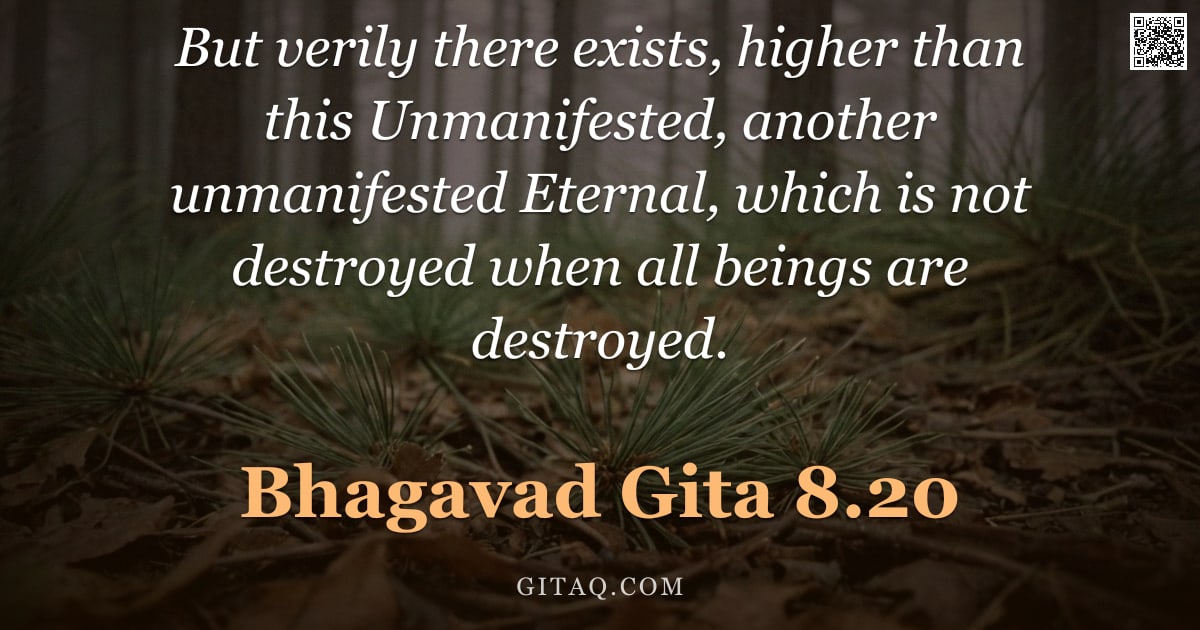
परस्तस्मात्तु भावोऽन्योऽव्यक्तोऽव्यक्तात्सनातनः | यः स सर्वेषु भूतेषु नश्यत्सु न विनश्यति ||८-२०||
parastasmāttu bhāvo.anyo.avyakto.avyaktātsanātanaḥ . yaḥ sa sarveṣu bhūteṣu naśyatsu na vinaśyati ||8-20||
What Does This Verse Mean?
In this verse, Lord Krishna tells Arjuna that beyond the subtle, unmanifested energy of the universe, there is an even higher reality known as the Eternal Self or Purusha. While all physical beings and material forms dissolve at the end of time, this conscious essence remains untouched and indestructible. The key teaching is that our true identity is not the temporary body but this imperishable spirit that survives beyond death.
The Teaching Behind It
This verse is central to Jnana Yoga (the path of knowledge) and Sankhya philosophy within the Gita, distinguishing between the changing material world (Prakriti) and the unchanging conscious spirit (Purusha). It develops the concept that while matter undergoes constant cycles of manifestation and dissolution, pure consciousness is timeless and unaffected by physical decay.
Word by Word
Classical Commentary
Where This Happens
This verse appears in Chapter 8 during Krishna's discourse on 'Akshara Brahma Yoga' (The Yoga of the Imperishable Brahman), occurring just after he has described how one attains different states based on their final thoughts at death. Lord Krishna is speaking to Arjuna, who is still overwhelmed by grief and confusion about his duty to fight his own relatives in the war. The listener needs reassurance that despite the terrifying prospect of total destruction in this cosmic cycle, there exists a permanent reality that provides safety beyond physical annihilation.
Living It Out Today
When facing a career collapse or a major financial loss where your job title and bank account seem to vanish overnight, remember that these are temporary 'unmanifested' conditions. Your core identity as a capable human being remains intact even when external circumstances fall apart completely. Instead of fearing the end of an old chapter in life, focus on anchoring yourself in values like integrity and compassion which cannot be destroyed by any event.
Explained for Children
Imagine you are wearing a favorite raincoat when it gets very old or torn; even though the coat breaks down, YOU who wore it stay exactly the same and safe. Krishna explains that all living things might lose their bodies like an old toy breaking apart, but inside every one of us is a special spark of light called the soul that never breaks or disappears. This means you are forever loved and eternal, no matter what happens to your body.
Daily Reflection
Today, as you navigate tasks or challenges that feel temporary and fleeting, remember that there is an inner core of yours that no circumstance can touch. Just as a wave crashes but never destroys the ocean itself, your true nature survives all losses without ever being diminished by them. This verse invites you to stop identifying with what fades away and instead find deep comfort in the part of you that has always been whole.
A Practice for Today
Close your eyes and visualize all forms around you dissolving into silence, yet notice a stillness within that does not fade with them. Rest your awareness in this unshakeable presence, the eternal witness that remains when every changing thing has passed away.
Key Teachings
- The Hierarchy of Reality
Krishna distinguishes between three levels: the manifest world, the unmanifested cosmic energy (Prakriti), and a supreme state beyond even that which is eternal. This verse establishes that our ultimate identity lies not in the perishable layers but in this transcendent reality. - The Indestructible Self
While all beings are subject to destruction at the end of a cosmic cycle, the true essence described here remains untouched and immortal. This teaches that death is merely an event for forms, not a possibility for the fundamental nature of existence. - Beyond the Unmanifested
The text reveals that even the subtle 'unmanifest' state which holds all potentialities is surpassed by this supreme eternal principle. It directs the seeker to look beyond cosmic cycles and material causes to find a permanent anchor for their consciousness.
Themes
Related Verses
Read This Next
Recommended Reading
GitaQ earns from qualifying purchases as an Amazon Associate.