Bhagavad Gita 18.57
Moksha Sanyasa Yoga · English Translation
चेतसा सर्वकर्माणि मयि संन्यस्य मत्परः | बुद्धियोगमुपाश्रित्य मच्चित्तः सततं भव ||१८-५७||
cetasā sarvakarmāṇi mayi saṃnyasya matparaḥ . buddhiyogamupāśritya maccittaḥ satataṃ bhava ||18-57||
What Does This Verse Mean?
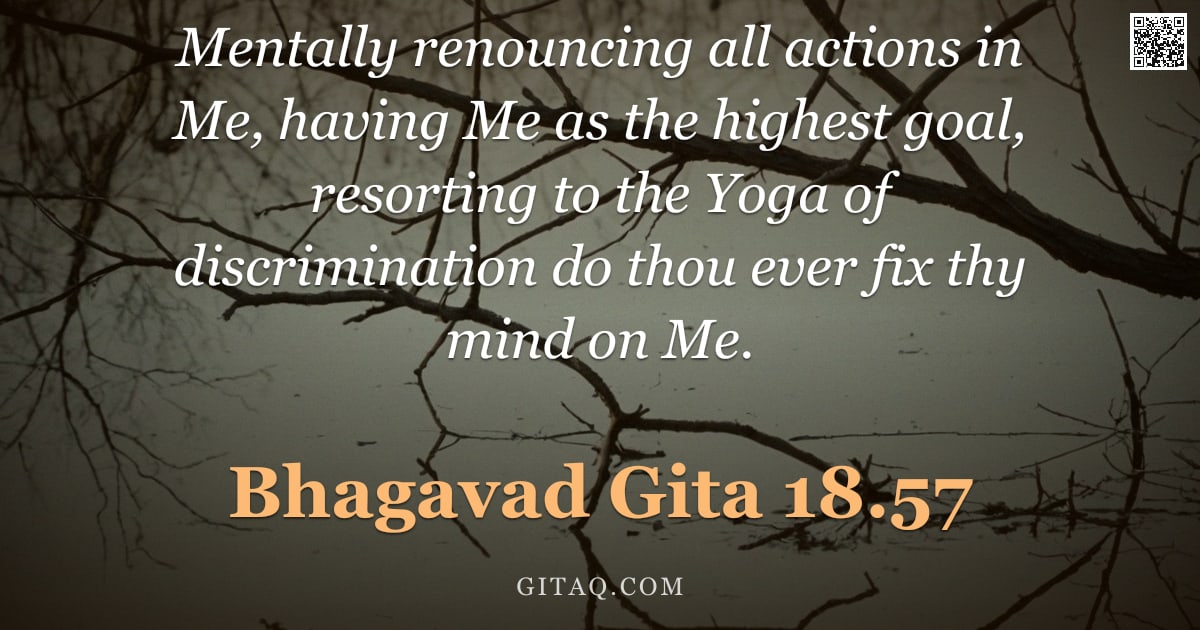
In this verse, Lord Krishna concludes his instructions by telling Arjuna to mentally surrender every action to the Divine and make God their supreme goal. By fixing their mind constantly on the Supreme through a disciplined practice of discrimination (buddhi-yoga), one transcends the bondage of karma. The core teaching is that true freedom comes from performing actions without attachment, while keeping the consciousness rooted in the Divine.
The Teaching Behind It
This verse synthesizes Karma Yoga (action), Bhakti Yoga (devotion), and Jnana Yoga (discrimination) by instructing the seeker to offer all actions as worship while using intellect to discern the eternal from the temporary. It develops the concept of Ishvara-arpita-karma, where action is performed not for personal gain but as a sacred duty dedicated to the Divine.
Word by Word
Classical Commentary
Where This Happens
This verse appears near the end of Chapter 18 as Krishna wraps up his teachings to Arjuna just before the great battle of Kurukshetra begins. At this moment, Arjuna's confusion has vanished after hearing about Karma Yoga and Bhakti Yoga; he is ready for action but seeks final confirmation on how to maintain inner peace while fighting. Krishna emphasizes that even in a chaotic battlefield or intense conflict, one can remain steady by offering all actions as worship.
Living It Out Today
Consider a professional facing a high-stakes project deadline with significant pressure from management and clients. Instead of becoming paralyzed by anxiety over the outcome or ego about personal credit, they perform every task as an offering to their higher purpose while trusting that the result is in universal hands. This approach allows them to maintain clarity and focus on execution rather than fear, turning a stressful situation into a disciplined practice.
Explained for Children
Imagine you are playing a huge game with your friends where everyone has to do their best part. Krishna tells us to play our hardest but remember that there is one special player who loves all of us and watches over everything we do. Instead of worrying about winning or losing, we focus on doing our job well for the love of that special player and trust them completely with the result.
Daily Reflection
Today, I invite you to pause before any action you take and ask yourself: 'Am I doing this for my own small gain or for a higher purpose?' True freedom comes not from stopping life's work, but from shifting your inner posture so that every effort becomes an offering. When you fix your mind on the Divine as the ultimate goal, even the most mundane tasks transform into moments of connection and peace.
A Practice for Today
Close your eyes and visualize placing every current worry, task, or desire into a sacred vessel at the feet of the Divine. Whisper internally that these actions belong to You now, while you settle deeply as the witness who is held by grace.
Key Teachings
- Renunciation in Action
The verse teaches that renunciation (sannyasa) is not about abandoning physical duties but mentally surrendering all actions to the Divine. One performs their necessary work while internally releasing ownership of both the action and its results. - Divine as Supreme Goal
By establishing Krishna (the speaker) as 'matpara' or the highest goal, a seeker aligns all efforts toward spiritual realization rather than material gain. This shift in priority turns every activity into a direct path to liberation. - Yoga of Discrimination
The instruction to resort to 'buddhi-yogam' implies using the intellect to distinguish between the transient self and the eternal Self. This disciplined application of wisdom allows one to remain steady in consciousness amidst the chaos of worldly duties. - Constant Abiding
The command 'satataṃ bhava' urges a continuous, unbroken state of mind fixed on the Divine. This is not an occasional practice but a permanent mental attitude that permeates every moment of existence.
Themes
Related Verses
Read This Next
- 2.47 — This verse establishes the foundational principle of performing duty without attachment to results, which prepares the mind for total surrender.
- 3.30 — It explicitly instructs the devotee to dedicate all actions to Krishna with a pure heart and no sense of egoistic ownership.
- 12.15 — This verse describes the qualities of one who is dear to the Divine, showing how constant devotion leads to becoming an instrument of grace for all beings.
Recommended Reading
GitaQ earns from qualifying purchases as an Amazon Associate.