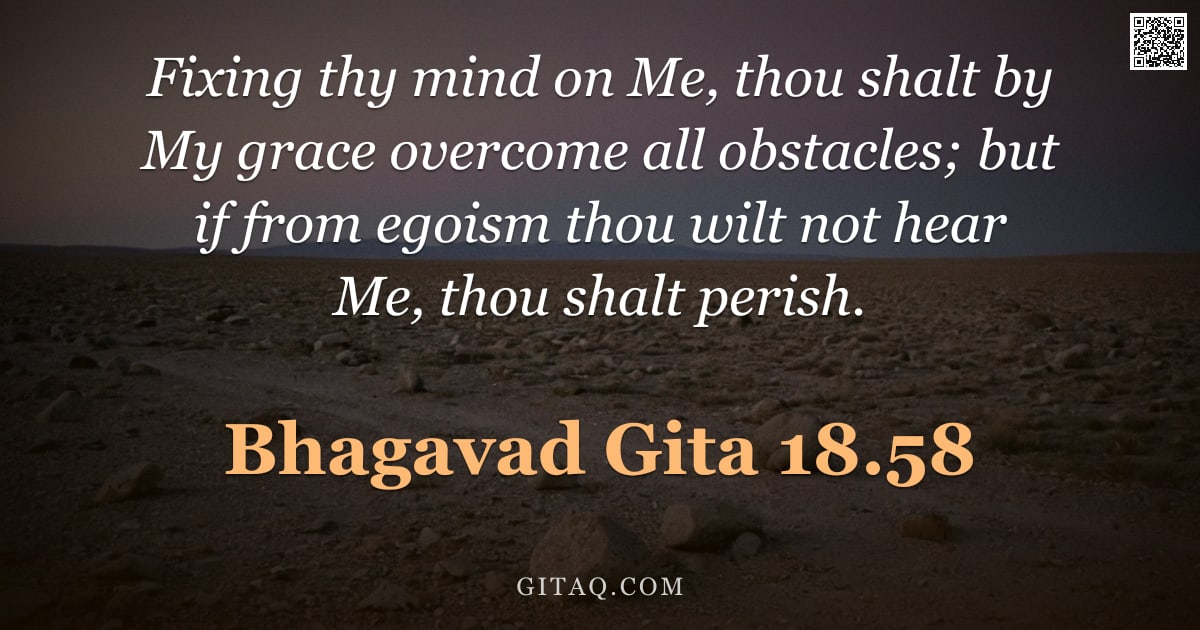
Bhagavad Gita 18.58
Moksha Sanyasa Yoga · English Translation
मच्चित्तः सर्वदुर्गाणि मत्प्रसादात्तरिष्यसि | अथ चेत्त्वमहंकारान्न श्रोष्यसि विनङ्क्ष्यसि ||१८-५८||
maccittaḥ sarvadurgāṇi matprasādāttariṣyasi . atha cettvamahaṃkārānna śroṣyasi vinaṅkṣyasi ||18-58||
What Does This Verse Mean?
In this verse, Lord Krishna tells Arjuna that with his mind fixed on the Divine and through divine grace, he will overcome every obstacle in life. However, if arrogance causes him to reject this wisdom, he will fail and suffer the consequences of his own egoism. The core teaching is a dual path: surrender leads to victory, while pride leads to destruction.
The Teaching Behind It
This verse encapsulates the essence of Bhakti Yoga (the path of devotion) integrated with Jnana Yoga (knowledge). It establishes 'Maccitta' (fixing the mind on God) as the primary means to transcend the limitations of the ego, illustrating that divine grace is accessible only when the individual self surrenders its claim to independence.
Word by Word
Classical Commentary
Where This Happens
This verse occurs in Chapter 18 of the Bhagavad Gita, towards the end of Lord Krishna's discourse on the battlefield of Kurukshetra just before Arjuna prepares to fight the Kaurava army. After explaining the nature of action and renunciation, Krishna is giving his final instruction regarding the ultimate outcome of their relationship. He speaks directly to Arjuna, who has been paralyzed by grief and confusion, offering a conditional promise: success through devotion or failure through ego.
Living It Out Today
Consider a professional facing a critical project deadline with limited resources. If they approach the challenge with humility, asking for guidance from mentors and trusting in a higher purpose while doing their best work, they will find creative solutions to every obstacle that arises. Conversely, if they refuse help because of an inflated belief in their own infallibility or ignore ethical advice out of arrogance, they are likely to make fatal errors that could ruin the project. This verse teaches that confidence rooted in ego is fragile, while reliance on wisdom and grace creates resilience.
Explained for Children
Imagine you are trying to climb a really tall mountain with many tricky spots. If you hold tightly to your teacher's hand (which represents trusting God), they can help you get over every bump safely. But if you say, 'I don't need anyone,' and try to do it all by yourself because you think you know better than the expert guide, you might trip and fall. Krishna is saying that asking for help with a humble heart makes everything possible.
Daily Reflection
You often find yourself stumbling not because of external forces, but because an inner voice of ego insists it knows better than the Divine guidance offered in your heart. This verse invites a tender shift from 'I must do everything alone' to 'I am held by grace,' reminding you that listening is just as powerful as acting. When you release the need for self-importance, the path clears naturally.
A Practice for Today
Sit quietly and visualize your mind resting completely on the Divine presence, releasing all mental clutter as if placing a heavy burden down. Silently affirm that with total surrender to this grace, no obstacle stands insurmountable before you.
Key Teachings
- The Power of Total Surrender
By fixing your mind entirely on the Divine (maccittaḥ), you align with a higher intelligence that can navigate any difficulty. This state transforms personal struggle into divine cooperation, making every challenge surmountable. - Grace as the Great Equalizer
No obstacle is too great for those who rely on grace (matprasādāt) rather than mere physical strength or intellect. This teaching emphasizes that spiritual victory comes from a relationship with the Divine, not isolated effort. - The Destructive Nature of Egoism
When egoism (ahaṃkāra) takes over, it deafens us to wisdom and leads inevitably to spiritual destruction. The verse serves as a stark warning that refusal to listen to the Divine is synonymous with self-sabotage.
Themes
Related Verses
Read This Next
- 2.47 — Read this to understand how to perform duty without attachment while maintaining that focus on the result.
- 3.30 — This verse expands on the practical application of surrendering all actions and their fruits to the Divine.
- 12.15 — Read this to see how one who is free from egoism becomes dear to Krishna, illustrating the reward of the path described in 18.58.
Recommended Reading
GitaQ earns from qualifying purchases as an Amazon Associate.