Bhagavad Gita 18.56
Moksha Sanyasa Yoga · English Translation
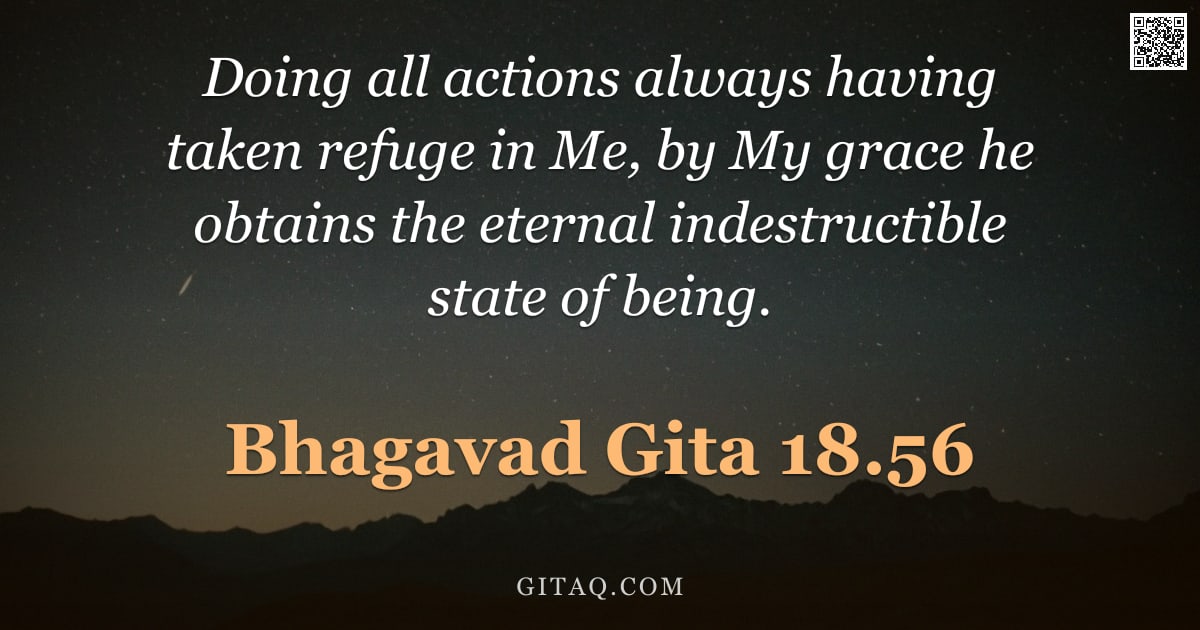
सर्वकर्माण्यपि सदा कुर्वाणो मद्व्यपाश्रयः | मत्प्रसादादवाप्नोति शाश्वतं पदमव्ययम् ||१८-५६||
sarvakarmāṇyapi sadā kurvāṇo madvyapāśrayaḥ . matprasādādavāpnoti śāśvataṃ padamavyayam ||18-56||
What Does This Verse Mean?
In this verse, Lord Krishna concludes his teachings to Arjuna by revealing the secret of liberation: performing all actions while taking refuge in Him leads directly to an eternal state of being. The key teaching is that true freedom comes not from stopping work, but from dedicating every action to the Divine and relying on His grace rather than one's own ego. By shifting our reliance from personal success or failure to divine will, we transcend the cycle of good and bad karma.
The Teaching Behind It
This verse synthesizes Karma Yoga (selfless action) with Bhakti Yoga (devotion), teaching that action becomes spiritual when offered as an offering of love. It develops the concept of 'Saranagati' or surrender, where the ego's claim on the fruits of action is surrendered to God, leading to liberation (Moksha). This represents the culmination of Jnana Yoga (knowledge) by realizing the self through divine grace rather than intellectual effort alone.
Word by Word
Classical Commentary
Where This Happens
This verse appears at the very end of Chapter 18 in the Bhagavad Gita, which takes place on the battlefield of Kurukshetra just before the great war begins. Lord Krishna has spent chapters explaining complex philosophies to Arjuna, who is currently paralyzed by grief and moral confusion about fighting his own relatives. As a final summary of all spiritual paths—action, knowledge, meditation, and devotion—Krishna offers this ultimate assurance that leads directly into the conclusion where Arjya regains his clarity.
Living It Out Today
Consider a professional facing a high-stakes project deadline with overwhelming anxiety about potential failure or criticism. Instead of obsessing over the outcome as their sole measure of self-worth, they perform every task to the best of their ability while mentally dedicating the results to something greater than themselves, such as serving humanity or honoring God's will. This shift in mindset removes the paralyzing fear of loss and allows them to act with clarity and peace, knowing that their true safety lies not in external success but in divine support.
Explained for Children
Imagine you are helping your mom bake a cake for a party. Instead of worrying about whether you made it perfectly all by yourself, you pray that God helps you mix and bake with love. When you do this, even if the cake looks a little different than expected, you feel happy because you know someone special is watching over you. Krishna says when we always ask God for help while doing our chores or homework, we become like superheroes who are safe from any worry forever.
Daily Reflection
You often carry the heavy burden of thinking your efforts must stand on their own merit or that success depends entirely on your personal stamina. Today, imagine placing that entire weight gently into Divine hands through simple refuge and trust. When you realize that grace is what ultimately sustains every action, the anxiety of outcome begins to dissolve into a quiet confidence.
A Practice for Today
Close your eyes and silently repeat, 'I act not for the result, but as an offering to You.' Visualize every task you face today being wrapped in a golden light of surrender before it begins.
Key Teachings
- The Shift from Doer to Instrument
This verse teaches us to stop identifying as the sole author of our actions and instead view ourselves as instruments in Divine hands. By doing so, we release the ego's burden while still engaging fully with the world. - Refuge is a Continuous Practice
The phrase 'always having taken refuge' implies that surrender is not a one-time event but a recurring attitude for every moment. It transforms mundane tasks into acts of worship when performed with this conscious connection. - Grace as the Catalyst for Liberation
While we must do our duty, it is specifically by Divine grace that one transcends the cycle of karma to reach an eternal state. Human effort prepares the vessel, but only Divine favor fills it with immortality.
Themes
Related Verses
Read This Next
- 2.47 — Read this next for Krishna's foundational instruction on detachment while performing duty.
- 3.30 — This verse explicitly commands the act of dedicating all actions to God, reinforcing today's theme of refuge.
- 12.15 — Explore this passage on how a devotee who is free from selfishness and devoted only to Krishna becomes dear to Him.
Recommended Reading
GitaQ earns from qualifying purchases as an Amazon Associate.