Bhagavad Gita 8.21
Akshara Brahma Yoga · English Translation
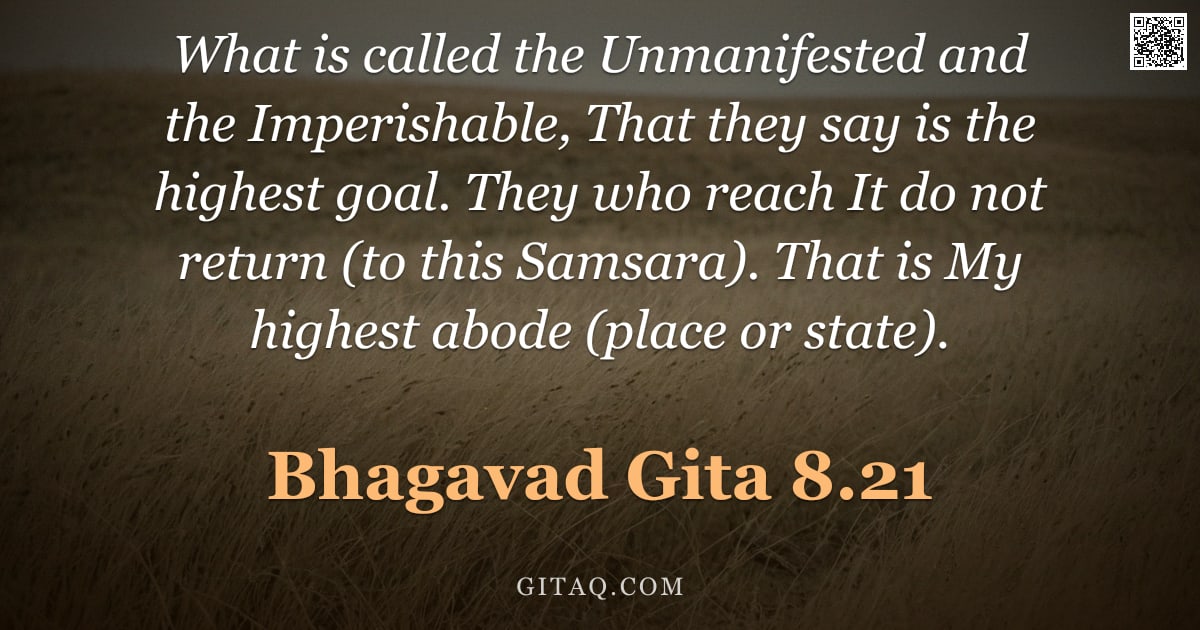
अव्यक्तोऽक्षर इत्युक्तस्तमाहुः परमां गतिम् | यं प्राप्य न निवर्तन्ते तद्धाम परमं मम ||८-२१||
avyakto.akṣara ityuktastamāhuḥ paramāṃ gatim . yaṃ prāpya na nivartante taddhāma paramaṃ mama ||8-21||
What Does This Verse Mean?
In this verse, Lord Krishna describes the ultimate destination of spiritual life as the 'Unmanifested' and 'Imperishable Brahman.' He explains that those who attain this supreme state never have to return to the cycle of birth and death. This highest abode is described as his own divine realm, representing the final goal for all seekers.
The Teaching Behind It
This verse synthesizes Jnana Yoga (the path of knowledge) and Bhakti Yoga by identifying the formless Absolute as both a philosophical truth and Krishna's personal supreme abode. It develops the concept of Akshara Brahma, distinguishing between the temporary manifest world and the eternal, unchanging reality that is free from rebirth.
Word by Word
Classical Commentary
Where This Happens
This teaching occurs during the Bhagavad Gita's eighth chapter on the battlefield of Kurukshetra, just before Krishna describes how one should meditate at the moment of death. Arjuna has been asking deep questions about the nature of Brahman and what happens after life ends. Krishna responds by clarifying that while many paths exist, there is a supreme state beyond all names and forms.
Living It Out Today
When facing an overwhelming career decision or family crisis where you feel trapped in a cycle of stress and repeating mistakes, this verse reminds us to look for the 'unmanifested' peace within. Instead of chasing temporary external solutions that require constant re-engagement with anxiety, focus on connecting with your inner stillness. By anchoring yourself in this higher state of being, you gain the clarity to act without fear of future regret or failure.
Explained for Children
Imagine you are playing a video game with many levels; sometimes when you finish one level, you have to start over at the beginning again. But this verse talks about finding a special 'final boss' room where once you enter, you never have to restart or play another round ever again. It is like reaching the ultimate safe place of peace and happiness where no more games begin.
Daily Reflection
You often feel pulled by the constant cycle of birth and death, seeking happiness in temporary things that inevitably fade away. Today, remember that there is a higher destination beyond this changing world—a place of eternal peace that you can reach through unwavering devotion. When you anchor your heart in this supreme abode, the fear of returning to struggle loses its power over you.
A Practice for Today
Close your eyes and visualize the Unmanifested (Avyakta) as a vast, silent ocean beneath the waves of daily life. Rest your awareness in that stillness where all forms dissolve into pure existence.
Key Teachings
- The Nature of the Unmanifested
Krishna describes the ultimate reality as 'Avyakta,' meaning it has no form or attributes that can be grasped by the senses. It is the underlying, invisible foundation from which all manifest life arises and into which it dissolves. - The Promise of Non-Return
Reaching this highest goal marks a definitive end to the cycle of rebirth (Samsara). Unlike temporary achievements in this world, attaining this state ensures one never falls back into illusion or suffering. - The Divine Abode as Ultimate Goal
This supreme destination is not a distant location but Krishna's own highest nature. It represents the complete realization of unity with the divine, where the soul finds its final and perfect rest.
Themes
Related Verses
Read This Next
- 2.15 — Understand how a sage remains steady and unaffected by dualities like pleasure and pain, preparing for higher realization.
- 3.9 — Learn the concept of Yajna (sacrifice) as a way to purify action so that one is not bound by karma again.
- 15.6 — Explore Krishna's description of His supreme abode where even light does not return, mirroring the 'no return' theme here.
Recommended Reading
GitaQ earns from qualifying purchases as an Amazon Associate.