Bhagavad Gita 15.6
Purushottama Yoga · English Translation
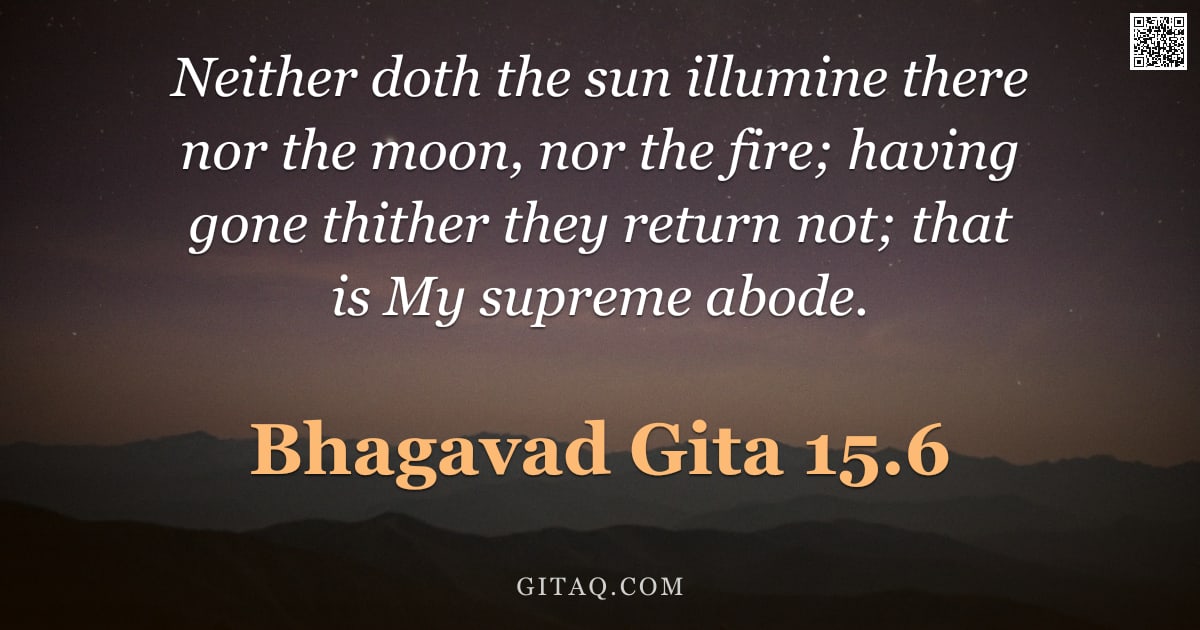
न तद्भासयते सूर्यो न शशाङ्को न पावकः | यद्गत्वा न निवर्तन्ते तद्धाम परमं मम ||१५-६||
na tadbhāsayate sūryo na śaśāṅko na pāvakaḥ . yadgatvā na nivartante taddhāma paramaṃ mama ||15-6||
What Does This Verse Mean?
In this verse, Lord Krishna describes the nature of His supreme abode to Arjuna by using a powerful analogy: just as the sun and moon light up our world but cannot reach or illuminate that divine realm, even fire fails there. He explains that once a soul reaches this highest destination after leaving their body, they never have to return to the cycle of birth and death again. The key teaching is that while material sources like sunlight are temporary and limited, Krishna's spiritual abode is eternal, self-luminous, and beyond the reach of ordinary physical elements.
The Teaching Behind It
This teaching belongs primarily to the strand of Jnana Yoga (the yoga of knowledge) as it reveals the fundamental nature of reality by distinguishing between the perishable material world and the imperishable spiritual realm. It develops the concept of 'Parabrahman' or the Supreme Absolute, establishing that while sensory perception is limited to the physical universe, there exists a higher dimension beyond space, time, and matter.
Word by Word
Classical Commentary
Where This Happens
This verse appears during the Bhagavad Gita's fifteenth chapter, known as Purushottama Yoga, where Krishna is deepening his discourse on Arjuna's despair regarding the futility of life and death. At this point in the conversation on the battlefield of Kurukshetra, Krishna has just described the material world as an inverted banyan tree rooted above; now he contrasts that temporary existence with His own eternal realm to give Arjuna hope. Arjuna is listening intently, still grappling with his confusion about duty and mortality, seeking a path out of the suffering inherent in worldly life.
Living It Out Today
Consider a professional who feels overwhelmed by burnout from chasing promotions and external validation that never seems to satisfy them permanently. Instead of finding their worth solely in these fleeting achievements (like relying only on sunlight), they can shift their focus toward inner peace, spiritual practices, or service to others which provide a lasting sense of fulfillment. This verse teaches us to stop looking for 'light' from temporary sources like status, wealth, or other people's opinions when we need true stability and return home spiritually.
Explained for Children
Imagine you are playing a video game where there is a special 'endless level' that no matter how hard you play in it, you never have to restart. Lord Krishna says our world is like a normal room lit by a lamp (the sun) or fire; when the electricity goes out or we leave the room, the light stops and we come back later. But God's home is different—it is like a magical lantern that shines forever on its own without needing batteries. Once you go there to play in this perfect world with your friends and family who love each other always, you never have to say goodbye again.
Daily Reflection
You often chase after temporary sources of comfort like success, relationships, or achievements, much like we rely on the sun for daylight. Yet today, remember that there exists an unchanging dimension within you where your soul finds its true home and permanent peace. When you rest in this inner sanctuary, the distractions of the world cannot disturb your inherent light.
A Practice for Today
Close your eyes and visualize the sun, moon, and fire as brilliant yet limited lights that fade when their work is done. Turn your awareness inward to a radiant inner light that does not depend on any external source and never sets.
Key Teachings
- The Nature of Limitation
Even the most powerful physical sources like the sun, moon, and fire are temporary and dependent on their own cycles. This verse establishes that no material energy can provide eternal illumination or sustenance. - The Irreversible Journey Home
Those who reach this supreme abode do not return to the cycle of birth and death, marking a transition from impermanence to eternity. This destination is described as 'My' own highest realm, indicating it is inseparable from the Divine. - The Source of All Light
Since all material lights are merely reflections or derivatives, they cannot illuminate this spiritual realm which surpasses them. The verse invites us to seek the original source of consciousness that shines within without needing external fuel.
Themes
Related Verses
Read This Next
- 2.47 — This verse establishes your duty without attachment to results, preparing you for the journey toward that higher abode.
- 3.30 — It teaches surrendering all actions to Krishna, a necessary step in attaining His supreme nature described here.
- 12.15 — This verse describes the qualities of one who is dear to God and thus naturally drawn toward that same eternal home.
Recommended Reading
GitaQ earns from qualifying purchases as an Amazon Associate.