Bhagavad Gita 4.9
Jnana Karma Sanyasa Yoga · English Translation
जन्म कर्म च मे दिव्यमेवं यो वेत्ति तत्त्वतः | त्यक्त्वा देहं पुनर्जन्म नैति मामेति सोऽर्जुन ||४-९||
janma karma ca me divyamevaṃ yo vetti tattvataḥ . tyaktvā dehaṃ punarjanma naiti māmeti so.arjuna ||4-9||
What Does This Verse Mean?
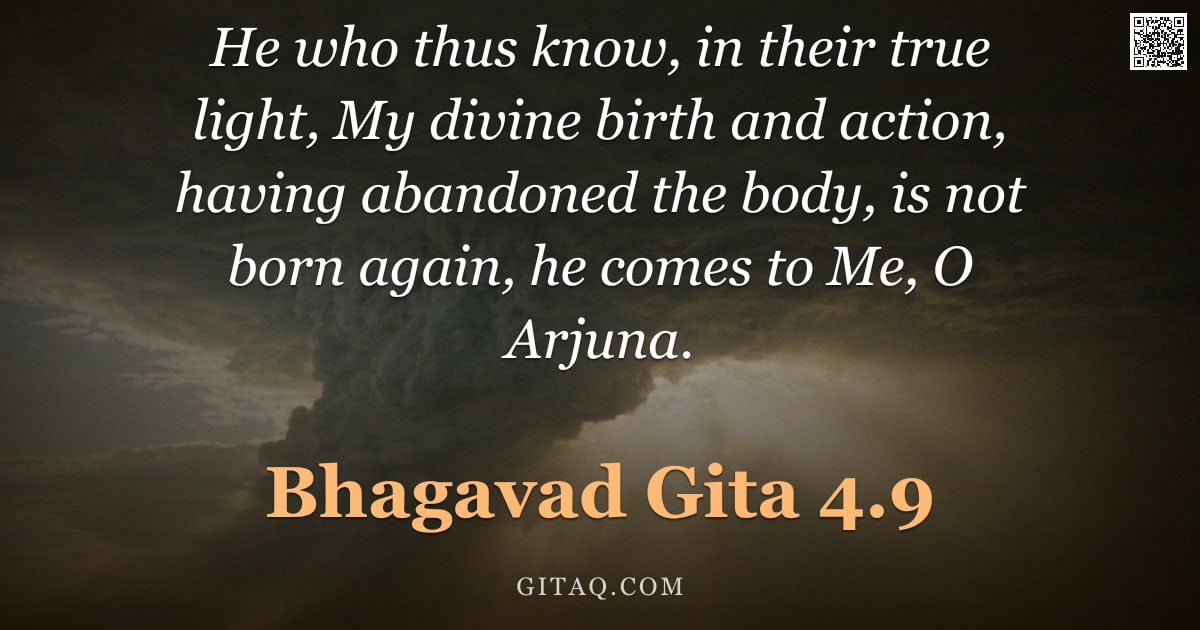
In this verse, Lord Krishna tells Arjuna that anyone who truly understands His divine nature and the purpose of His actions attains liberation from the cycle of rebirth after leaving their body. By realizing the truth behind God's birth and deeds with full conviction, a person transcends material existence. This realization allows them to return directly to the Divine source rather than being born again in this world.
The Teaching Behind It
This verse synthesizes Jnana Yoga (the path of knowledge) and Bhakti Yoga (devotion), asserting that true spiritual realization comes from understanding the divine nature behind all actions. It develops the concept of 'Tattva-vit' or one who knows the absolute truth, which is the prerequisite for achieving Moksha (liberation). The teaching posits that intellectual assent to God's divinity must transform into deep experiential knowledge to break the chain of karma.
Word by Word
Classical Commentary
Where This Happens
This verse occurs on the battlefield of Kurukshetra during a moment of deep crisis where Arjuna is overwhelmed by grief and confusion about fighting his own relatives. Krishna has just begun revealing His universal form (Vishvarupa) in Chapter 11, but here He returns to a personal conversation to clarify the mystery of His appearance on earth. After explaining that He appears out of compassion whenever righteousness declines, Arjuna is seeking clarity on how one can achieve freedom from this endless cycle of birth and death.
Living It Out Today
Consider a professional who feels trapped in a toxic job they hate but fears quitting because they need the income; they feel like their identity is tied to that paycheck. Instead of just working for money, if they realize their true nature as an eternal being capable of handling any outcome, the anxiety about 'what happens next' dissolves. This shift from fear-based action to purposeful duty allows them to either leave with clarity or stay without resentment, effectively ending their internal suffering even before a physical change occurs.
Explained for Children
Imagine you are playing a video game where every time your character dies, they have to start over at level one forever; that is like our current life if we don't learn the secret. Krishna explains that when someone truly understands how amazing their Creator is and why He helps them, it's like finding a special 'exit door' in the game. Once you find this door after finishing your character's story (dying), you don't have to restart at level one again; instead, you get to go play forever with the Game Designer!
Daily Reflection
You often wonder why your efforts feel so heavy or if they will ever lead you anywhere meaningful; today, remember that true knowledge transforms even mundane acts into divine offerings. When you see my birth and actions as part of a higher, timeless reality, the fear of being trapped in cycles fades away. You are invited to live with this freedom, knowing that your ultimate home is not here but within me.
A Practice for Today
Close your eyes and breathe, imagining that every action you perform today is not an ordinary task but a divine play of the Lord. Visualize yourself as a witness to this sacred activity, letting go of the ego's claim on the results while remaining fully engaged in the present moment.
Key Teachings
- The Nature of Divine Incarnation
Krishna reveals that His birth and actions are 'divya' (transcendental), distinct from the ordinary, karmic births and deeds of human beings. Understanding this distinction is essential to realize that God acts out of free will for cosmic order, not bound by past karma. - Knowledge as Liberation
True liberation does not come from mere ritual or physical renunciation alone, but from 'tattvatah'—knowing the absolute truth of who I am and why I act. This spiritual insight acts as a fire that burns away the accumulated seeds of past actions binding one to rebirth. - The Promise of Return
For those who internalize this divine perspective, the cycle of birth and death breaks; they abandon their bodies without generating new karmic bonds. The ultimate destination for such a soul is not another temporary life on earth but eternal communion with the Divine.
Themes
Related Verses
Read This Next
- 2.47 — Read this next to understand Krishna's instruction on performing duty without attachment, which sets the stage for understanding His divine actions.
- 3.30 — This verse explains the practical method of dedicating all works to God, deepening your grasp of how ordinary action becomes spiritual when done with right knowledge.
- 12.15 — Read this final selection to see the qualities of a devotee who has attained that state of non-rebirth and supreme devotion Krishna describes in verse 4.9.
Recommended Reading
GitaQ earns from qualifying purchases as an Amazon Associate.