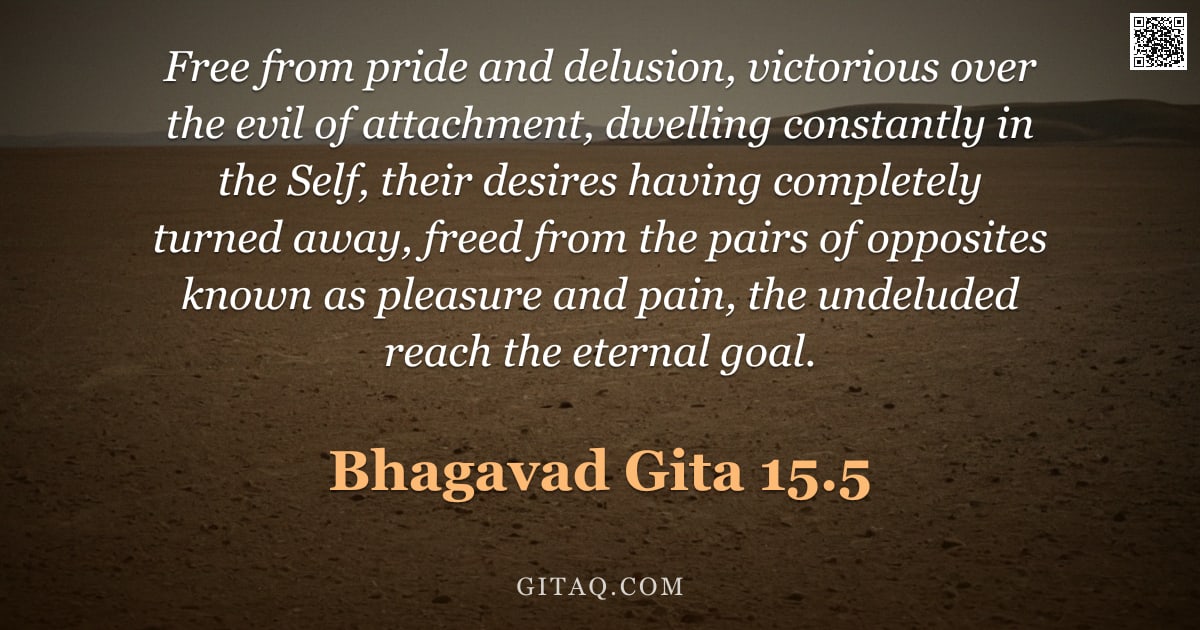
Bhagavad Gita 15.5
Purushottama Yoga · English Translation
निर्मानमोहा जितसङ्गदोषा अध्यात्मनित्या विनिवृत्तकामाः | द्वन्द्वैर्विमुक्ताः सुखदुःखसंज्ञैर्- गच्छन्त्यमूढाः पदमव्ययं तत् ||१५-५||
nirmānamohā jitasaṅgadoṣā adhyātmanityā vinivṛttakāmāḥ . dvandvairvimuktāḥ sukhaduḥkhasaṃjñaira- gacchantyamūḍhāḥ padamavyayaṃ tat ||15-5||
What Does This Verse Mean?
In this verse, Lord Krishna describes the characteristics of a wise person who has transcended material illusions to reach their eternal destination. Speaking to Arjuna on the battlefield of Kurukshetra, He explains that such individuals are free from pride and delusion while having mastered attachment to sensory pleasures. They remain balanced amidst happiness and sadness because they have turned inward toward their true spiritual nature rather than chasing external goals.
The Teaching Behind It
This verse synthesizes the core principles of Jnana Yoga (the path of knowledge) and Karma Yoga (the path of selfless action), emphasizing that wisdom arises from detachment. It develops the concept of 'Samatvam' or equanimity, where one transcends the dualities of pleasure and pain to realize their identity as part of the eternal Self.
Word by Word
Classical Commentary
Where This Happens
This verse appears in Chapter 15 of the Bhagavad Gita, where Lord Krishna is concluding his teachings on the nature of the material world before addressing Arjuna's confusion about duty. At this point in the Mahabharata narrative, a heavy silence follows the description of the 'banyan tree' of attachment that binds souls to rebirth; Arjuna has just been overwhelmed by the weight of his responsibilities and fear for his relatives. Krishna is shifting from describing the problem (attachment) to offering the specific solution: the qualities required to break free from this cycle.
Living It Out Today
Consider a professional facing a sudden, major setback at work that threatens their reputation; instead of spiraling into panic or ego-driven denial, they remain grounded by focusing on their long-term purpose rather than immediate success. This person detaches emotionally from the 'praise and blame' dynamic, treating both as temporary noise while staying committed to doing good work for its own sake. By maintaining this inner stability during a crisis, they avoid making rash decisions driven by fear or arrogance, allowing them to navigate toward their true career goals with clarity.
Explained for Children
Imagine you are playing a video game where the score changes constantly between winning and losing, but one player stays calm no matter what happens on the screen. This verse describes that kind of person who doesn't get too proud when they win or too sad when things go wrong because their heart is focused on something much more important than just the game. By not getting distracted by temporary feelings like excitement or fear, these wise people find a safe and happy place inside themselves that never goes away.
Daily Reflection
You are invited to pause whenever you feel pulled between comfort and discomfort; remember that true freedom is not found in avoiding these opposites but in standing steady beyond them. When attachment tries to bind you, recall that your essence has always been pure consciousness, untouched by the results of your actions or the moods of the world.
A Practice for Today
Begin by silently acknowledging any moment of pride or delusion arising today, and gently release it as a passing cloud. Rest your awareness in the quiet space within that remains untouched by the fluctuations of pleasure and pain.
Key Teachings
- The Pillars of Liberation
True freedom begins with uprooting pride (nirmāna) and delusion (moha), which cloud our perception of reality. By cultivating victory over attachment, we shift from seeking external validation to finding inner stability. - The Transcendence of Duality
Life naturally presents pairs of opposites like heat and cold or joy and sorrow; the wise person does not oscillate between them but dwells in a state of equanimity. This detachment from sensory dualities is what allows one to see the eternal Self clearly. - The Destination of Desire
Desires are like waves that subside only when their source—the ego—is recognized as unreal. When desires turn inward and away from worldly objects, the undeluded soul naturally ascends to the imperishable abode.
Themes
Related Verses
Read This Next
- 2.14 — This verse explains how the wise perceive the dualities of heat and cold, pleasure and pain as transient, providing a foundation for understanding the 'pairs of opposites' mentioned in 15.5.
Recommended Reading
GitaQ earns from qualifying purchases as an Amazon Associate.