Bhagavad Gita 15.4
Purushottama Yoga · English Translation
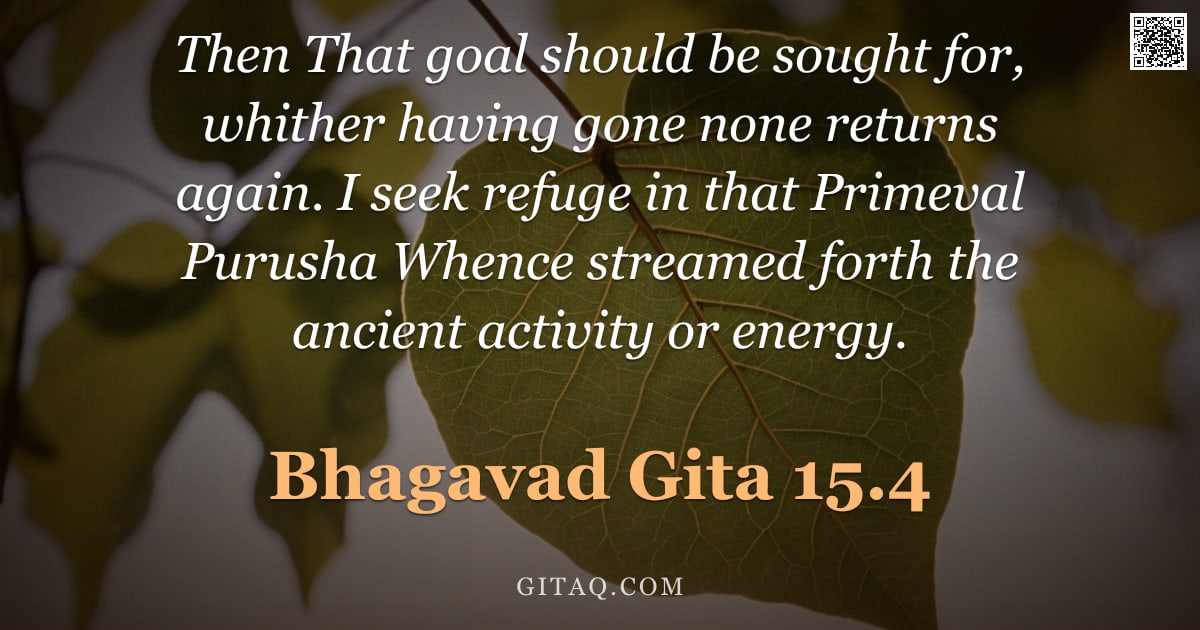
ततः पदं तत्परिमार्गितव्यं यस्मिन्गता न निवर्तन्ति भूयः | तमेव चाद्यं पुरुषं प्रपद्ये | यतः प्रवृत्तिः प्रसृता पुराणी ||१५-४||
tataḥ padaṃ tatparimārgitavyaṃ yasmingatā na nivartanti bhūyaḥ . tameva cādyaṃ puruṣaṃ prapadye . yataḥ pravṛttiḥ prasṛtā purāṇī ||15-4||
What Does This Verse Mean?
In this verse, Krishna tells Arjuna that after understanding the temporary nature of the material world, one must seek a permanent spiritual destination from which there is no return to birth and death. He describes this ultimate goal as reaching the feet of the Supreme Personality of Godhead, who exists before all creation began. The core teaching is that while worldly achievements fade and cause us to cycle through repeated lifetimes, true success lies in surrendering to the Primeval Lord who grants eternal liberation.
The Teaching Behind It
This verse synthesizes Jnana Yoga (knowledge of reality) with Bhakti Yoga (devotion), marking a transition from understanding the illusion of the world to active surrender. It develops the concept of 'apavarga' or liberation, asserting that true knowledge inevitably leads to seeking refuge in the Supreme Purusha rather than remaining entangled in cosmic evolution.
Word by Word
Classical Commentary
Where This Happens
This verse occurs on the battlefield of Kurukshetra during a critical pause where Krishna has just finished explaining the eternal nature of the soul and the temporary reality of the physical world (the 'banyan tree' analogy from verses 1-3). Arjuna, having been convinced that his duty is to fight but still feeling overwhelmed by the prospect of endless cycles of birth and death, needs a clear path forward. Krishna speaks as both the charioteer and the Supreme Divine Teacher, guiding the confused warrior toward the ultimate purpose of human life.
Living It Out Today
When you face an exhausting career decision where every promotion feels like just more stress without lasting satisfaction, remember that this verse points to seeking a deeper sense of purpose beyond professional success. Instead of chasing temporary accolades or money (the 'ancient activity'), take time for spiritual grounding through prayer or meditation in the morning before making your choice. By anchoring your identity in something unchanging rather than shifting external rewards, you find clarity and peace that prevents burnout.
Explained for Children
Imagine you are playing a video game where every time your character dies, they have to start over at level one again. Krishna says that this world of games is just like that endless loop. But there is a special place outside the game—a safe home with Mom and Dad—where once you go, you never have to play or get sad ever again. He invites us to run straight for that safe home instead of keeping score in the game.
Daily Reflection
You are invited today to recognize where you truly belong amidst the endless cycle of returning efforts. Just as a river seeks its source, your spirit is longing for that one destination where no return to struggle occurs. In seeking refuge in this ancient light, find peace with the realization that your true home is beyond all temporary activities.
A Practice for Today
Visualize the eternal light of the Supreme Person, distinct from this fleeting world that constantly cycles through birth and death. Sit quietly with the resolve to turn your mind inward toward That Primeval Source from which all energy flows.
Key Teachings
- The Impermanence of Return
This verse defines liberation not merely as an experience but as a final destination where one never returns to the cycle of birth and death. It teaches that true success is reaching a state from which there is no regression. - The Primeval Source
All activity and energy in existence stream forth from this singular, ancient Purusha who exists before time begins. Understanding Him as the origin point helps us trace our own consciousness back to its root. - Active Surrender
The path forward involves a deliberate seeking and taking refuge in that Supreme Person rather than passively drifting with worldly energy. It transforms spiritual life from wandering into purposeful devotion toward the ultimate goal.
Themes
Related Verses
Read This Next
- 2.47 — Follows up on duty without attachment after understanding the ultimate goal.
- 3.30 — Explores the practical method of surrendering all actions to the Divine as a first step toward that destination.
- 12.15 — Describes the qualities of those who are dear to Krishna, helping you identify with the devotee seeking refuge in the Supreme Person.
Recommended Reading
GitaQ earns from qualifying purchases as an Amazon Associate.