Bhagavad Gita 9.34
Raja Vidya Raja Guhya Yoga · English Translation
मन्मना भव मद्भक्तो मद्याजी मां नमस्कुरु | मामेवैष्यसि युक्त्वैवमात्मानं मत्परायणः ||९-३४||
manmanā bhava madbhakto madyājī māṃ namaskuru . māmevaiṣyasi yuktvaivamātmānaṃ matparāyaṇaḥ ||9-34||
What Does This Verse Mean?
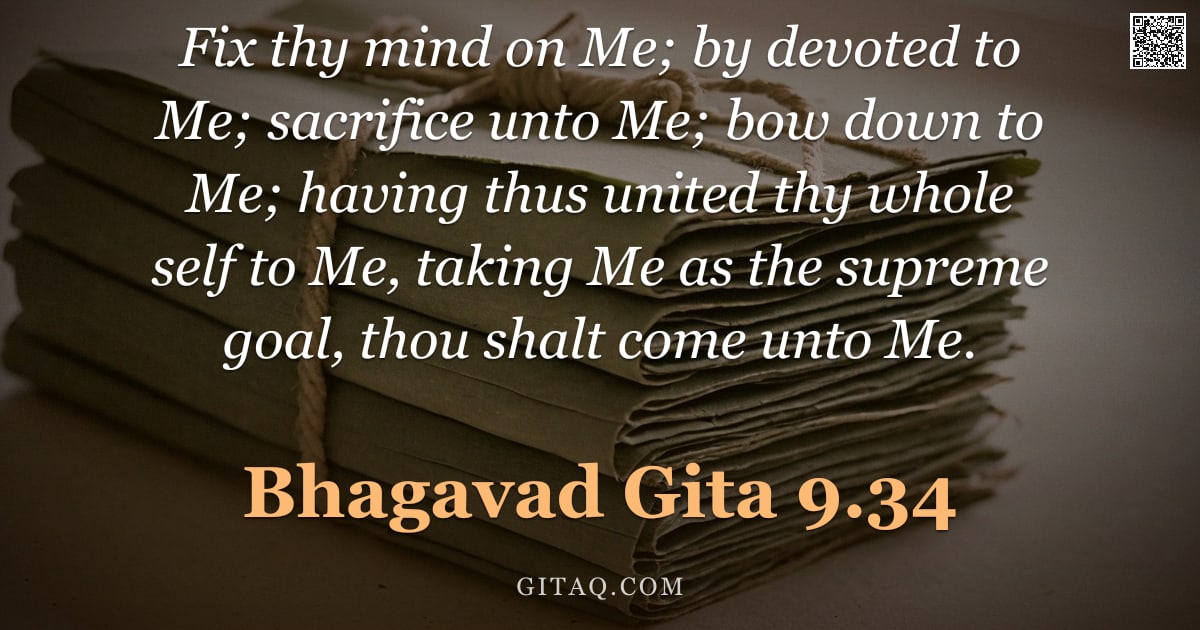
In this verse, Lord Krishna concludes his teachings to Arjuna by summarizing the path of pure devotion. He instructs Arjuna to keep his mind constantly fixed on God, act as His devotee, offer all sacrifices and worship to Him alone, and surrender completely with a sense of humility. The core teaching is that when one unifies their entire being—mind, heart, and actions—with the Divine as their ultimate goal, they are guaranteed to return to the source of all existence.
The Teaching Behind It
This verse is the quintessential teaching of Bhakti Yoga (the path of devotion), which integrates Jnana (knowledge) through total surrender rather than intellectual analysis. It develops the concept that while other paths require immense discipline, the path of loving union with the Divine allows for immediate spiritual integration and liberation.
Word by Word
Classical Commentary
Where This Happens
This verse appears at the climax of Chapter 9, known as 'Raja Vidya' or Royal Knowledge, where Krishna reveals his supreme nature. The setting is still the battlefield of Kurukshetra, where Arjuna has just heard about the universal form and realized that surrendering to Krishna is easier than trying to master complex philosophies alone. After a long discourse on duty and detachment, Krishna now offers the most accessible path for anyone seeking liberation: complete devotion.
Living It Out Today
Consider a professional facing a high-stakes decision where they feel overwhelmed by fear of failure or personal ambition; instead of spiraling into anxiety, this verse teaches them to pause and consciously 'fix their mind' on a higher purpose. They can approach the situation as an offering (sacrifice) rather than a burden for gain, surrendering the outcome with humility while doing their best work. By making that principle their supreme goal during the stressful moment, they find clarity and inner peace regardless of the external result.
Explained for Children
Imagine you have an amazing best friend who loves you very much, like a superhero parent. This verse is Krishna telling us to be that special kind of devotee: always thinking about Him in our hearts, helping others because He likes it, and saying 'thank you' with kindness every day. If we make God the most important person in our lives and do everything together as friends, He promises that we will never have to worry again; we'll be safe forever.
Daily Reflection
You are invited today to stop scattering your energy across endless worries and instead gather it all into one sacred point: Me. When you offer every small act as a sacrifice and view me as your ultimate goal, the heavy burden of separation simply vanishes. This complete union is not just a promise for the distant future; it begins right now in this moment of conscious surrender.
A Practice for Today
Begin by silently repeating, 'My mind rests only in You,' allowing all other thoughts to dissolve into this single anchor of devotion. Visualize your entire being—your actions, your offerings, and your surrender—as a gentle bow directed toward the Divine presence within.
Key Teachings
- The Totality of Surrender
This verse demands more than intellectual assent; it requires fixing one's entire consciousness on the Divine. By uniting the mind, heart, and actions into a single point of focus, we transform ordinary life into an act of worship. - The Fourfold Path
Krishna outlines four specific practices: fixing the mind on Him, becoming His devotee, offering all work to Him, and bowing down with humility. These are not separate tasks but an integrated flow where external actions reflect internal devotion. - The Promise of Union
The culmination of this practice is the assurance that one who takes Krishna as their supreme goal will inevitably return to Him. This verse establishes that total dedication guarantees a direct, personal reunion with the Divine source.
Themes
Related Verses
Read This Next
- 2.47 — To understand the foundational principle of performing duty without attachment to results before learning total dedication.
- 3.30 — This verse expands on the practical application of 'sacrificing unto Me' by instructing one to dedicate all actions completely.
- 12.15 — To see how Krishna reciprocates and becomes dear to those who embody the qualities of devotion described in chapter 9.
Recommended Reading
GitaQ earns from qualifying purchases as an Amazon Associate.