Bhagavad Gita 9.33
Raja Vidya Raja Guhya Yoga · English Translation
किं पुनर्ब्राह्मणाः पुण्या भक्ता राजर्षयस्तथा | अनित्यमसुखं लोकमिमं प्राप्य भजस्व माम् ||९-३३||
kiṃ punarbrāhmaṇāḥ puṇyā bhaktā rājarṣayastathā . anityamasukhaṃ lokamimaṃ prāpya bhajasva mām ||9-33||
What Does This Verse Mean?
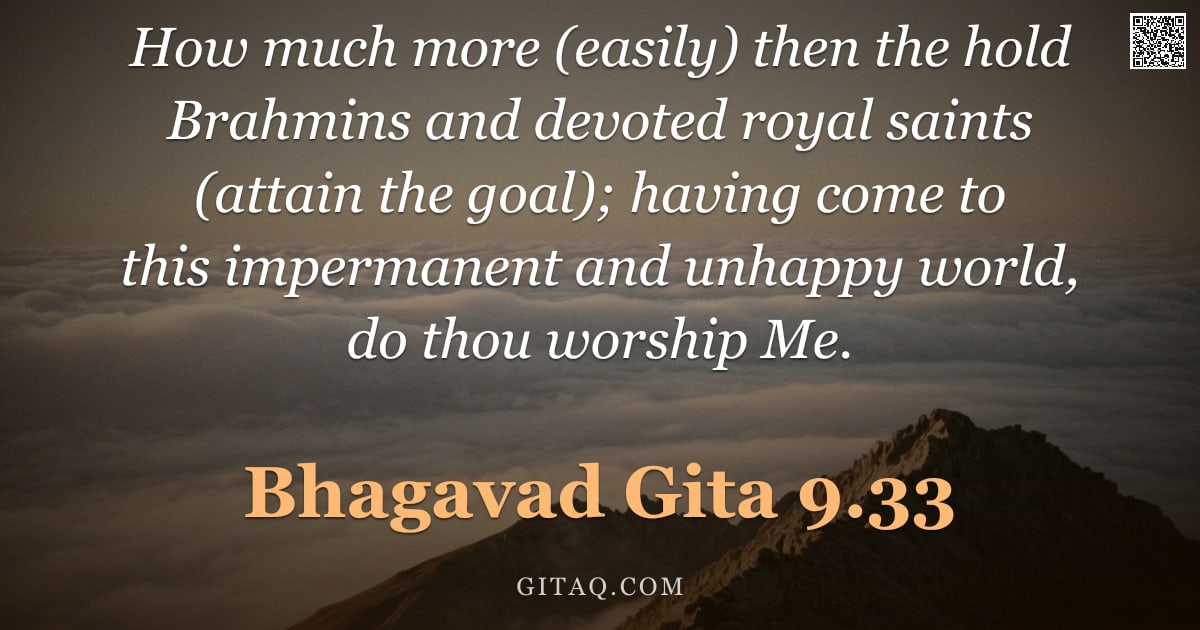
In this verse, Krishna assures Arjuna that if even those from the lowest or most difficult social backgrounds can attain liberation through devotion, then learned Brahmins and wise kings who are already spiritually inclined have an even easier path to follow. He reminds his listener that the current world is temporary and filled with inevitable suffering, urging him to focus entirely on worshipping Krishna as a refuge. The core teaching emphasizes that sincere devotion transcends social status or intellectual achievement when facing the impermanence of life.
The Teaching Behind It
This verse is a cornerstone of Bhakti Yoga (the yoga of devotion), asserting that the path to liberation is open and often easier for those with faith compared to purely intellectual pursuits or rigid ritualism alone. It integrates Jnana Yoga concepts by first establishing the nature of the world as 'anitya' (impermanent) and full of suffering, which serves as the necessary motivation to seek a permanent refuge in the Divine.
Word by Word
Classical Commentary
Where This Happens
This verse occurs during the Bhagavad Gita's ninth chapter, where Lord Krishna shifts from discussing cosmic mysteries to offering direct, personal instruction to Arjuna. It follows a series of profound teachings about God's all-pervading nature and the ease of attaining Him through pure devotion (Bhakti). At this moment on the Kurukshetra battlefield, Arjuna is overwhelmed by doubt and grief after Krishna has revealed His universal form; he feels small compared to such vast knowledge. Krishna uses this verse to ground his teaching in practical reality, acknowledging that while social status varies among humans, spiritual liberation through devotion is accessible to all.
Living It Out Today
Consider a professional who has spent years climbing the corporate ladder but now faces sudden job loss and anxiety about their future stability. While they might feel they have 'lost everything' due to this temporary setback (the impermanent world), Krishna's teaching suggests that their past skills or status do not define their ultimate peace. Instead of obsessing over the instability, they should anchor themselves in a deeper practice—whether through meditation, service, or prayer—to find stability within rather than without. This shift from seeking external security to internal devotion transforms panic into resilience.
Explained for Children
Imagine you are playing in a playground where everything eventually breaks or gets taken away; it can be scary and sad, right? Lord Krishna is saying that if even people who have never played this game before can find their way to safety by holding hands with God, then the smart kids and leaders of the school will definitely make it too! He wants you to know that instead of worrying about broken toys or bad days in a temporary world, we should just focus on loving our best friend, Krishna, who is always there for us.
Daily Reflection
You often feel exhausted by the cycle of seeking happiness in things that inevitably fade away today or tomorrow. Remember that even those with great knowledge and royal status find themselves needing a return home, just like you do right now. This verse is not asking for perfection from you, but simply an honest turning toward the Divine as your only true refuge.
A Practice for Today
Sit quietly and acknowledge that this world, with its fleeting joys and inevitable sorrows, is a temporary stage where true rest cannot be found. Shift your gaze from the impermanent landscape of life to the one constant presence who offers shelter beyond all change.
Key Teachings
- The Impermanence of the World
Krishna explicitly labels this earthly existence as 'anityam' (impermanent) and 'asukham' (full of sorrow), reminding us that no material achievement brings lasting peace. Recognizing this reality is not pessimistic but liberating, freeing you from the futile search for eternal satisfaction in temporary objects. - The Ease of Divine Devotion
If even Brahmins and royal saints—who possess immense spiritual merit—must turn to worship after birth, then your path is made clear. The verse implies that once you accept the transient nature of this life, surrendering to God becomes not just a duty but the most natural and accessible solution. - Universal Accessibility of Surrender
By addressing 'brāhmaṇās' (scholars) and 'rājarṣayasthathā' (royal sages), Krishna dissolves social hierarchies, showing that spiritual liberation is open to all regardless of status. The call to worship ('bhajasva mām') is a direct invitation for anyone who realizes the futility of worldly attachment.
Themes
Related Verses
Read This Next
- 2.47 — This verse complements 9.33 by clarifying how one should act in this impermanent world without attachment to results.
- 3.30 — Read next for the practical method of offering all actions and thoughts as worship, which fulfills the command 'bhajasva mām' (worship Me).
- 12.15 — This verse describes the qualities of a devotee who has found refuge in Krishna, embodying the relief from worldly sorrow mentioned in 9.33.
Recommended Reading
GitaQ earns from qualifying purchases as an Amazon Associate.