Bhagavad Gita 9.32
Raja Vidya Raja Guhya Yoga · English Translation
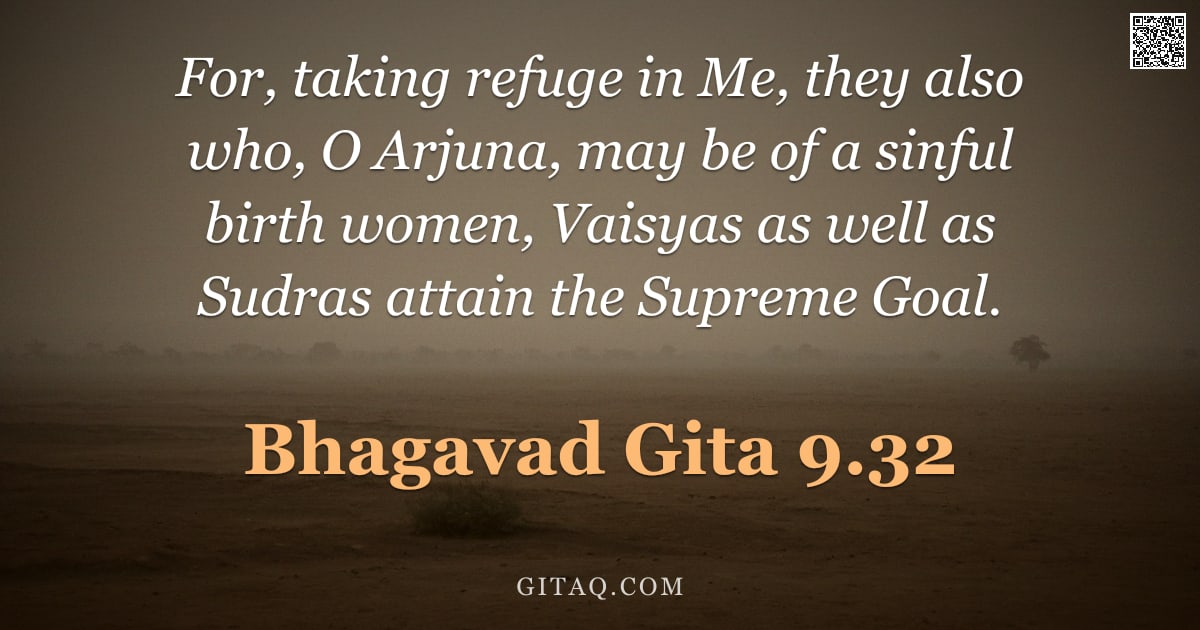
मां हि पार्थ व्यपाश्रित्य येऽपि स्युः पापयोनयः | स्त्रियो वैश्यास्तथा शूद्रास्तेऽपि यान्ति परां गतिम् ||९-३२||
māṃ hi pārtha vyapāśritya ye.api syuḥ pāpayonayaḥ . striyo vaiśyāstathā śūdrāste.api yānti parāṃ gatim ||9-32||
What Does This Verse Mean?
In this verse, Lord Krishna assures Arjuna that anyone who takes refuge in Him can attain the highest spiritual goal, regardless of their birth or social status. He explicitly includes women, Vaisyas (merchants), and Sudras (workers) to show that divine grace is not limited by caste or gender. The core teaching is that sincere devotion and surrender are far more important than one's background in achieving liberation.
The Teaching Behind It
This teaching belongs primarily to Bhakti Yoga (the yoga of devotion) as it emphasizes surrender to the Divine over ritualistic purity. It also integrates concepts from Jnana Yoga (knowledge), revealing that the true nature of the soul is identical for all and transcends physical or social distinctions.
Word by Word
Classical Commentary
Where This Happens
This verse occurs on the battlefield of Kurukshetra during a moment when Krishna has just finished explaining the mystery of divine knowledge (Raja Vidya). Arjuna is listening intently to his friend and charioteer, having been convinced that duty requires action without attachment. At this point in the conversation, Krishna aims to shatter any lingering doubts about whether spiritual perfection is reserved only for a select few sages or priests.
Living It Out Today
If you are struggling with feelings of inadequacy because your career path feels like 'lower work' compared to others, remember that dedication and integrity make every role sacred. In family life, if you feel judged by traditional expectations regarding gender roles or background, this verse reminds us that spiritual worth is determined by our actions and heart, not societal labels.
Explained for Children
Imagine a giant tree where every child wants to reach the very top fruit, no matter how tall they grow up. Krishna says it doesn't matter if you were born with short legs or long ones; what matters is holding tight onto his hand and climbing together. Just like everyone gets invited to the same big birthday party regardless of their clothes, anyone who truly loves God can reach heaven.
Daily Reflection
You may have spent years believing that spiritual progress requires a specific background, gender, or social status before you are worthy of peace. Today, let go of these self-imposed hierarchies and recognize that your true nature is already pure, regardless of where you began in life's journey. When you surrender your need to prove yourself through external achievements, the Supreme Goal becomes accessible right now.
A Practice for Today
Sit quietly and visualize your own limitations or past mistakes not as barriers, but as the very ground upon which divine grace is most evident. Silently affirm that no aspect of your identity can separate you from the infinite love waiting to embrace you if you simply turn inward.
Key Teachings
- The Universality of Grace
Krishna explicitly shatters social barriers by listing women, Vaishyas (merchants), and Shudras (laborers) as equally capable of attaining the highest spiritual state. This teaching asserts that divine grace is not reserved for an elite few but is available to all who sincerely seek it. - The Power of Surrender
The verse emphasizes 'vyapashritya' (taking refuge) as the sole condition required, rather than ritual purity or caste lineage. It teaches that a heart fully surrendered to the Divine transforms any birth into a vessel for liberation. - Transcending Birth and Karma
While acknowledging 'pāpayonayaḥ' (sinful births) as a societal or karmic reality, Krishna declares that devotion transcends the effects of past actions. This reveals that spiritual potential is inherent in every soul, independent of their current circumstances.
Themes
Related Verses
Read This Next
- 2.47 — To understand how one performs duty without attachment, which is the practical application of surrendering action.
- 3.30 — To learn the specific instruction on dedicating all actions to Krishna as a method of purification and yoga.
- 12.15 — To see how those who are free from envy and established in devotion become dear to Him, deepening the theme of accessible love.
Recommended Reading
GitaQ earns from qualifying purchases as an Amazon Associate.