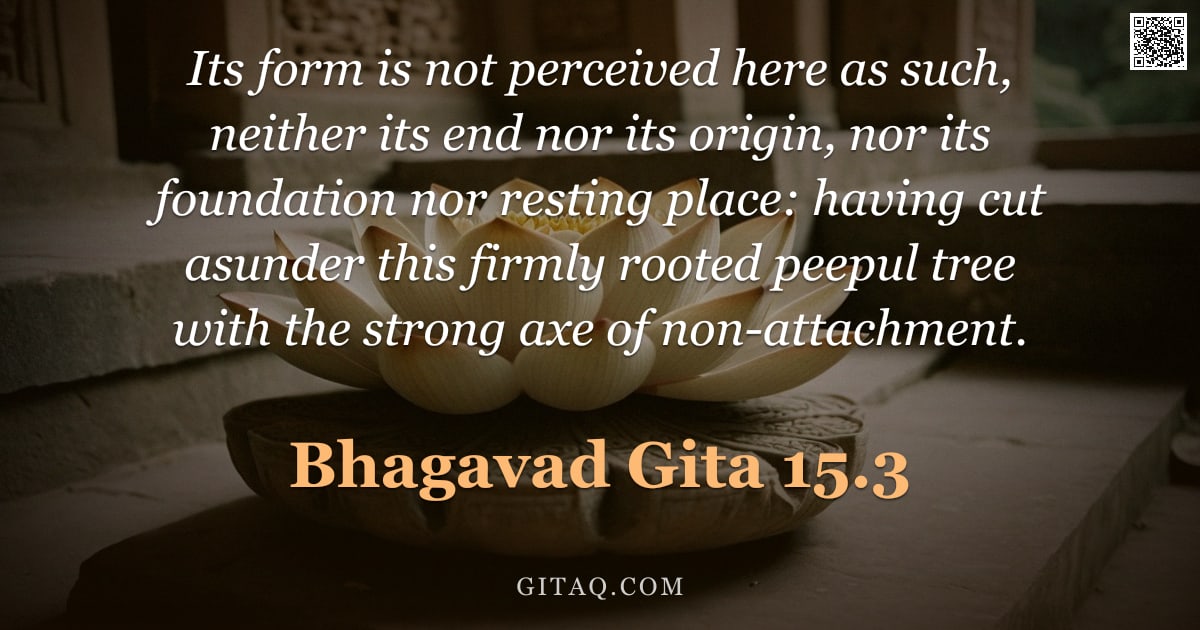
Bhagavad Gita 15.3
Purushottama Yoga · English Translation
न रूपमस्येह तथोपलभ्यते नान्तो न चादिर्न च सम्प्रतिष्ठा | अश्वत्थमेनं सुविरूढमूलं असङ्गशस्त्रेण दृढेन छित्त्वा ||१५-३||
na rūpamasyeha tathopalabhyate nānto na cādirna ca sampratiṣṭhā . aśvatthamenaṃ suvirūḍhamūlaṃ asaṅgaśastreṇa dṛḍhena chittvā ||15-3||
What Does This Verse Mean?
In this verse, Lord Krishna describes the material world as a great banyan tree with roots reaching upward and branches below, noting that its true nature is hidden from ordinary perception because it has no visible end or beginning in human experience. He teaches Arjuna that to find liberation, one must use the 'axe of non-attachment' (vairagya) to sever their connection to this temporary world. The core message is that realizing the illusory and binding nature of material existence allows us to cut through our entanglement and seek a higher reality.
The Teaching Behind It
This teaching belongs primarily to Jnana Yoga (the path of knowledge) within Vedanta, as it uses discrimination (viveka) to distinguish between the eternal Self and the temporary material world. It develops the concept of 'Maya' or illusionary attachment, illustrating that liberation requires cutting the bond with the phenomenal universe through spiritual wisdom.
Word by Word
Classical Commentary
Where This Happens
This verse appears in Chapter 15, part of Krishna's discourse to Arjuna on the battlefield of Kurukshetra during the Mahabharata war. Just prior to this, Krishna has finished describing his divine form and the cycle of birth and death; now he shifts focus to explaining the nature of material existence using a metaphor. Arjuna is still confused about how to fight without attachment after seeing the terrifying vision of Vishvarupa, so Krishna offers this philosophical insight to help him understand that the world itself is an illusionary tree from which one must detach.
Living It Out Today
Consider a professional who is constantly anxious about their career trajectory, obsessed with office politics and fearing they will never reach the 'top' because there seems to be no end to these demands. This verse teaches them to recognize that this relentless pursuit of status is like a tree with deep roots in uncertainty; by applying the axe of non-attachment—focusing on doing their duty excellently without obsessing over the outcome—they can sever the anxiety and find peace.
Explained for Children
Imagine you are standing in front of a huge, tangled tree where the roots go up into the sky instead of down; this represents how confusing and tricky our worries about money or fame can feel. Krishna tells Arjuna that we get stuck in this messy tangle if we keep holding on too tightly to things that will eventually change. To become free from these worries, he suggests using a special invisible axe made of letting go, which helps us cut the tree down and step onto solid ground where there is no more confusion.
Daily Reflection
You often feel trapped by circumstances that seem to have no clear beginning or end, much like the invisible foundation of this cosmic tree. Yet, you possess within yourself a sharp instrument capable of severing these bonds: your capacity for non-attachment. When you choose not to cling to outcomes or identities, you free yourself from the cycle of endless longing.
A Practice for Today
Close your eyes and visualize the peepul tree of worldly existence, with its tangled roots of desire spreading endlessly upward and downward. Silently repeat a mantra of detachment as you imagine cutting through these deep-seated attachments with an axe made of pure clarity.
Key Teachings
- The Illusion of Form
This verse reveals that the material world is a complex illusion whose true nature cannot be grasped by physical senses. It teaches us to look beyond appearances and understand the transient, shadow-like reality of worldly existence. - The Rootedness in Samsara
Just as an inverted tree has its roots above and branches below, our desires bind us to the cycle of birth and death. The verse illustrates how attachment creates a firm foundation for suffering that keeps us stuck. - The Axe of Detachment
Karma yoga is presented not as passive resignation but as an active tool, specifically the 'axe' of non-attachment. This spiritual weapon allows the seeker to cut through the tangled roots and attain liberation.
Themes
Related Verses
Read This Next
- 2.47 — This verse establishes the foundational principle of acting without attachment to results.
- 3.30 — It expands on surrendering actions as a means to cut through the bonds of karma and ego.
- 12.15 — This verse describes the qualities of one who has successfully transcended attachment, offering a vision of the liberated state.
Recommended Reading
GitaQ earns from qualifying purchases as an Amazon Associate.