Bhagavad Gita 13.16
Kshetra Kshetrajna Vibhaga Yoga · English Translation
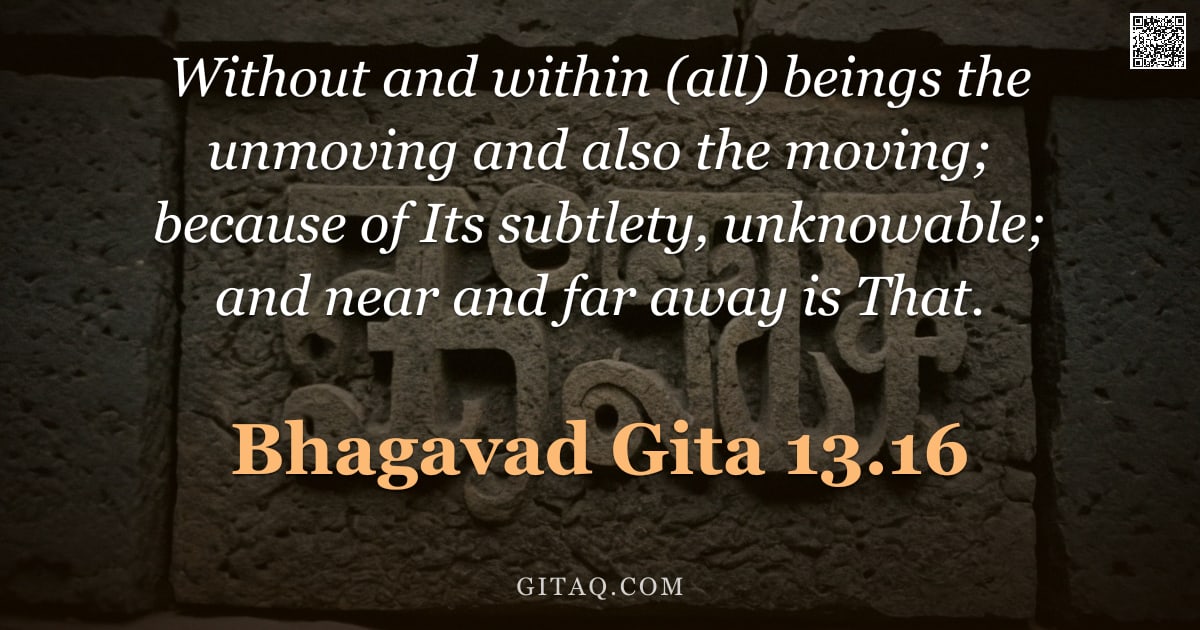
बहिरन्तश्च भूतानामचरं चरमेव च | सूक्ष्मत्वात्तदविज्ञेयं दूरस्थं चान्तिके च तत् ||१३-१६||
bahirantaśca bhūtānāmacaraṃ carameva ca . sūkṣmatvāttadavijñeyaṃ dūrasthaṃ cāntike ca tat ||13-16||
What Does This Verse Mean?
Lord Krishna explains to Arjuna that the Supreme Soul exists both outside and inside every living being, whether moving or still. Because this presence is incredibly subtle, it cannot be fully grasped by ordinary senses or logic alone. Yet, paradoxically, while It seems distant in its greatness, It is also intimately close, residing within our very hearts right now.
The Teaching Behind It
This teaching is central to Jnana Yoga (the path of knowledge) and Sankhya philosophy within the Gita, focusing on distinguishing between the field (matter/body) and the Knower of the Field (consciousness). It develops the concept of Brahman as non-dual consciousness that transcends spatial limitations like distance or proximity while remaining immanent in all creation.
Word by Word
Classical Commentary
Where This Happens
This verse occurs during the Bhagavad Gita's discourse on the battlefield of Kurukshetra, where Lord Krishna is guiding his friend and warrior Arjuna through a crisis of duty. After describing the physical field (the body) in previous verses, Krishna now shifts to the Knower of the Field (the Soul/Supreme). At this moment, Arjuna is paralyzed by grief over fighting his kin; Krishna's teaching aims to lift him out of sorrow by revealing that the divine consciousness pervades all existence without being limited by space or form.
Living It Out Today
When you feel overwhelmed by a difficult decision at work or family conflict, remember that your true self is not just the stressed mind reacting to the situation. The same unchanging presence described in this verse exists within you and even within the people challenging you, regardless of their actions or status. By recognizing this subtle unity beyond the visible chaos, you can approach problems with greater calmness and detachment from the immediate emotional turbulence.
Explained for Children
Imagine the wind: you can't see it, but you know it's there because trees move and your hair blows! The divine presence works like that invisible wind. It surrounds us everywhere (outside), hides inside every leaf and animal (inside), moves with living things (moving) and stays still in stones (unmoving). Even though we can't touch or see this special energy, it is always right here next to you, closer than your own thoughts.
Daily Reflection
You often search for God in distant temples or far-off lands, yet today remember That which dwells within and around you right now. The Divine does not hide because it is small; rather, It remains unseen to our limited senses precisely because Its presence is too subtle to be grasped by the eye or mind alone. When you feel a sense of peace that cannot be explained, know that this is your own Self touching That which is near yet far, moving and unmoving all at once.
A Practice for Today
Close your eyes and gently expand your awareness to feel the presence of the Divine both within every beat of your heart and surrounding you from all directions. Sit with this paradox: that the One who is too subtle for the mind to grasp simultaneously resides in the deepest core of your being while embracing the vast universe outside.
Key Teachings
- The Omnipresence Beyond Duality
This verse dissolves the illusion of separation by declaring that the Divine exists both outside in the cosmos and inside every living creature. Whether an entity is moving or stationary, conscious or seemingly inert, it is permeated by a presence that transcends spatial boundaries. - The Paradox of Subtlety
Because the Supreme Spirit is infinitely subtle (sūkṣmatva), It cannot be captured by ordinary perception or intellectual analysis. This unknowability is not a lack but a sign of Its infinite nature, which defies the limited categories of human understanding. - The Nearness and Farthest Reach
Paradoxically, the Divine is described as both distant (dūrastha) and immediate (antike), teaching that spiritual distance exists only in our perception. While It appears far to those who look outward without inner realization, it remains closer than one's own breath to those who turn inward.
Themes
Related Verses
Read This Next
- 2.47 — Read this next to understand how one should act without attachment while recognizing that the results belong not to you but to the Divine will.
- 3.30 — Continue your study with this verse on surrendering all actions and their fruits, deepening the practical application of seeing God in every deed.
- 12.15 — Finish this sequence by reading how Krishna describes His devotees who are dear to Him because they see no distinction between self and others.
Recommended Reading
GitaQ earns from qualifying purchases as an Amazon Associate.