Bhagavad Gita 13.17
Kshetra Kshetrajna Vibhaga Yoga · English Translation
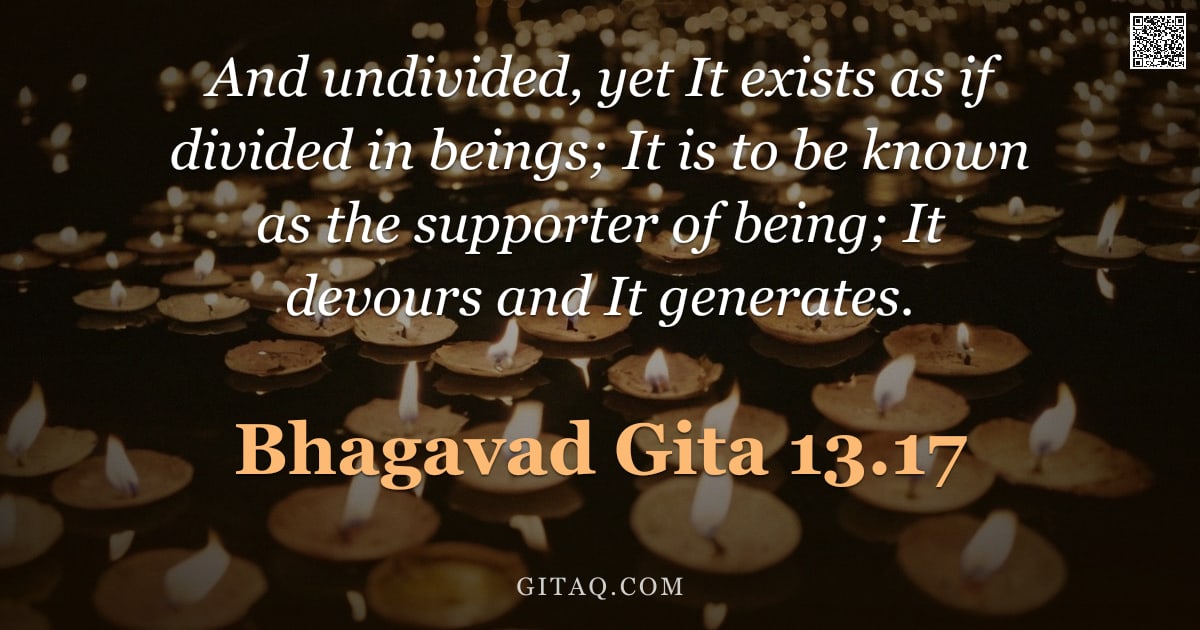
अविभक्तं च भूतेषु विभक्तमिव च स्थितम् | भूतभर्तृ च तज्ज्ञेयं ग्रसिष्णु प्रभविष्णु च ||१३-१७||
avibhaktaṃ ca bhūteṣu vibhaktamiva ca sthitam . bhūtabhartṛ ca tajjñeyaṃ grasiṣṇu prabhaviṣṇu ca ||13-17||
What Does This Verse Mean?
In this verse, Krishna describes the Supreme Soul as being present everywhere without ever actually dividing itself from its source. Just like a single sun reflects in many water pots but remains one and untouched by them, the Divine exists within all living beings while remaining distinct and whole. This teaching emphasizes that the Lord supports every creature, consumes time through creation and destruction, yet never loses His unity or purity.
The Teaching Behind It
This verse is central to Jnana Yoga (the path of knowledge) and the Sankhya philosophy outlined in Chapter 13. It develops the concept of *Vibhaktam* (undivided yet appearing divided), illustrating that Brahman (the Absolute) transcends duality while simultaneously sustaining all creation through its inherent power.
Word by Word
Classical Commentary
Where This Happens
This verse occurs during the Bhagavad Gita's discourse on Kurukshetra where Lord Krishna is instructing Prince Arjuna in Chapter 13. At this point, Arjuna has just asked about the distinction between the physical body (the field) and the conscious observer (the knower of the field). As a warrior paralyzed by grief and confusion over fighting his own kin, Arjuna needs to understand that the true Self is eternal and distinct from the changing world he fears.
Living It Out Today
When facing a high-pressure deadline at work where you feel overwhelmed or like your attention is split between ten different tasks, remember this teaching as a mental anchor. You can acknowledge the stress of multiple demands without losing your internal sense of calm unity; just as light hits every corner of a room simultaneously but remains one source, your awareness can witness all challenges without being fragmented by them.
Explained for Children
Imagine you have a big balloon filled with air, and then you let it go; as long as it floats in different rooms of your house, one single stream of air is filling the whole space. Even though that same air seems to be everywhere at once inside every room, it never actually breaks into pieces or gets tired from being there. The Divine Spirit works exactly like this—it lives inside you and everyone else all the time, holding everything together without ever splitting apart.
Daily Reflection
Today, pause to recognize how the same divine presence holds both your moments of joy and sorrow without being divided between them. You are not merely a fragment lost in the crowd but the very ground that allows every other person to stand and breathe. Even as you navigate complex relationships or personal challenges, remember that this unchanging witness within is readying itself to support you through all transitions.
A Practice for Today
Close your eyes and visualize the light of consciousness that permeates every cell of your body, yet remains untouched by any pain or change within them. Rest in the awareness that while you experience division through different roles and emotions, your true Self is one seamless whole supporting all life.
Key Teachings
- The Paradox of Non-Duality
This verse introduces the profound mystery where the Absolute appears divided in countless beings while remaining fundamentally undivided, like space appearing broken by walls but never actually cut. It teaches that our perception of separation is an illusion overlaying a singular, unified reality. - The Role as Sustainer
As the 'Bhūtabhartṛ', or supporter of beings, the Divine acts as the essential foundation without which no life could exist for even an instant. We are invited to view our existence not as self-sustaining but as a gift held within this divine support. - The Cyclic Power
Recognizing that the Divine both 'devours' (grasiṣṇu) and 'generates' (prabhaviṣṇu), we understand life as a rhythmic dance of dissolution and creation rather than linear progress. This perspective helps us release fear regarding endings, knowing they are simply the precursor to new beginnings.
Themes
Related Verses
Read This Next
- 2.47 — This verse complements the theme of non-attachment to results while acting as a supporter, establishing the practical mindset for engaging with the world.
- 3.30 — Read this next to understand how one surrenders all actions and their fruits to the Divine, aligning personal effort with divine will.
- 12.15 — This verse describes the qualities of a devotee who is dear to Krishna because they are free from agitation, reflecting the peace of knowing one's true nature as part of the whole.
Recommended Reading
GitaQ earns from qualifying purchases as an Amazon Associate.