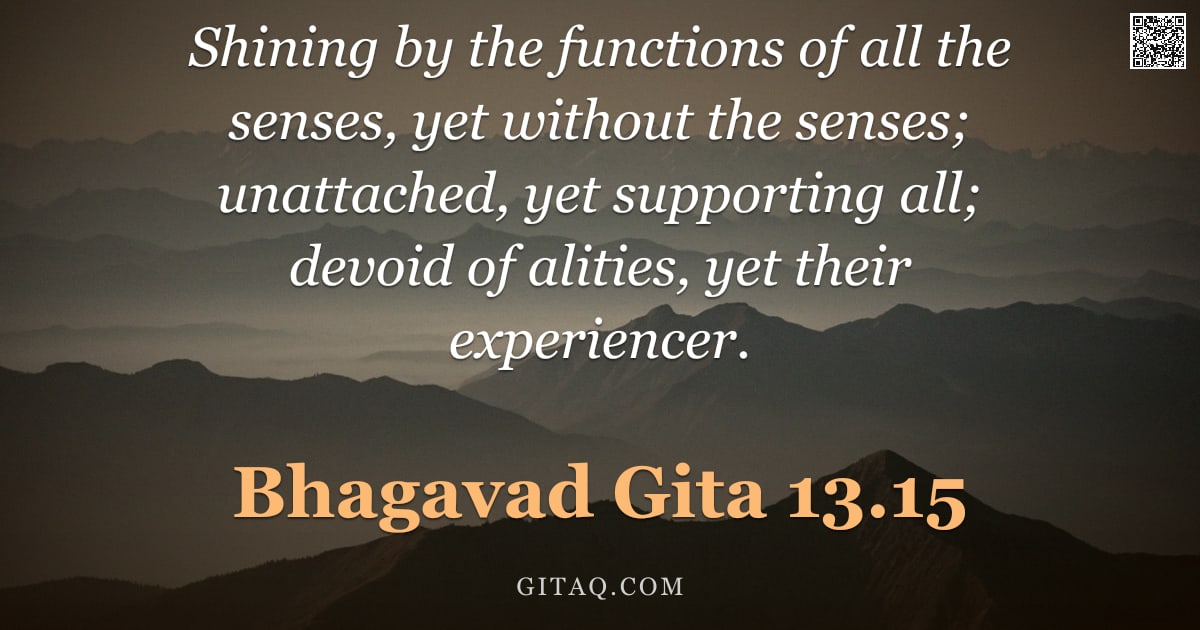
Bhagavad Gita 13.15
Kshetra Kshetrajna Vibhaga Yoga · English Translation
सर्वेन्द्रियगुणाभासं सर्वेन्द्रियविवर्जितम् | असक्तं सर्वभृच्चैव निर्गुणं गुणभोक्तृ च ||१३-१५||
sarvendriyaguṇābhāsaṃ sarvendriyavivarjitam . asaktaṃ sarvabhṛccaiva nirguṇaṃ guṇabhoktṛ ca ||13-15||
What Does This Verse Mean?
In this verse, Lord Krishna describes the Supreme Self (Brahman) as being present everywhere and shining through every sense we have, yet it never actually touches or gets changed by those senses. It is like a light that illuminates everything but remains untouched by what it shines on; it supports all of creation while remaining completely detached from the chaos below. Although the Divine has no physical form or qualities of its own, it allows us to experience and enjoy the world's changing conditions.
The Teaching Behind It
This verse is a cornerstone of the Sankhya and Jnana Yoga traditions within the Gita, specifically illustrating the concept of *Nirguna Brahman* (the formless Absolute) versus *Saguna* (God with attributes). It develops the non-dualistic understanding that while the Divine manifests as consciousness in all beings (*sarvendriyaguṇābhāsa*), it remains eternally distinct from the material qualities (*gunas*) and actions of the world.
Word by Word
Classical Commentary
Where This Happens
This verse occurs in Chapter 13 of the Bhagavad Gita during Krishna's discourse with Arjuna on the battlefield of Kurukshetra. At this point, Krishna has just finished explaining that the physical body is a 'field' and the soul or God within it is the 'knower of the field.' He continues to dismantle Arjuna's confusion about whether he should fight his relatives by revealing the nature of the Supreme Being as something beyond the duality of war and peace, action and inaction.
Living It Out Today
When you are facing a high-pressure deadline at work or dealing with intense family conflict, remember that your core identity is like the screen behind a movie: it holds all the images (your thoughts, emotions, and reactions) but isn't damaged by them. You can fully engage in solving the problem—acting as 'supporting all' through your efforts—but maintain an inner distance where you don't let stress or failure define who you are. This allows you to make clear decisions without being paralyzed by anxiety or losing your sense of self-worth.
Explained for Children
Imagine you are wearing a pair of sunglasses that make everything look colorful and bright. The sun is shining through those glasses so you can see the colors, but the sunlight itself isn't colored by your blue or red lenses—it stays pure white just as it was before. In the same way, our inner spirit makes us able to see, hear, and feel things every day, but unlike a mirror that gets dusty when we touch it, our true self never changes no matter what happens around us.
Daily Reflection
Today, try to notice how often you confuse your true self with the roles you play through your eyes and ears; remember that while you experience joy or sorrow, the core of who you are remains untouched by these waves. You can support the world around you without letting its demands bind your inner peace. By resting as the silent observer rather than the anxious participant, you discover a freedom that no circumstance can disturb.
A Practice for Today
Close your eyes and visualize the light of consciousness illuminating every sense you possess, yet remaining entirely untouched by their activity or noise. Feel yourself as that silent witness within, holding all experiences without clinging to them or rejecting any.
Key Teachings
- The Transcendent Witness
The Divine is present in every sensory function yet remains distinct from the physical instruments themselves. This teaches us to identify not with our limited organs, but with the infinite consciousness that animates them. - Detached Support
Just as a magnet attracts iron without losing its own nature, the Supreme supports all beings while remaining completely unattached. We learn to act in service of others without developing a sense of ownership or egoistic attachment to the results. - The Paradox of Experience
Though devoid of material qualities (gunas) itself, It is the ultimate experiencer of all actions performed through them. This resolves our confusion by showing that while we feel bound by pleasure and pain, the Self behind us remains pure and untouched.
Themes
Related Verses
Read This Next
- 2.47 — Read this next to understand how 'unattached' action (karma yoga) is practiced while remaining like the unattached witness described here.
- 3.30 — This verse deepens the concept of surrender, showing how offering all actions leads to freedom from attachment and karmic bondage.
- 12.15 — Explore this description of a devotee who is free from agitation and envy, mirroring the detached yet supportive nature of the Divine outlined in 13.15.
Recommended Reading
GitaQ earns from qualifying purchases as an Amazon Associate.