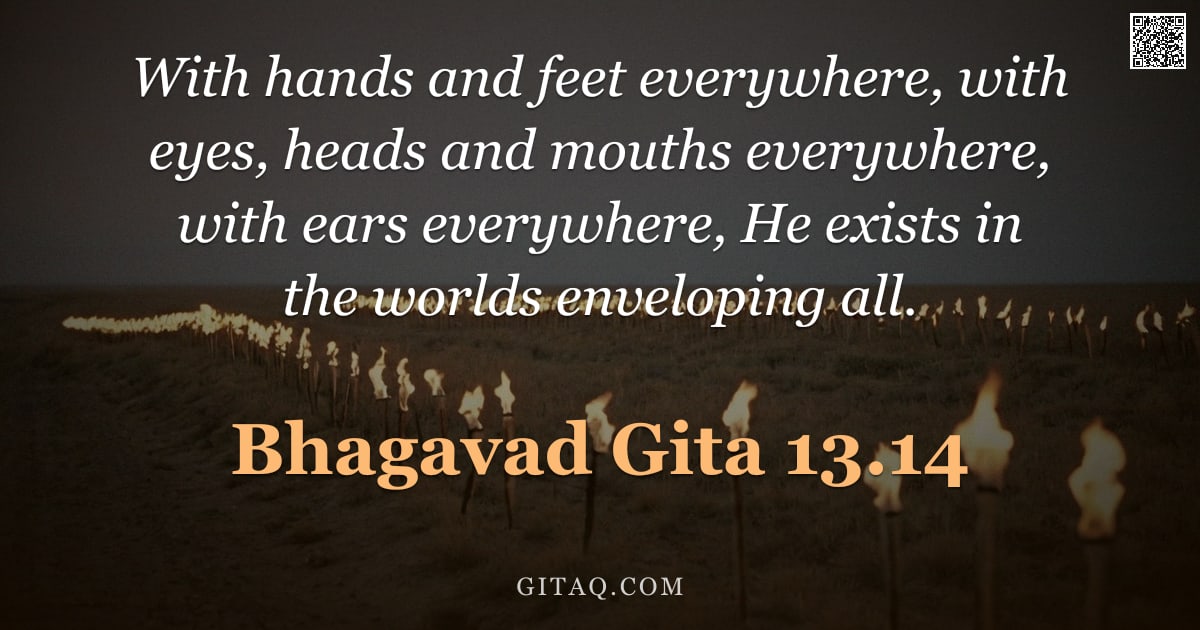
Bhagavad Gita 13.14
Kshetra Kshetrajna Vibhaga Yoga · English Translation
सर्वतः पाणिपादं तत्सर्वतोऽक्षिशिरोमुखम् | सर्वतः श्रुतिमल्लोके सर्वमावृत्य तिष्ठति ||१३-१४||
sarvataḥ pāṇipādaṃ tatsarvato.akṣiśiromukham . sarvataḥ śrutimalloke sarvamāvṛtya tiṣṭhati ||13-14||
What Does This Verse Mean?
In this verse, Lord Krishna describes the Supreme Consciousness as being present everywhere simultaneously with all its senses active at once. He is speaking to Arjuna on the battlefield of Kurukshetra to help him understand that the divine reality pervades every corner of existence. The key teaching is that God is not distant or limited by a single body, but rather exists within and beyond everything as an all-encompassing presence.
The Teaching Behind It
This verse is central to Jnana Yoga (the path of knowledge) and Sankhya philosophy within the Gita's framework. It develops the concept of Vishvarupa or Universal Form, illustrating that Brahman (Ultimate Reality) transcends all dualities of space and time while simultaneously pervading every atom.
Word by Word
Classical Commentary
Where This Happens
This verse occurs during the dialogue on the battlefield of Kurukshetra, where Krishna is guiding Arjuna through his crisis of duty and despair. It follows a detailed description of the physical body as the 'field' (kshetra) and precedes an explanation of the divine knower within it. As Arjuna struggles to distinguish between the temporary material world and the eternal spiritual reality, this verse expands his vision from the finite human form to the infinite cosmic presence.
Living It Out Today
When you feel overwhelmed by a difficult decision at work or family tension that seems unresolvable, remember that your perspective is limited while a greater wisdom surrounds every situation. Instead of trying to solve everything alone with just one set of eyes and ears, pause to trust in the interconnectedness of all things happening around you right now. This realization can reduce anxiety by shifting your focus from being trapped in a single problem to seeing yourself as part of a larger, supportive whole.
Explained for Children
Imagine if you could be in your bedroom, at school, and playing soccer with friends all at the exact same time! This verse teaches us about something even bigger: God is like that super-powerful light that fills every single room of a huge house. Just as sunlight touches everything without getting tired or moving from place to place, this divine presence holds hands in everyone's lives while being everywhere else too.
Daily Reflection
You may feel small amidst the chaos of daily life, but this verse reminds you that the same infinite presence is active within every hand and foot around you. When you look closely, you will see that there are no separate workers; it is all One playing a multitude of roles through your own eyes and ears. This realization transforms how you interact with others, as you begin to treat every encounter as an interaction with the very fabric of existence.
A Practice for Today
Close your eyes and imagine that every hand you see moving today belongs to the Divine, just as your own hands do. Visualize a single consciousness watching through countless eyes while remaining one silent witness in all places at once.
Key Teachings
- Omnipresence in Action
The Divine is not distant but actively manifesting through the biological functions and movements of all beings. Every hand that works, every foot that steps, and every eye that sees is a direct expression of this singular reality. - Non-Dual Perception
While appearing as many with different senses and roles, the underlying consciousness remains one undivided entity. The verse dissolves the illusion of separation by showing that all sensory experiences are facets of a single awareness. - The All-Encompassing Witness
God exists as the silent observer who envelops every world and moment without being affected or diminished. This teaching invites us to shift from identifying with our limited body-mind complex to recognizing ourselves as that all-pervading witness.
Themes
Related Verses
Read This Next
- 2.47 — After recognizing the omnipresence of God here, this verse guides you to perform your duty without attachment to results.
- 3.30 — This verse deepens the practice by instructing one to dedicate all actions and their fruits directly back to the Divine.
- 12.15 — Following this vision of God as 'all-enveloping,' you will find comfort in learning how a devotee who is pleasing to everyone becomes dear to Krishna.
Recommended Reading
GitaQ earns from qualifying purchases as an Amazon Associate.