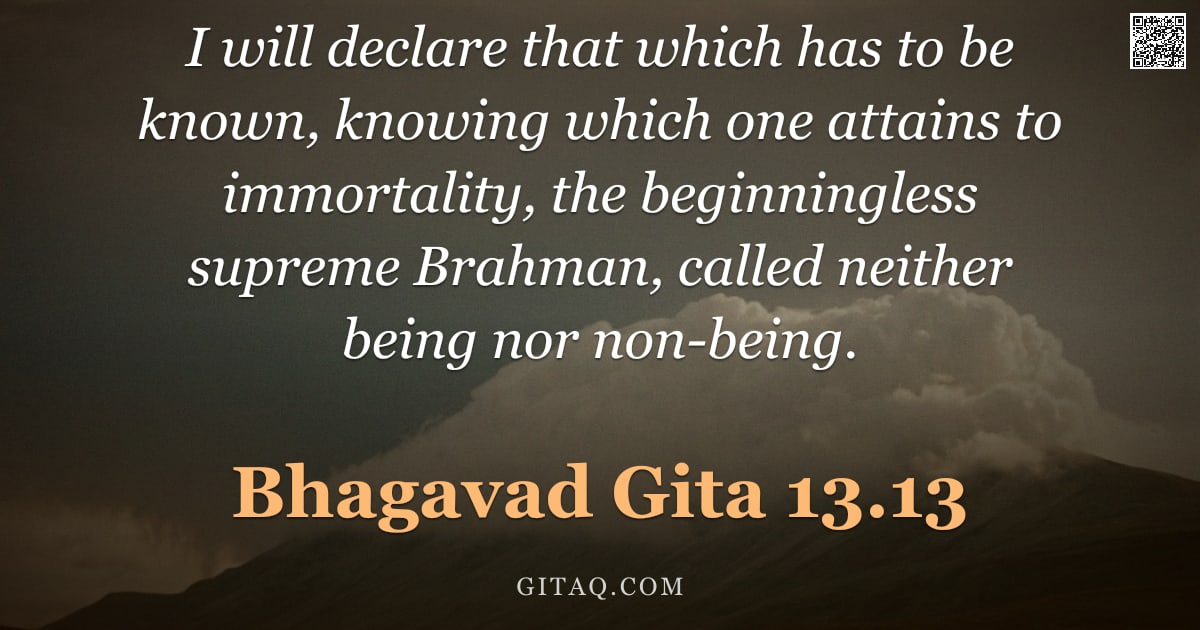
Bhagavad Gita 13.13
Kshetra Kshetrajna Vibhaga Yoga · English Translation
ज्ञेयं यत्तत्प्रवक्ष्यामि यज्ज्ञात्वामृतमश्नुते | अनादिमत्परं ब्रह्म न सत्तन्नासदुच्यते ||१३-१३||
jñeyaṃ yattatpravakṣyāmi yajjñātvāmṛtamaśnute . anādi matparaṃ brahma na sattannāsaducyate ||13-13||
What Does This Verse Mean?
In this verse, Krishna promises to reveal the ultimate truth that everyone needs to know to overcome death and attain immortality. He describes this supreme reality as Brahman, which has no beginning or end and exists beyond our usual categories of 'being' or 'non-being.' The core teaching is that realizing this infinite, formless source of existence is the only path to true liberation from the cycle of birth and decay.
The Teaching Behind It
This verse is a cornerstone of Jnana Yoga (the path of knowledge) and Advaita Vedanta philosophy, which teaches that ultimate reality cannot be fully grasped by dualistic logic. It develops the concept of Nirguna Brahman—the absolute truth that is without attributes or form—distinguishing it from Saguna Brahman (God with qualities). The teaching emphasizes transcending the mind's tendency to categorize existence into binary opposites like 'is' and 'is not'.
Word by Word
Classical Commentary
Where This Happens
This verse occurs during the intense dialogue between Lord Krishna and Arjuna on the battlefield of Kurukshetra, specifically within Chapter 13 where they discuss the difference between the physical body (the field) and the soul's witness consciousness. After explaining the nature of matter and self in previous verses, Krishna is now transitioning to describe the ultimate reality that transcends both. Arjuna has just listened to complex philosophical distinctions about prakriti and purusha; he likely feels a mix of intellectual curiosity and spiritual longing for clarity on how to attain liberation from suffering.
Living It Out Today
When facing an overwhelming career crisis where success or failure seems binary, this verse reminds you that your true identity is not the outcome but the unchanging awareness observing it. Instead of getting trapped in anxiety about whether a project will 'succeed' (being) or 'fail' (non-being), focus on connecting with your inner stability and purposeless potential. By anchoring yourself in this beginningless confidence, you make decisions from clarity rather than fear, allowing you to navigate the situation without losing your peace.
Explained for Children
Imagine you are looking at a glowing light in the sky. You might call it bright because it shines (like 'being'), or dark because you can't see its edges clearly (like 'non-being'). But the real nature of that light is something much bigger than just being on or off; it's an endless, beginningless glow that has always been there and will never go away. Krishna says if we truly understand this special kind of existence inside us, we become like a star that never fades.
Daily Reflection
You often feel caught between the extremes of success and failure, being 'something' one moment and nothing the next. This verse reminds you to look deeper into your own heart where the true Self resides beyond these dualities. When you realize this beginningless reality within yourself, the fear of loss dissolves because what is eternal cannot truly be lost.
A Practice for Today
Sit quietly and acknowledge that your true nature exists before time began, untouched by the rise or fall of events around you. Rest in the awareness that there is a silent space within you which cannot be categorized as either existing or non-existing.
Key Teachings
- The Necessity of Knowing
Krishna emphasizes that there is a specific knowledge required to transcend mortality and attain immortality. This implies that spiritual realization is not automatic but requires intentional inquiry into the nature of reality. - The Beginningless Source
Brahman, or ultimate Reality, has no beginning (anadi), meaning it exists outside the linear constraints of time and creation. This teaches that our true identity is not a temporary acquisition but an eternal possession. - Transcending Duality
The Supreme Brahman is described as neither 'being' nor 'non-being,' placing it beyond the limits of human logic and dualistic perception. This points to a reality that encompasses all possibilities without being defined by any single one.
Themes
Related Verses
Read This Next
- 2.16 — This verse directly explains why the unreal has no being and the real never ceases to be, clarifying the 'neither being nor non-being' concept.
- 12.8 — After understanding the nature of Brahman as infinite and beyond duality, this verse guides you to fix your mind upon that very formless reality for stability.
Recommended Reading
GitaQ earns from qualifying purchases as an Amazon Associate.