Bhagavad Gita 13.12
Kshetra Kshetrajna Vibhaga Yoga · English Translation
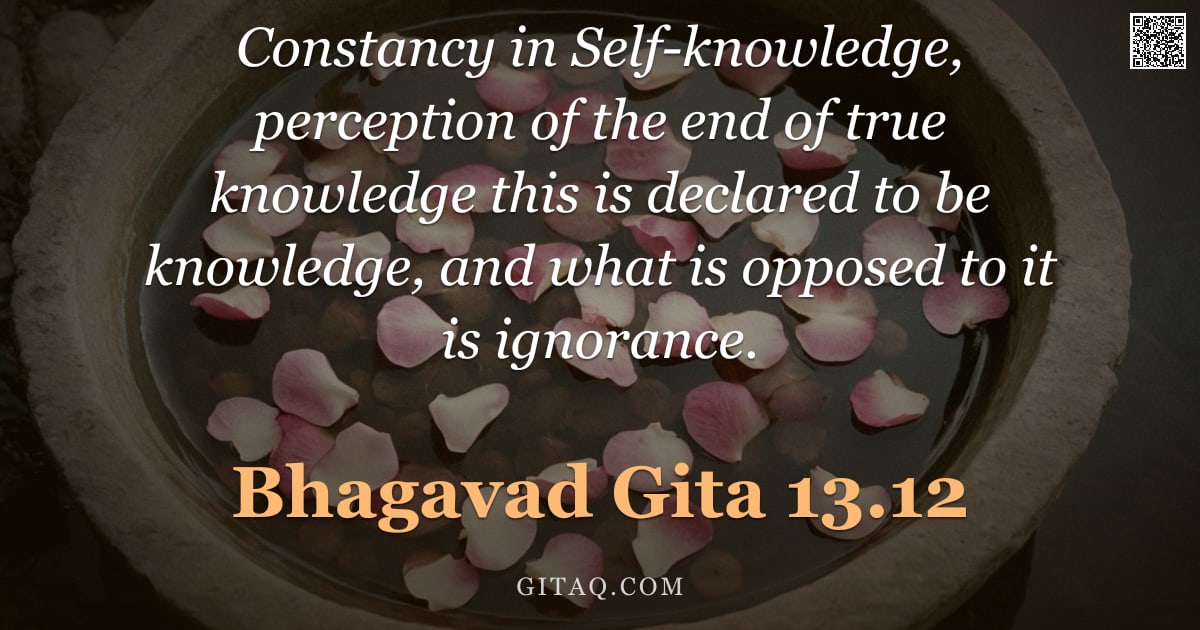
अध्यात्मज्ञाननित्यत्वं तत्त्वज्ञानार्थदर्शनम् | एतज्ज्ञानमिति प्रोक्तमज्ञानं यदतोऽन्यथा ||१३-१२||
adhyātmajñānanityatvaṃ tattvajñānārthadarśanam . etajjñānamiti proktamajñānaṃ yadato.anyathā ||13-12||
What Does This Verse Mean?
In this verse, Lord Krishna is defining the true nature of knowledge to Arjuna as part of his teaching on distinguishing between the physical body and the eternal soul. He states that genuine wisdom consists of a steady commitment to understanding one's spiritual self (Atman) and perceiving the ultimate goal or end point of all truth-seeking. Conversely, anything that moves away from this realization is labeled as ignorance. This serves as the concluding definition for what constitutes true knowledge before Krishna lists specific examples in the following verses.
The Teaching Behind It
This verse is foundational to Jnana Yoga (the path of knowledge) and Samkhya philosophy within the Gita's framework. It introduces the core concept that true wisdom is not merely intellectual accumulation but a stable realization of the difference between the temporary material field (Kshetra) and the eternal observer (Kshetrajna). The teaching emphasizes 'Nityatva' (constancy/eternity), suggesting that knowledge must be an unwavering state of being rather than a fleeting emotional response.
Word by Word
Classical Commentary
Where This Happens
This verse occurs on the battlefield of Kurukshetra during a pivotal moment where Lord Krishna has just begun his discourse to Prince Arjuna, who is overwhelmed by confusion and grief. Having previously explained the distinction between matter (the field) and spirit (the knower), Krishna now provides a formal definition of 'knowledge' itself before diving into its specific attributes in verses 13:9-24. At this point, Arjuna has surrendered his ego as a warrior but still struggles to understand how spiritual wisdom translates into action amidst the chaos of war.
Living It Out Today
Consider a professional who faces sudden layoffs or a major project failure; instead of spiraling into anxiety and losing their sense of self-worth (ignorance), they maintain 'constancy in Self-knowledge' by recognizing that their value is not tied to their job title. This shift allows them to perceive the situation clearly as a temporary event, enabling a calm transition to new opportunities without being paralyzed by fear. By focusing on the end goal of inner stability rather than external validation, one transforms a crisis into an opportunity for growth.
Explained for Children
Imagine you are looking at a movie screen and seeing people cry; if you know it's just light on a screen, your heart stays calm because you understand the truth behind the image. This verse teaches that real wisdom is like being that calm viewer: staying steady in knowing who you truly are (your inner self) instead of getting confused by what you see or feel. When we stop chasing every shadow and realize the one true light inside us, that is knowledge; but if we get lost thinking the shadows are real, that is ignorance.
Daily Reflection
You often chase answers outside of yourself, believing that wisdom must be accumulated like possessions. Yet this verse reminds you that true knowledge is simply seeing clearly and remaining steady in what you already are. Let go of the confusion between mere information and the direct perception of reality; your peace lies in knowing who you are beyond these fleeting thoughts.
A Practice for Today
Settle into stillness and ask yourself where your mind seeks the end of knowledge, not as a destination to reach, but as a recognition of what is already true. Contemplate constancy in this Self-knowledge by releasing the need for new experiences or external validation today.
Key Teachings
- Constancy in Self-Knowledge
True knowledge is not a sporadic insight but an unwavering steadiness (nityatva) in understanding the nature of the self. It requires maintaining this awareness through all changing circumstances, rather than treating spiritual realization as a temporary mood. - The Perception of Truth's End
Knowledge is defined by seeing the ultimate conclusion (arthadarśanam) where duality dissolves into non-dual reality. This means perceiving that there is nothing more to discover about one's true nature, as it is complete and self-evident. - The Distinction of Ignorance
Anything contrary to this steady perception—confusion, duality, or the belief that truth must be acquired from outside—is defined as ignorance. Recognizing what is not knowledge helps clarify and protect one's understanding of the Self.
Themes
Related Verses
Read This Next
- 2.47 — To understand how performing duty without attachment supports the constancy required for Self-knowledge.
- 3.30 — To explore dedicating all actions to the Divine, which purifies the mind and aids in perceiving truth directly.
- 12.15 — To see how a person who is not disturbed by others' suffering embodies the steady perception of oneness described here.
Recommended Reading
GitaQ earns from qualifying purchases as an Amazon Associate.