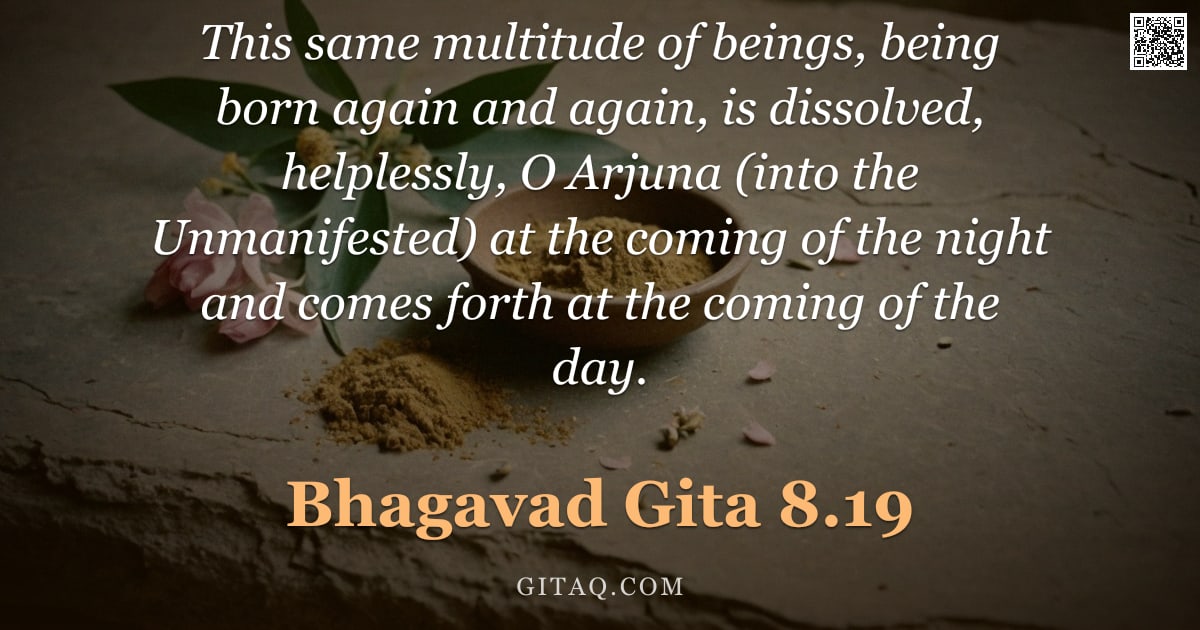
Bhagavad Gita 8.19
Akshara Brahma Yoga · English Translation
भूतग्रामः स एवायं भूत्वा भूत्वा प्रलीयते | रात्र्यागमेऽवशः पार्थ प्रभवत्यहरागमे ||८-१९||
bhūtagrāmaḥ sa evāyaṃ bhūtvā bhūtvā pralīyate . rātryāgame.avaśaḥ pārtha prabhavatyaharāgame ||8-19||
What Does This Verse Mean?
In this verse, Lord Krishna explains to Arjuna the natural rhythm of creation and dissolution that governs all living beings. Just as day turns into night and back again, countless souls are born from the Unmanifested state at dawn and dissolve back into it when darkness falls. This cycle repeats endlessly until one realizes they are not these temporary bodies but the eternal witness who remains unchanged through every shift in time.
The Teaching Behind It
This verse is a cornerstone of Sankhya philosophy within the Gita, distinguishing between the eternal Self (Purusha) and the transient material world (Prakriti). It develops the concept that individual existence is bound by the dualities of creation and destruction, which operate automatically through time rather than personal will.
Word by Word
Classical Commentary
Where This Happens
This teaching occurs on the battlefield of Kurukshetra during a moment when Arjuna is paralyzed by grief and confusion about fighting his own kin. Having just listened to Krishna's explanation that death destroys only the body (Chapter 2), Arjuna still struggles with the fear of losing everyone he loves again in this cycle. Krishna uses this specific analogy of day and night to illustrate that birth and death are not tragedies but natural, inevitable phases of existence governed by cosmic law.
Living It Out Today
When you face a sudden job loss or a major family crisis, remember that like the 'night' phase described here, difficult periods are temporary and part of a larger cycle. Instead of panicking as if this is an end forever, view it as a time for rest and dissolution where old structures break down to make way for renewal. By accepting your helplessness in controlling external events (avashah), you can stop resisting the flow of change and focus on maintaining your inner stability until the 'morning' arrives.
Explained for Children
Imagine you have a big bucket of colorful sand toys that get mixed up on your floor (daytime) and then quietly swept back into a box under the bed when it's bedtime. That is exactly what happens to all living beings! During the day, we are born and play in our bodies, but at night, we rest and go away until morning comes again. The important part is that you are like the child who knows how to use the toys; even though the toys come and go, *you* stay right there watching everything happen.
Daily Reflection
Today, you may feel overwhelmed by events that seem to happen against your will, just as Arjuna was told beings dissolve helplessly into the Unmanifested at night's arrival. Remember that this rhythm of appearing and disappearing applies not only to the cosmos but also to your own moods, thoughts, and circumstances throughout each day. When you feel lost in a dark moment or overwhelmed by change, trust that just as light inevitably returns with the morning, there is an eternal order guiding every transition.
A Practice for Today
Close your eyes and visualize the vast cycle of creation and dissolution, imagining all beings merging into a silent, dark ocean at night's end before rising again with dawn. Rest your awareness in that stillness between breaths where existence dissolves and is reborn without resistance.
Key Teachings
- The Cosmic Rhythm of Creation
This verse establishes that creation and destruction are not random events but a fixed, rhythmic cycle governed by cosmic law. Just as night inevitably follows day, the dissolution of all beings into the Unmanifested is an inevitable part of existence. - Helplessness in Dissolution
The Sanskrit term 'avaśaḥ' (helplessly) highlights that individual entities cannot resist this cosmic law; they must merge back into the source. This teaching invites us to surrender our ego's desire for permanence and accept the transient nature of all material forms. - The Cycle of Samsara
By stating beings are 'born again and again' (bhūtvā bhūtvā), Krishna connects this daily cycle to the broader spiritual journey of rebirth. Understanding that life is a continuous process of manifesting and unmanifesting helps us view our current struggles as temporary phases in a larger evolution.
Themes
Related Verses
Read This Next
- 2.47 — Read this next to understand how one should act in this cycle without attachment to the results of actions.
- 3.30 — This verse offers practical guidance on dedicating all works and their fruits to Krishna, a remedy for feeling bound by fate.
- 12.15 — Read this final selection to see how the qualities of one who is dear to Krishna relate to accepting the flow of nature without distress.
Recommended Reading
GitaQ earns from qualifying purchases as an Amazon Associate.