Bhagavad Gita 8.18
Akshara Brahma Yoga · English Translation
अव्यक्ताद् व्यक्तयः सर्वाः प्रभवन्त्यहरागमे | रात्र्यागमे प्रलीयन्ते तत्रैवाव्यक्तसंज्ञके ||८-१८||
avyaktād vyaktayaḥ sarvāḥ prabhavantyaharāgame . rātryāgame pralīyante tatraivāvyaktasaṃjñake ||8-18||
What Does This Verse Mean?
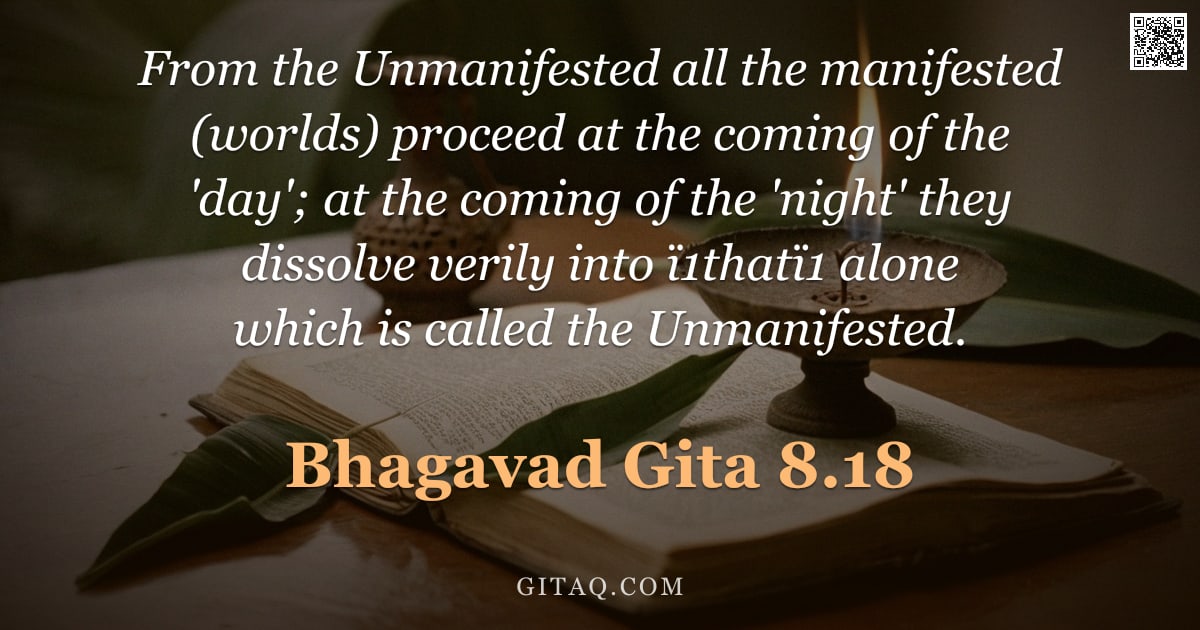
In this verse, Lord Krishna explains to Arjuna the cosmic rhythm of creation and dissolution that governs all existence. He describes how everything in the universe emerges from an unmanifested state when a new day begins and dissolves back into that same source when night falls. The key teaching is that while the world appears constantly changing, it ultimately returns to its original, silent foundation after every cycle of activity ends.
The Teaching Behind It
This verse belongs primarily to the Jnana Yoga (path of knowledge) and Sankhya philosophy strands, as it elucidates the metaphysical mechanics of Prakriti (nature). It develops the concept that all manifestation is temporary and cyclical, emerging from and returning to the unmanifested state known as Avyakta.
Word by Word
Classical Commentary
Where This Happens
This teaching occurs on the battlefield of Kurukshetra during the Mahabharata war, where Krishna is guiding his devotee Arjuna through Chapter 8, known as 'Akshara Brahma Yoga.' Just before this verse, they have discussed the nature of death and what happens to a soul after leaving the body. Arjuna, still feeling overwhelmed by grief for fighting his own relatives, seeks clarity on how time itself operates in relation to life and death.
Living It Out Today
Consider a project manager facing an intense deadline; just as manifested worlds arise from silence during 'day,' their focus shifts into high-energy action mode. When the work is done or when they rest at night (the 'night'), that energy doesn't vanish but dissolves back, allowing them to recharge for tomorrow's cycle. Understanding this rhythm helps reduce anxiety about constant productivity, reminding us that periods of intense output must be followed by natural periods of restoration and quiet.
Explained for Children
Imagine the entire universe as a giant ocean where everything floats on waves. When morning comes (the 'day'), all the little islands and boats suddenly appear from under the water to be seen by everyone. But when evening arrives (the 'night'), they don't disappear forever; instead, they gently sink back down into the deep water until tomorrow's sun brings them up again. This teaches us that everything has a time to show itself and a time to rest in peace.
Daily Reflection
You often feel overwhelmed by the constant churn of daily life, believing these experiences are permanent and solid. Yet today's verse reminds you that every emotion, event, or challenge is merely a manifestation arising in 'daylight' before dissolving back into the quiet source at 'night'. This cycle isn't something to fear; it is the natural rhythm of existence where your true Self remains untouched by the appearing and disappearing waves.
A Practice for Today
Sit quietly and visualize the vast, silent expanse of the Unmanifested that exists before any thought or sensation arises. Hold this awareness as you watch your current thoughts emerge like a sunrise from within that stillness, knowing they will eventually return to it just as night follows day.
Key Teachings
- The Cyclical Nature of Existence
Creation and dissolution are not linear events but rhythmic pulses governed by cosmic days and nights, much like breathing. This teaches us that nothing in the manifested world is final or permanent, offering relief from attachment to fleeting outcomes. - The Unmanifest as Source
Just as all waves originate from and return to the ocean, every created form proceeds from and dissolves into the Avyakta (Unmanifested). Recognizing this source allows us to see beyond the illusion of separateness in our daily struggles. - The Role of Time
Time itself acts as the mechanism for manifestation, where 'day' brings form and 'night' withdraws it. Understanding that we are participants in this divine rhythm helps us navigate change with equanimity rather than resistance.
Themes
Related Verses
Read This Next
- 2.47 — To learn how to act within this cycle without attachment, focusing on duty rather than results.
- 3.30 — To see the practical application of surrendering all actions and their fruits back to the Divine source.
- 12.15 — To connect with a devotee who is described as dear precisely because they are free from agitation regarding these changing phenomena.
Recommended Reading
GitaQ earns from qualifying purchases as an Amazon Associate.