Bhagavad Gita 9.8
Raja Vidya Raja Guhya Yoga · English Translation
प्रकृतिं स्वामवष्टभ्य विसृजामि पुनः पुनः | भूतग्राममिमं कृत्स्नमवशं प्रकृतेर्वशात् ||९-८||
prakṛtiṃ svāmavaṣṭabhya visṛjāmi punaḥ punaḥ . bhūtagrāmamimaṃ kṛtsnamavaśaṃ prakṛtervaśāt ||9-8||
What Does This Verse Mean?
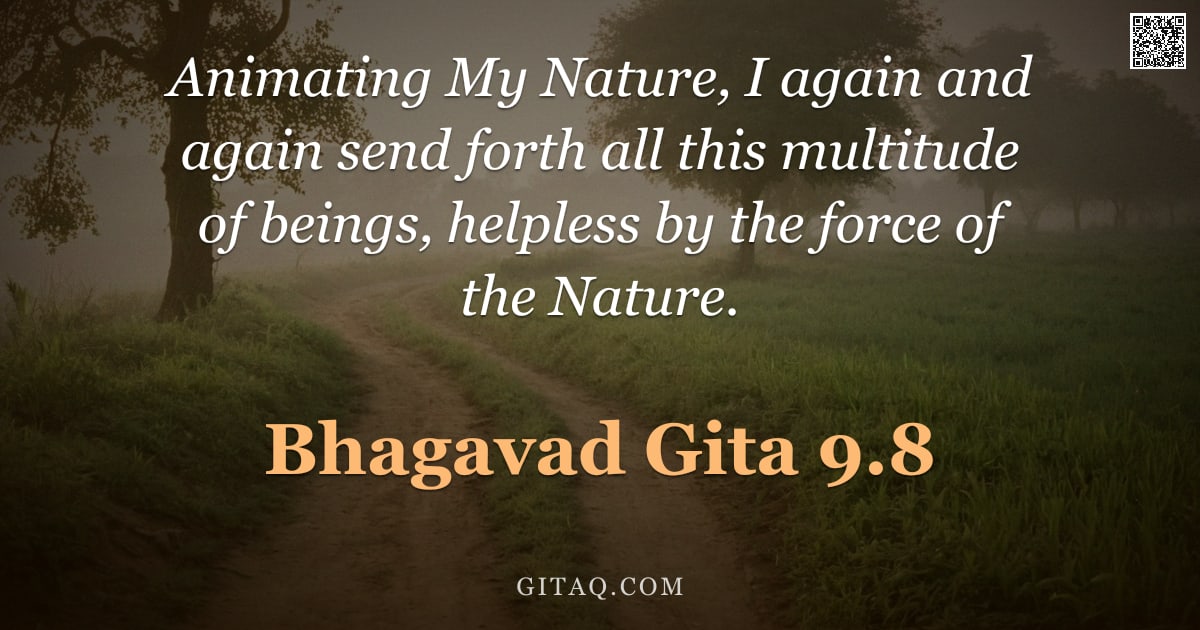
In this verse, Lord Krishna explains to Arjuna that He is the source of all creation and periodically brings forth every living being into existence by activating His own material energy, known as Prakriti. Once beings are born, they follow their inherent nature and actions without total control over their circumstances, appearing 'helpless' against the forces of this cosmic nature. The key teaching here is that while God initiates creation, individual souls experience life through the laws of cause and effect governed by material nature.
The Teaching Behind It
This teaching integrates concepts from Sankhya philosophy regarding Prakriti (material nature) with Bhakti Yoga's emphasis on God as the ultimate controller. It develops the concept of divine immanence, where the Creator is not distant but actively animates and sustains the cycle of birth and death through His own energy.
Word by Word
Classical Commentary
Where This Happens
This verse appears during Chapter 9, a pivotal section where Krishna reveals his supreme cosmic form and explains how he is both immanent in creation and transcendent beyond it. At this point on the battlefield of Kurukshetra, Arjuna has just accepted Krishna's invitation to see His divine universal vision (Vishvarupa) and is overwhelmed by awe and fear. Krishna speaks these words immediately after describing his own role as the seed-giver, assuring a confused warrior that all beings are sustained by God's will even when they feel powerless.
Living It Out Today
When you face an anxiety-filled situation at work where every plan seems to fail despite your best efforts, remember this verse: external circumstances often follow their own momentum (nature) rather than individual wish. Instead of taking the failure personally or feeling like a victim, use it as a moment to observe how actions and reactions play out naturally, allowing you to detach from the outcome while remaining committed to doing your part responsibly.
Explained for Children
Imagine a master storyteller who creates an entire world full of characters every time they open their book. This verse teaches us that just like a puppeteer moves puppets or a director guides actors in a movie, God sets everything into motion again and again so life can continue. We are all part of this great story; sometimes things happen to us because we are following the rules of the game (nature) rather than having full control over every single moment.
Daily Reflection
Today, consider how often you try to force outcomes in your own small world when everything is already part of a grand design beyond your control. You are not the ultimate doer; instead, you are invited to participate willingly in the dance of existence that animates all beings. When challenges arise or plans shift, remember that this shifting hand belongs to Nature itself, guided by the Lord's will.
A Practice for Today
Close your eyes and visualize yourself as an instrument held by the Divine, allowing life's cycles of creation to flow through you rather than resisting them. Breathe deeply, acknowledging that just as seasons change without effort from within themselves, so too does this universe unfold according to a higher rhythm.
Key Teachings
- The Divine as Source and Sustainer
Krishna declares that He remains behind all activity yet is the very force animating His own nature (Prakriti) to create. This teaches us that while we act, the ultimate power driving our existence belongs solely to Him. - The Cycle of Re-creation
The universe undergoes a perpetual process where beings are sent forth 'again and again' (punah punah) in an endless cycle. This verse reveals that birth, life, and dissolution are not random events but recurring acts of divine will. - Helplessness Under Natural Law
All beings are described as 'helpless' (avasham), moving only under the compulsion of Nature's three modes. This implies that true freedom comes not from fighting this law, but from understanding and surrendering to it.
Themes
Related Verses
Read This Next
- 2.47 — To learn how to perform one's duty without attachment, understanding that results are in God's hands while we focus on action.
- 3.30 — To deepen the practice of surrendering all actions and their fruits to Krishna, a direct application of accepting His control over Nature.
- 12.15 — To discover the qualities of a devotee who finds peace in this understanding, remaining unaffected by the changing tides of creation and dissolution.
Recommended Reading
GitaQ earns from qualifying purchases as an Amazon Associate.