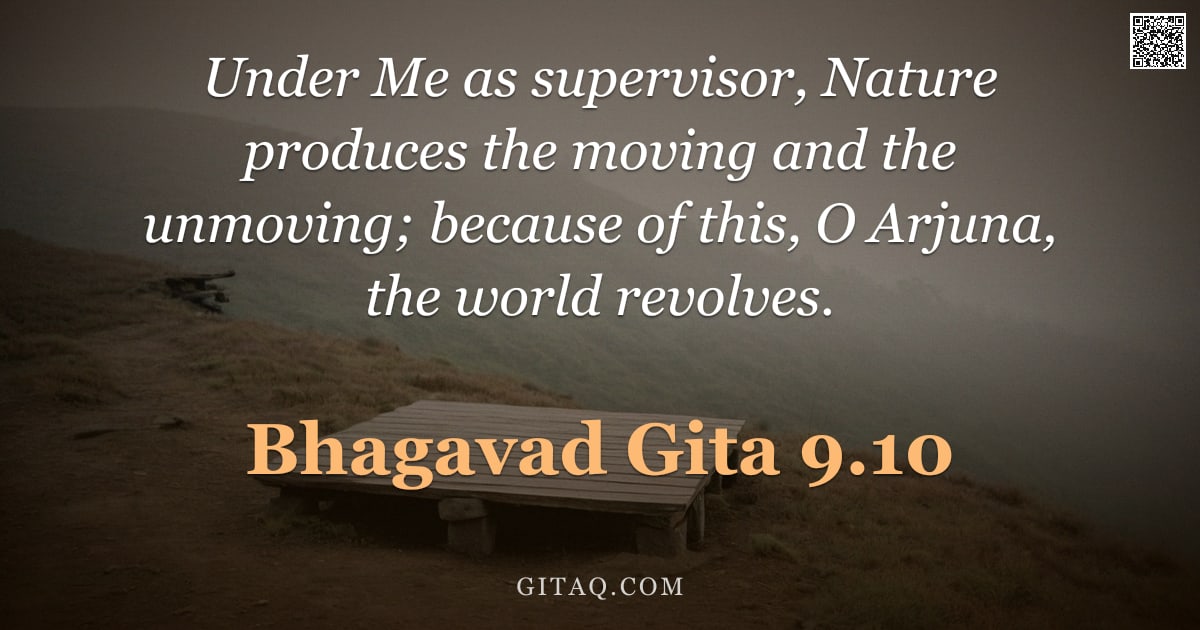
Bhagavad Gita 9.10
Raja Vidya Raja Guhya Yoga · English Translation
मयाध्यक्षेण प्रकृतिः सूयते सचराचरम् | हेतुनानेन कौन्तेय जगद्विपरिवर्तते ||९-१०||
mayādhyakṣeṇa prakṛtiḥ sūyate sacarācaram . hetunānena kaunteya jagadviparivartate ||9-10||
What Does This Verse Mean?
In this verse, Lord Krishna explains to Arjuna that the entire universe operates under His supervision through the force of Nature (Prakriti). Just as a master builder oversees workers who actually lay the bricks, God remains the silent supervisor while Nature performs all actions and creates both moving beings like humans and unmoving things like mountains. Because this divine order is in place, the world continues to function and revolve without interruption.
The Teaching Behind It
This verse belongs primarily to Jnana Yoga (the path of knowledge) and Sankhya philosophy by clarifying the relationship between the Divine, Nature, and matter. It establishes the concept of Isvara-prakriti-sambandha, teaching that while God is the ultimate cause and supervisor, He does not directly interfere with the mechanical laws of Nature but allows them to function autonomously.
Word by Word
Classical Commentary
Where This Happens
This teaching occurs on the battlefield of Kurukshetra during the Mahabharata, where Krishna has just finished explaining His omnipresence and divine nature in Chapter 8. Arjuna is still feeling overwhelmed by the prospect of fighting his own kin and needs reassurance that he does not carry the burden of the universe alone. By speaking this verse at a critical moment before the war begins, Krishna shifts Arjuna's focus from personal anxiety to trust in the cosmic order.
Living It Out Today
When you are facing an impossible work project where every detail seems out of your control, remember that like the world revolving under divine supervision, there is a larger process at play beyond your immediate stress. Instead of trying to micromanage every outcome or forcing results through anxiety, focus on doing your specific duty with full attention while trusting that the overall system will align correctly. This mindset transforms overwhelming pressure into focused action.
Explained for Children
Imagine you are playing with a huge set of building blocks that can move on their own when you push them. You don't have to hold every single block or force it to roll; instead, you just press 'start' and then watch as the whole game plays out beautifully because you gave the rules at the beginning. This verse teaches us that God is like that player who set up the world's rules so everything from a tiny ant to a giant star can do its job perfectly.
Daily Reflection
Today, take a moment to see how every breath and heartbeat is part of a larger divine rhythm that you do not need to force or control. When anxiety arises about your future or your role, remember that just as seasons change under God's watchful eye, the world continues its sacred purpose regardless of your worries. You are invited to relax into this flow, trusting that while you participate in life, it is ultimately sustained by a power far greater than yourself.
A Practice for Today
Close your eyes and visualize the rhythm of nature—the rising sun, the falling leaf—as a single dance orchestrated by the Divine presence within you. Rest your awareness not as an observer standing apart from this movement, but as the silent conductor who holds the entire performance together in perfect harmony.
Key Teachings
- The Supreme as Supervisor
Krishna clarifies that He does not merely observe creation but acts as the supreme director (adhyaksha) who governs its functioning. This teaching shifts our perspective from seeing God as a distant creator to an active, sustaining presence in every moment of existence. - Nature's Dual Function
The verse highlights that Nature (Prakriti), under divine instruction, generates both the moving beings and the unmoving elements like mountains and stars. This illustrates a unified cosmos where lifeless matter and conscious life operate in perfect synchronization. - Cyclical Order of Existence
The 'revolution' or revolving of the world refers to the continuous cycle of creation, preservation, and dissolution that maintains cosmic order. Without this divine supervision, the universe would lack direction; with it, every atom moves according to a purposeful design.
Themes
Related Verses
Read This Next
- 2.47 — To understand how to perform one's duty without attachment while accepting that results are governed by divine will.
- 3.30 — To learn the practical method of surrendering all actions and their fruits back to the Divine for purification.
- 12.15 — To discover how those who are devoted to this Supreme order become dear to God, as they do not disturb creation.
Recommended Reading
GitaQ earns from qualifying purchases as an Amazon Associate.