Bhagavad Gita 9.9
Raja Vidya Raja Guhya Yoga · English Translation
न च मां तानि कर्माणि निबध्नन्ति धनञ्जय | उदासीनवदासीनमसक्तं तेषु कर्मसु ||९-९||
na ca māṃ tāni karmāṇi nibadhnanti dhanañjaya . udāsīnavadāsīnamasaktaṃ teṣu karmasu ||9-9||
What Does This Verse Mean?
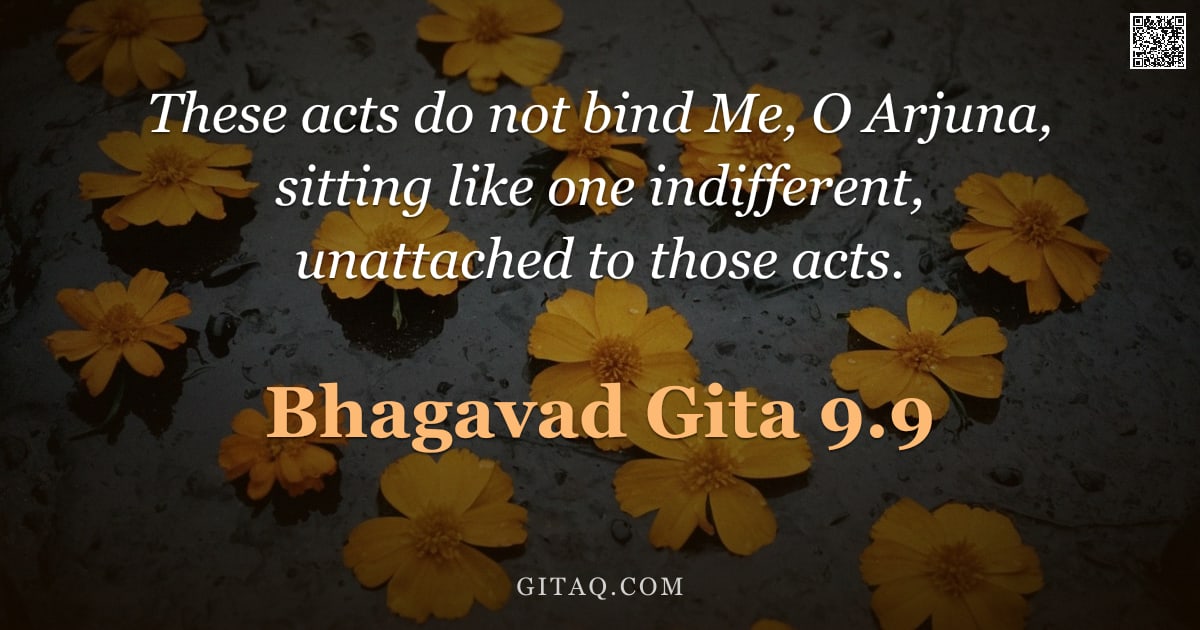
In this verse, Lord Krishna tells Arjuna that His divine actions do not bind Him to the results of those deeds. Even though He is performing acts through which creation continues, He remains like a detached observer who has no personal attachment to them. The key teaching is that one can act in the world without being mentally or spiritually tied down by success or failure.
The Teaching Behind It
This verse is a cornerstone of Karma Yoga, which teaches performing action without attachment to the fruits of labor. It also illustrates Jnana Yoga (the yoga of knowledge) by revealing that the true Self remains untouched by external actions, just as space remains unaffected by objects moving through it.
Word by Word
Classical Commentary
Where This Happens
This conversation takes place on the battlefield of Kurukshetra during the Mahabharata war, where Arjuna is overwhelmed by moral confusion. After Krishna has explained His divine nature as the Supreme Lord in Chapter 9, He uses this specific verse to clarify that while He orchestrates all cosmic events, He remains untouched by them. This reassures a grieving and confused warrior who fears that his own actions might bind him just like they bound others.
Living It Out Today
Consider a project manager leading a team through a high-stakes product launch where the outcome is uncertain; they can work with total dedication while remaining emotionally stable regardless of whether the client accepts it or rejects it. By focusing on giving their best effort rather than obsessing over the final result, they avoid burnout and anxiety during the process. This mindset allows them to make clear decisions under pressure without being paralyzed by fear of failure.
Explained for Children
Imagine you are playing with your toys and building a huge castle out of blocks. You put all your energy into it, but if someone accidentally knocks it over, you don't get sad or angry because you know how to build another one later. Krishna is saying that just like you can play without getting upset when things change, the Divine plays in the world with love and care but isn't stuck by what happens next.
Daily Reflection
Today, I invite you to pause and recall a moment where you felt overwhelmed by duty or result; notice how you can shift your perspective from 'I must do this' to 'This action is happening through me.' Just as Lord Krishna sits detached yet fully present in the universe of activity, you too have an inner sanctuary that remains calm regardless of external chaos. When you act with a spirit of offering rather than ownership, the heavy burden of attachment naturally lifts, revealing your true freedom.
A Practice for Today
Close your eyes and visualize your daily actions as clouds drifting across the vast sky of your true Self; notice how they touch but do not stain or bind you. Rest in the quiet awareness that, like the sun illuminating all without being affected by what it shines upon, your essential nature remains untouched by the fruits of your work.
Key Teachings
- The Paradox of Immanent Detachment
Krishna demonstrates that one can be fully engaged in cosmic and human affairs without developing personal possessiveness or egoic entanglement. This teaching reveals that true detachment is not physical withdrawal, but a state of inner equanimity while performing necessary duties. - The Nature of the Divine Actor
Unlike humans who are bound by karma due to desire and identification with results, the Supreme Self witnesses all actions without being contaminated. This distinction serves as a powerful analogy for how we can aspire to perform our duties while remaining spiritually unattached. - Karma Yoga in Action
The verse provides the philosophical foundation for Karma Yoga, where action is performed as an offering rather than a means of personal gain. By adopting this 'udāsīna' (indifferent) stance toward results, one breaks the cycle of bondage and moves toward liberation.
Themes
Related Verses
Read This Next
- 2.47 — This verse establishes the practical principle of focusing on action alone and not the fruits, which directly supports Krishna's explanation in Chapter 9.
- 3.30 — Here, Lord Krishna instructs Arjuna to surrender all actions to Him as a means to achieve the state of detachment described in this verse.
- 12.15 — This shloka describes the qualities of a devotee who is free from distress and attachment, reflecting the 'indifferent' nature that Krishna embodies.
Recommended Reading
GitaQ earns from qualifying purchases as an Amazon Associate.