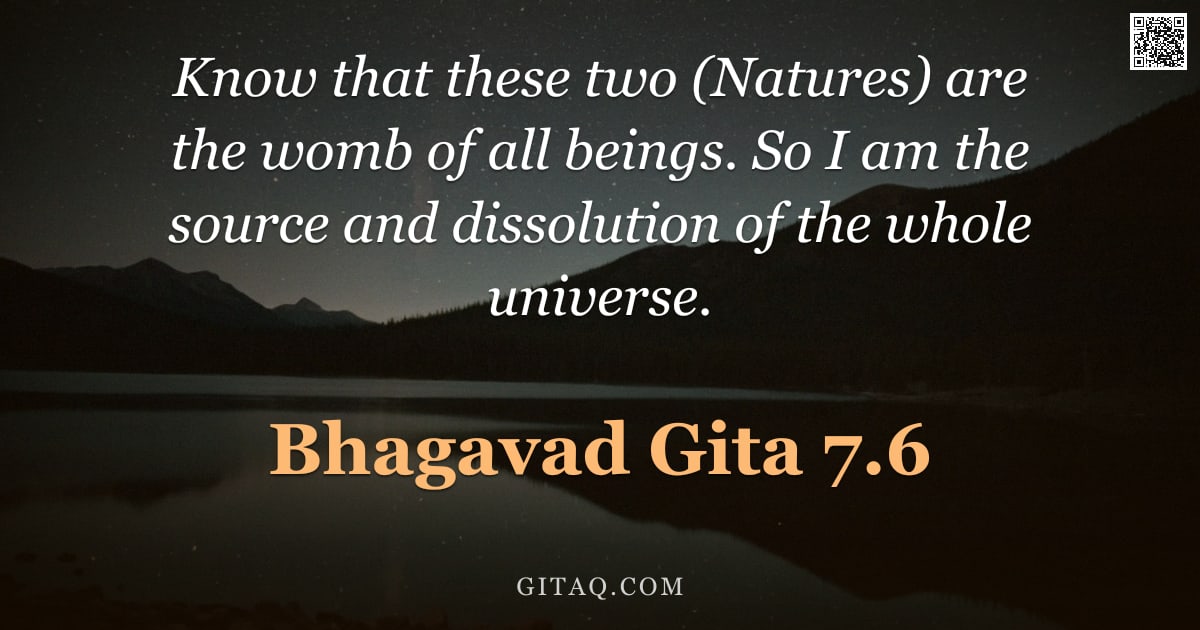
Bhagavad Gita 7.6
Jnana Vijnana Yoga · English Translation
एतद्योनीनि भूतानि सर्वाणीत्युपधारय | अहं कृत्स्नस्य जगतः प्रभवः प्रलयस्तथा ||७-६||
etadyonīni bhūtāni sarvāṇītyupadhāraya . ahaṃ kṛtsnasya jagataḥ prabhavaḥ pralayastathā ||7-6||
What Does This Verse Mean?
In this verse, Lord Krishna tells Arjuna that the two fundamental natures of existence—matter and spirit—are born from Him alone. He declares Himself to be both the origin (source) and the end (dissolution) of the entire universe. The key teaching is a call for total recognition: understand that everything in creation flows from God's energy, yet remains distinct as His expression.
The Teaching Behind It
This verse anchors the Jnana Vijnana Yoga (Knowledge and Wisdom) by establishing God's role as the material cause of creation using Sankhya concepts. It bridges Dvaita (dualism) and Vishishtadvaita, teaching that while Prakriti (nature) appears separate, it is ultimately non-different from its source in Krishna.
Word by Word
Classical Commentary
Where This Happens
This teaching occurs on the battlefield of Kurukshetra during the Mahabharata war, where Krishna is guiding his friend Arjuna through a crisis of duty. After revealing parts of His divine form in Chapter 10 and describing the cosmic energy in Chapter 7's earlier verses, He now summarizes that all material existence stems from Him. At this moment, Arjuna has just listened to descriptions of God's vast powers but still feels overwhelmed; Krishna is asking him to hold firmly onto the knowledge that everything originates from a single source.
Living It Out Today
When you face a massive work project or family crisis and feel completely lost in chaos, remember that this situation arose from natural causes (your actions and circumstances) which are part of a larger order. Instead of feeling isolated by fear, recognize that the same energy sustaining your breath is also capable of guiding you through the resolution. By viewing challenges as temporary phases within a universal cycle rather than permanent failures, you can act with clarity and surrender anxiety about the outcome.
Explained for Children
Imagine the Sun shining brightly; without it, no flowers can grow, bloom, or return to being seeds again. Krishna says He is just like that source of light and life for everyone and everything you see around you. Just as all waves in the ocean come from the water itself, every living being comes from Him, lives by His power, and eventually returns to Him.
Daily Reflection
Today, pause to consider how every moment of your life is sustained by that same power which brings forth stars and dissolves them. You are never separate from this flow; when you feel overwhelmed by creation or lost in endings, remember that Krishna holds both the beginning and the end within His own hands. Let this realization soften your grip on control, inviting a deep sense of trust as you witness life unfolding.
A Practice for Today
Rest your awareness on the silence that holds both the birth of new thoughts and their passing away, recognizing yourself as the container rather than the content. In this stillness, acknowledge the Divine presence not just as a creator to be worshipped from afar, but as the very ground of being where you arise and dissolve.
Key Teachings
- The Dual Nature of Existence
Krishna first identifies two primordial natures (often interpreted as material and spiritual) that serve as the womb for all beings, establishing the framework from which everything emerges. This teaches us to look beyond individual forms to understand the fundamental principles governing creation. - The Source of All Origins
By declaring Himself 'prabhava', Krishna asserts that He is not merely a ruler but the literal cause and origin point of the entire cosmos. This shifts the seeker's focus from seeking answers outside to recognizing the Divine as the foundational source of all knowledge and existence. - The Cycle of Dissolution
Equally important is Krishna's role as 'pralaya', meaning He is also the force that withdraws creation back into potentiality. This teaching removes the fear of endings, framing dissolution not as a destruction but as a necessary return to the Divine source.
Themes
Related Verses
Read This Next
- 2.47 — To understand how one acts without attachment while remaining connected to this all-encompassing source.
- 3.30 — For practical guidance on surrendering the fruits of action and dedicating them back to that same Divine Source mentioned in 7.6.
- 12.15 — To find a description of the devotee who has realized this unity, becoming dear to Krishna because they are free from the cycle of birth and death.
Recommended Reading
GitaQ earns from qualifying purchases as an Amazon Associate.