Bhagavad Gita 7.5
Jnana Vijnana Yoga · English Translation
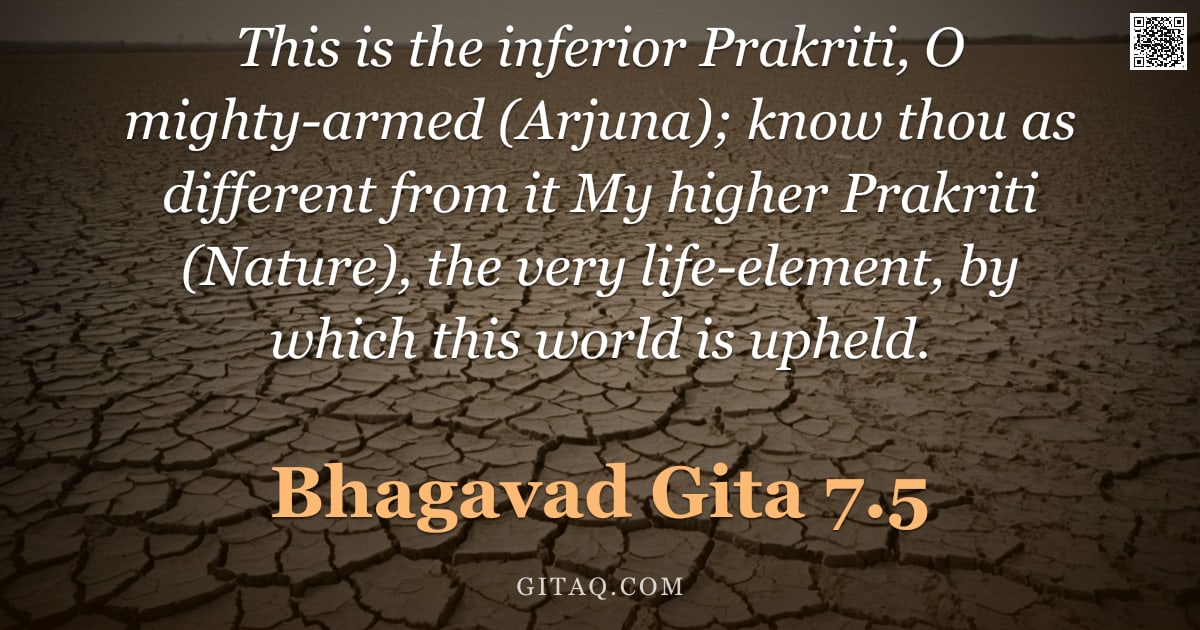
अपरेयमितस्त्वन्यां प्रकृतिं विद्धि मे पराम् | जीवभूतां महाबाहो ययेदं धार्यते जगत् ||७-५||
apareyamitastvanyāṃ prakṛtiṃ viddhi me parām . jīvabhūtāṃ mahābāho yayedaṃ dhāryate jagat ||7-5||
What Does This Verse Mean?
In this verse, Lord Krishna speaks to Arjuna on the battlefield of Kurukshetra, distinguishing between two types of nature or energy. He identifies 'this' as his inferior material nature (the physical elements) and introduces a higher, superior spiritual nature known as living beings or consciousness. The core teaching is that while the physical world is made of matter, it is sustained by this divine life force within every being.
The Teaching Behind It
This verse belongs primarily to Jnana Yoga (the path of knowledge) within the broader framework of Sankhya philosophy as presented in the Gita. It develops the concept of 'Dvaita' or dualistic aspects of Divine Nature, distinguishing between Akshara (inert matter) and Kshara (living consciousness), both emanating from the Supreme.
Word by Word
Classical Commentary
Where This Happens
This verse occurs in Chapter 7 of the Bhagavad Gita during a critical pause on the battlefield of Kurukshetra. Lord Krishna has just finished explaining his 'inferior' material energy (earth, water, fire, etc.) to Arjuna and is now transitioning to reveal his deeper spiritual nature. Arjuna, who was previously overwhelmed by confusion and attachment in Chapter 1, is listening intently as the divine teacher begins to unveil the ultimate secret of existence.
Living It Out Today
When you are facing a high-stakes work project that feels overwhelming, remember this verse: your anxiety often comes from focusing only on the 'inferior' elements—the tight deadlines and difficult colleagues. However, there is also a higher energy within you (your intuition, resilience, or spirit) that sustains you through challenges. Instead of just fighting the external pressure, connect with that inner life force to find clarity and realize that this situation can be upheld by your own potential.
Explained for Children
Imagine your favorite robot toy: the metal body and batteries are like the physical world we see around us—that's one kind of energy. But what makes the robot come alive to move and think? It needs a special spark inside it, just like how our bodies need 'life' or breath to exist. Krishna is telling Arjuna that God has two kinds of powers: the stuff everything is made of, and the magical life-force inside us all that keeps the whole world running.
Daily Reflection
Today, pause to recognize how often we get lost in the 'lower' nature—the noise, the emotions, and the temporary circumstances—forgetting the higher power holding us up. You are not just a fragile vessel subject to change; you carry an inner essence that is part of the Divine's own life-force. When challenges arise this day, remember that while the world may shift like sand beneath your feet, the ground itself remains steady because it rests in That which never fails.
A Practice for Today
Close your eyes and visualize two currents flowing through existence: the vast, changing landscape of matter and energy that you can see, and the silent, unchanging life-force holding it all together. Breathe into this distinction, acknowledging that while your body is part of the shifting world, your true self is the divine spark sustaining the very breath within.
Key Teachings
- The Dual Nature of Existence
Prakriti (Nature) is not a monolith but consists of two distinct aspects: Apara, the material energy that constitutes the physical world, and Para, the spiritual life principle. Understanding this distinction helps us stop mistaking our temporary roles for our eternal identity. - The Life-Force as Divine Sustenance
The 'higher' nature is described specifically as Jiva-bhuta, meaning it is the living essence that animates and supports every particle of creation. This teaches us that life itself is not an accident but a deliberate upholding by the Supreme Consciousness. - Beyond Material Identification
By identifying with the 'lower' nature, we remain bound to the cycle of change and suffering; however, recognizing our connection to the higher life-element grants us stability. This shift in perspective transforms how one experiences existence from being a victim of circumstances to a conscious participant upheld by Grace.
Themes
Related Verses
Read This Next
- 2.47 — This verse follows naturally to teach how one should act in this dual-natured world without attachment to results.
- 3.30 — Read next for practical instruction on offering all actions and the fruits of action back to the Divine, deepening the surrender implied by 'holding up' the world.
- 12.15 — Conclude this study sequence with Krishna describing the qualities of a devotee who is dear to Him, as one established in the higher nature naturally exhibits these traits.
Recommended Reading
GitaQ earns from qualifying purchases as an Amazon Associate.