Bhagavad Gita 8.17
Akshara Brahma Yoga · English Translation
सहस्रयुगपर्यन्तमहर्यद् ब्रह्मणो विदुः | रात्रिं युगसहस्रान्तां तेऽहोरात्रविदो जनाः ||८-१७||
sahasrayugaparyantamaharyad brahmaṇo viduḥ . rātriṃ yugasahasrāntāṃ te.ahorātravido janāḥ ||8-17||
What Does This Verse Mean?
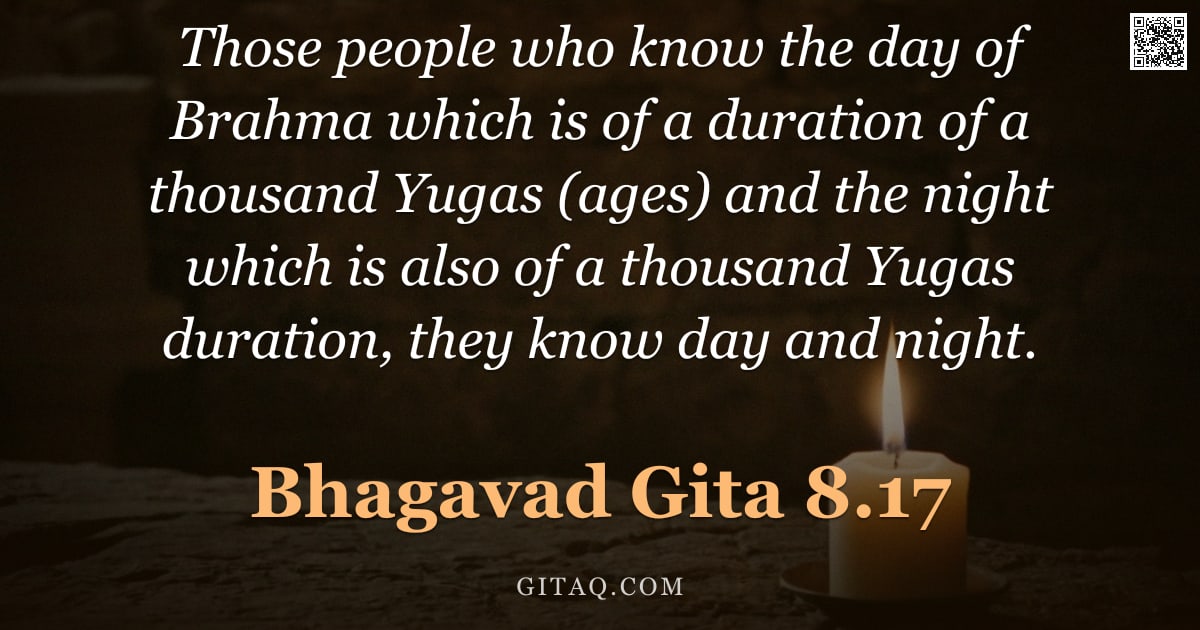
In this verse, Lord Krishna explains the vast scale of time to Arjuna by comparing a single day and night of Brahma (the cosmic creator) to thousands of human ages called Yugas. He teaches that while our personal lives feel long, they are merely tiny fractions within an immense divine timeline. The key teaching is that recognizing this perspective helps us understand the imperishable nature of reality beyond temporary worldly events.
The Teaching Behind It
This verse belongs primarily to Jnana Yoga (the path of knowledge) and Sankhya philosophy by distinguishing between the perishable material world and the imperishable reality. It develops the concept of 'Kala' (time) as a relative measure, illustrating that finite human existence is insignificant compared to the infinite cycles of creation and dissolution governed by Brahman.
Word by Word
Classical Commentary
Where This Happens
This verse occurs in Chapter 8 during the dialogue on the battlefield of Kurukshetra, where Krishna has just begun explaining the path to reach Him after death. Arjuna is overwhelmed by the confusion regarding the nature of Brahman and what happens at the moment of death, seeking clarity from his charioteer who reveals divine knowledge. The context sets a tone of deep philosophical inquiry amidst the tension of an impending war, aiming to shift focus from immediate battle anxiety to eternal truths.
Living It Out Today
When you face a high-stakes work crisis or a family conflict that feels all-consuming and permanent, remember this verse's perspective on time. Realizing that even massive cosmic events are just fleeting moments for the divine can help calm your anxiety about specific outcomes today. Instead of letting fear paralyze you during a hard decision, use this view to act with clarity, knowing that every situation is temporary within the grand flow of life.
Explained for Children
Imagine if one day for a giant in space was as long as all the years you have ever lived plus thousands more days, and their night was just as long! That's what 'one day' means to Brahma. Just like we feel tiny compared to mountains or oceans, our whole life is very small when looking at how big time really is for God. Knowing this helps us realize that even scary problems will pass because they are part of a much bigger picture.
Daily Reflection
In our rush to solve today's problems, we often forget how small our timeline truly is compared to the cosmic cycles of creation and dissolution. When you feel overwhelmed by time slipping away or circumstances shifting too quickly, remember that even a single day for the universe spans eons for us. This perspective does not make your struggles meaningless; rather, it places them in a context where they are part of a sacred, rhythmic dance.
A Practice for Today
Sit quietly and imagine time not as a linear line, but as the rhythmic breathing of the Divine—a thousand ages inhaling into existence and exhaling back into silence. Let this vastness dissolve your immediate anxieties, reminding you that every moment is held within an eternity of peace.
Key Teachings
- The Scale of Cosmic Time
A single day or night for the Supreme Being (Brahma) encompasses four thousand Yugas, illustrating that human perception of time is infinitesimally small compared to divine reality. This teaching invites us to shift from a frantic grasp on temporal duration to a reverence for eternal presence. - The Rhythm of Manifestation
Creation and dissolution are not chaotic events but structured phases, with the day representing expansion and the night representing withdrawal into potentiality. Understanding this rhythm helps us accept both periods of activity and rest as necessary parts of a single divine whole. - True Knowledge is Perspective
The verse defines 'knowing' not merely as intellectual facts, but as the ability to see one's life within the grand sweep of cosmic cycles. To truly know day and night is to realize that our individual struggles are transient moments in an imperishable reality.
Themes
Related Verses
Read This Next
- 2.16 — This verse complements Chapter 8 by contrasting what is real (the imperishable) versus what is unreal (the transient), reinforcing the theme of cosmic time.
- 3.5 — It explains why even wise people are driven to action, providing context for how one should behave within these vast cycles described in 8.17.
- 12.4 — This verse guides the practitioner on how to meditate upon that formless, imperishable reality which underlies all time and space mentioned earlier.
Recommended Reading
GitaQ earns from qualifying purchases as an Amazon Associate.