Bhagavad Gita 8.16
Akshara Brahma Yoga · English Translation
आब्रह्मभुवनाल्लोकाः पुनरावर्तिनोऽर्जुन | मामुपेत्य तु कौन्तेय पुनर्जन्म न विद्यते ||८-१६||
ābrahmabhuvanāllokāḥ punarāvartino.arjuna . māmupetya tu kaunteya punarjanma na vidyate ||8-16||
What Does This Verse Mean?
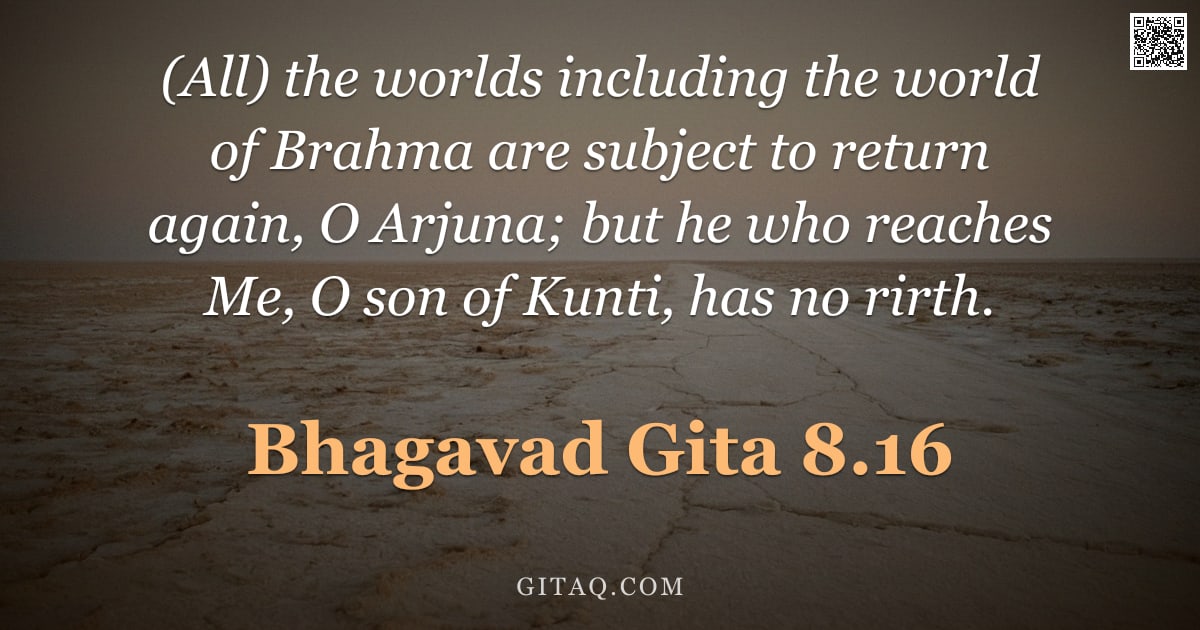
In this verse, Lord Krishna explains to Arjuna that even the highest heavenly realms, including the world of Brahma, are temporary and everyone who lives there must eventually return to Earth for another birth. He contrasts this with a special promise: those who surrender completely to Him reach a state beyond all cycles of rebirth. The core teaching is that material existence, no matter how glorious, always ends in suffering due to impermanence, while devotion leads to eternal freedom.
The Teaching Behind It
This teaching belongs primarily to Jnana Yoga (the path of knowledge) and Bhakti Yoga (the path of devotion), as it reveals the ultimate truth about the nature of reality. It develops the concept of 'Moksha' (liberation), distinguishing between the impermanent material universe ('Samsara') and the eternal spiritual realm attained through surrender to the Supreme.
Word by Word
Classical Commentary
Where This Happens
This verse appears in Chapter 8 of the Bhagavad Gita during the intense battlefield of Kurukshetra, where Prince Arjuna is paralyzed by grief and confusion about fighting his own relatives. Lord Krishna has just finished explaining various spiritual paths to reach the Supreme Divine at the moment of death. He uses this specific verse to reassure a terrified warrior that while all temporary achievements on Earth or in heaven are fleeting, true devotion offers an escape from the endless cycle of birth and death.
Living It Out Today
Consider a professional who has climbed every corporate ladder possible but still feels anxious about losing their job or status; they realize that no amount of worldly success can guarantee lasting security because it is all temporary. Instead of obsessing over building more 'castles in the air,' this verse encourages them to anchor their identity and peace in something eternal, like service to others or spiritual practice. By shifting focus from accumulating transient achievements to cultivating a deep inner connection with the divine, one finds stability that cannot be shaken by market crashes or career changes.
Explained for Children
Imagine you are playing at the most amazing theme park ever; it has giant slides and endless candy! But there's a rule: everyone eventually gets sent home from this park. However, if you make your best friend (who is like God) part of your life forever, they promise to take you on an adventure that never ends and where you never have to go back. Krishna tells Arjuna that even the biggest 'heavenly' party isn't permanent, but loving Him gives us a home that lasts forever.
Daily Reflection
You often find yourself chasing goals or seeking happiness in places that are inherently temporary, much like trying to build a home on shifting sand. This verse reminds you that even the most exalted realms eventually come to an end for everyone who enters them. True freedom is not found by moving from one temporary state to another, but by arriving at your eternal source where no return is necessary.
A Practice for Today
Sit quietly and visualize your current worries as temporary clouds that will eventually pass, just like the transient worlds described here. Offer these fleeting concerns to the Divine Presence within you, resting in the certainty that a state of eternal peace awaits beyond all cycles of birth and return.
Key Teachings
- The Impermanence of All Realms
Even the highest cosmic plane, Brahmaloka, belongs to the cycle of time and must be revisited after its duration ends. This teaching dismantles the illusion that any material or celestial achievement offers permanent security. - The Promise of Final Liberation
Attaining Krishna is described as a unique event where one transcends the law of rebirth entirely, achieving what no other spiritual attainment can. It establishes that personal union with the Divine is the only permanent destination for the soul. - The Shift from Cyclic to Eternal
The verse contrasts 'punar-avartino' (subject to return) with 'na vidyate' (non-existent), marking a clear boundary between samsara and moksha. It invites the seeker to reorient their entire life's purpose toward this singular, irreversible goal.
Themes
Related Verses
Read This Next
- 2.47 — Read this next to understand your duty (karma) as the necessary path that leads one toward the liberation described in verse 8.16.
- 3.30 — This verse explains the act of surrendering all actions to Krishna, which is the practical method for 'reaching' Him mentioned in our current text.
- 12.15 — Reading this will help you identify with a devotee who has realized that no return is necessary and is fully absorbed in service to the Divine.
Recommended Reading
GitaQ earns from qualifying purchases as an Amazon Associate.