Bhagavad Gita 8.15
Akshara Brahma Yoga · English Translation
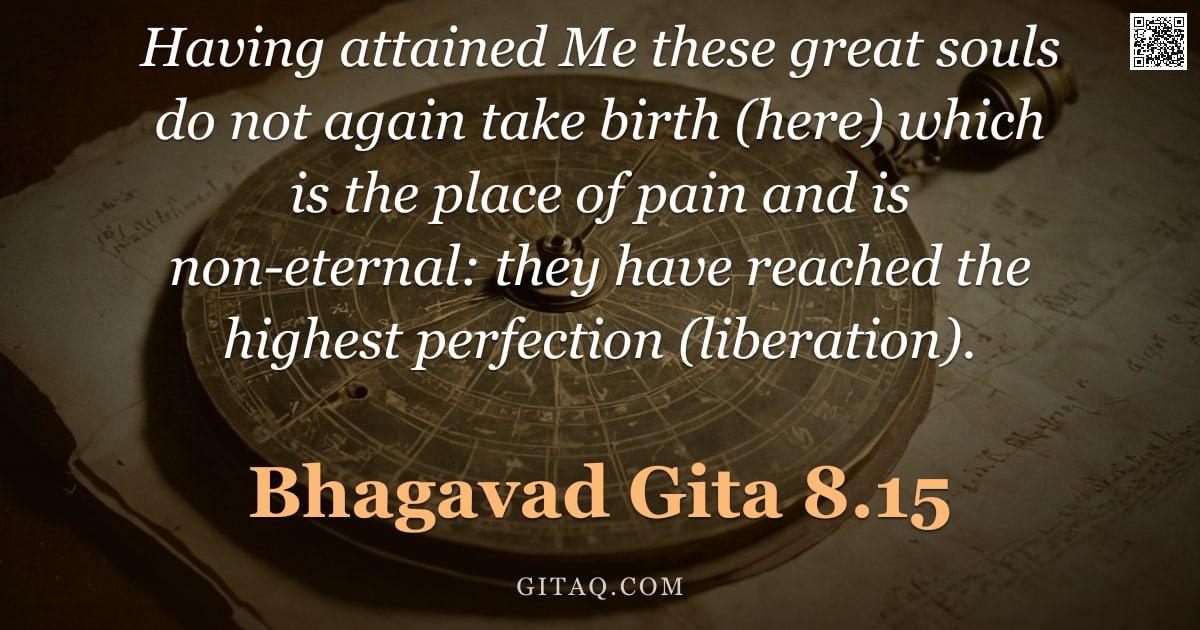
मामुपेत्य पुनर्जन्म दुःखालयमशाश्वतम् | नाप्नुवन्ति महात्मानः संसिद्धिं परमां गताः ||८-१५||
māmupetya punarjanma duḥkhālayamaśāśvatam . nāpnuvanti mahātmānaḥ saṃsiddhiṃ paramāṃ gatāḥ ||8-15||
What Does This Verse Mean?
In this verse, Lord Krishna tells Arjuna that once a wise soul fully surrenders to Him and attains His divine presence, they never return to the cycle of birth in this temporary world of suffering. He describes our current existence as a place filled with pain because it is not eternal or permanent. By reaching this highest state of perfection through devotion, great souls break free from rebirth entirely.
The Teaching Behind It
This verse belongs primarily to Bhakti Yoga (the path of devotion) while integrating concepts from Jnana Yoga (knowledge). It develops the concept of Moksha (liberation), asserting that supreme knowledge is realized through loving surrender, which breaks the causal link of Karma and ends the cycle of Samsara.
Word by Word
Classical Commentary
Where This Happens
This teaching occurs on the battlefield of Kurukshetra during the Mahabharata epic, where Lord Krishna is answering Arjuna's desperate questions about death and duty. After explaining the nature of the soul (Atman) as indestructible in the previous verses, Krishna now addresses what happens after this life ends for those who are devoted to Him. Arjuna has just expressed deep confusion regarding the ultimate goal of human existence, and Krishna is clarifying that true success means escaping the endless cycle of rebirth.
Living It Out Today
Consider a professional burnout scenario where you feel trapped in a high-pressure job with no end date or sense of fulfillment, constantly fearing failure. The teaching suggests shifting your focus from merely achieving external milestones to finding an internal anchor through purpose and service that transcends the immediate stress. By aligning your daily actions with a higher principle rather than just personal gain, you reduce anxiety about future outcomes and find peace regardless of whether you stay in or leave that specific role.
Explained for Children
Imagine you are playing a video game where every time your character dies, they start over again in the same difficult level forever—that's like being born and dying repeatedly without learning anything new. This verse says that when someone becomes truly wise and connects deeply with God, it's like finally finishing the whole game perfectly. Once you finish, you don't have to play those hard levels of sadness anymore; instead, you get a special badge for winning forever.
Daily Reflection
You often feel trapped by the repetitive cycles of joy and pain, believing happiness depends on external circumstances changing. Yet today's teaching reminds you that great souls have already found a way out: they do not return to birth because their hearts are fully anchored in the Divine. When you realize your connection to the Eternal, this temporary world loses its power to bind or hurt you.
A Practice for Today
Sit quietly and visualize the cycle of birth as a place of inevitable sorrow, contrasting it with the peace found only in divine union. Silently affirm that your true nature is eternal consciousness, not subject to the temporary pains of this world.
Key Teachings
- The Nature of Samsara
Life on Earth is characterized as a 'duḥkhālaya' (place of pain) because it is inherently temporary and impermanent. The verse establishes that any existence bound by time cannot be the ultimate goal for a seeker. - The Great Souls
'Mahatmas' are those who have attained such deep spiritual realization that they no longer identify with the physical body or worldly attachments. Their consciousness is so fixed on the Divine that rebirth becomes impossible for them. - Parama Siddhi
The highest perfection, 'parama siddhi', is not a new achievement but the natural state of liberation (moksha) attained upon reaching God. This state marks the end of all suffering and the beginning of eternal peace.
Themes
Related Verses
Read This Next
- 2.15 — To understand how a wise person remains unaffected by sorrow and pleasure in this impermanent life.
- 3.9 — To see the alternative path of performing duty without desire, which leads to purity rather than bondage.
- 12.5 — To learn why attaining liberation is difficult for those attached to the body and mind versus those focused on the formless Divine.
Recommended Reading
GitaQ earns from qualifying purchases as an Amazon Associate.