Bhagavad Gita 12.5
Bhakti Yoga · English Translation
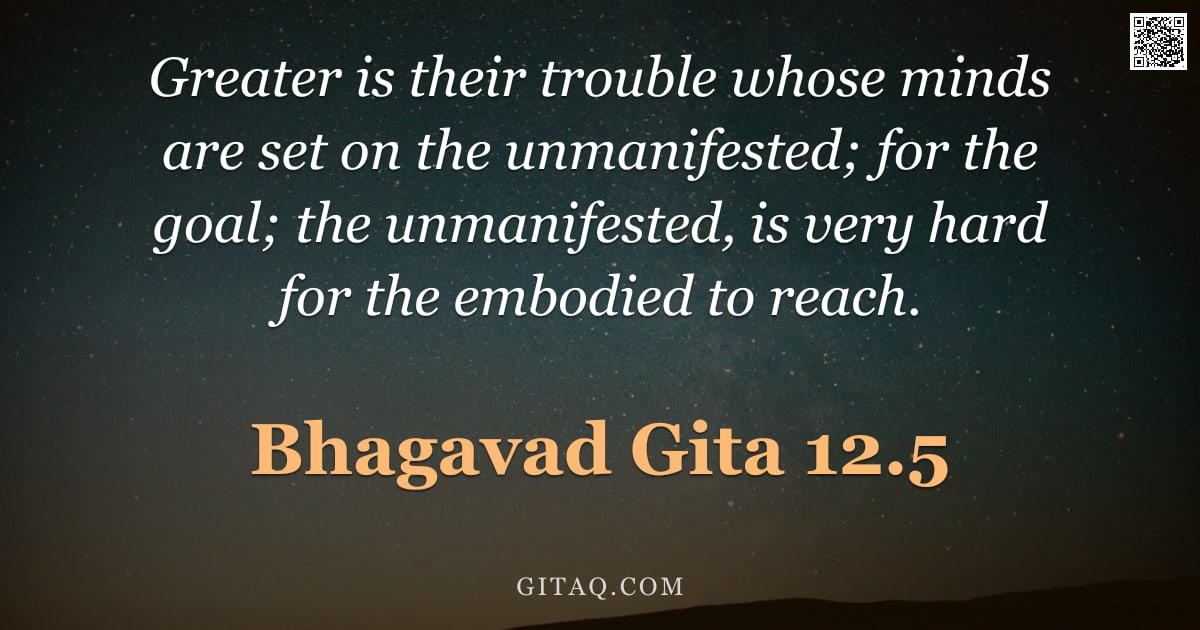
क्लेशोऽधिकतरस्तेषामव्यक्तासक्तचेतसाम् | अव्यक्ता हि गतिर्दुःखं देहवद्भिरवाप्यते ||१२-५||
kleśo.adhikatarasteṣāmavyaktāsaktacetasām || avyaktā hi gatirduḥkhaṃ dehavadbhiravāpyate ||12-5||
What Does This Verse Mean?
In this verse, Lord Krishna warns Arjuna that focusing the mind on the 'unmanifested' (the absolute reality without form) creates significantly more struggle for someone with a physical body than other paths of spirituality. He explains that because our minds are naturally conditioned to perceive forms and shapes within bodies, trying to grasp something formless is extremely difficult and often leads to frustration. The key teaching here is not to abandon the unmanifested entirely, but to recognize it as a much harder path for embodied beings unless they have mastered their senses completely.
The Teaching Behind It
This verse belongs primarily to Bhakti Yoga and Jnana Yoga (specifically regarding Sankhya philosophy) by distinguishing between 'Nirguna Brahman' (the unmanifested absolute) and the path of devotion. It develops the concept that for a conditioned soul bound in a physical body, focusing on formless reality is inherently more difficult due to the mind's natural tendency to objectify experience through senses.
Word by Word
Classical Commentary
Where This Happens
This teaching occurs during a critical pause in the dialogue between Lord Krishna and Prince Arjuna on the battlefield of Kurukshetra. Just before this verse, Arjuna had asked about the path of devotion (Bhakti Yoga) versus the path of knowledge focusing on the formless Absolute, seeking to understand which is superior for him as a warrior with a physical body. Krishna responds by validating that while the unmanifested path exists, it presents unique and severe challenges for those who are still attached to their physical existence and sensory perceptions.
Living It Out Today
Consider a professional leader facing an ethical crisis where they must make a decision without clear precedents or visible evidence of what will happen next. Instead of trying to force clarity from uncertainty (the 'unmanifested'), which often leads to anxiety, paralysis, and stress, the practical approach is to take small, concrete actions based on available data while trusting that the outcome will clarify itself over time. This verse teaches us not to get stuck in abstract planning when our physical reality requires immediate, tangible steps.
Explained for Children
Imagine you are trying to see wind; even though you can feel it blowing your hair or moving leaves, you cannot actually hold it in your hands because it has no shape. Trying to grab something that doesn't exist as a solid object is very confusing and hard work for us humans who need things we can touch and see. Krishna is saying that if you try to focus only on the invisible part of God without any pictures or names, it might feel like trying to catch wind with your bare hands—it causes more confusion than joy.
Daily Reflection
It is natural to feel frustrated when we try to grasp the infinite with our limited senses; this verse reminds us that such struggle often brings more pain than peace. When you find yourself exhausted by trying to force a connection or visualize something formless, pause and recognize that devotion does not require mental gymnastics. The path of love offers a gentle anchor in your own consciousness, making the journey home accessible rather than arduous.
A Practice for Today
Close your eyes and gently release any grip you have on trying to visualize the Divine as a distant, abstract force. Instead of chasing an invisible goal through mental strain, simply rest your awareness in the quiet presence that is already here within your own heart.
Key Teachings
- The Burden of Abstraction
Attempting to meditate on an unmanifest form requires immense mental effort that often leads to confusion and suffering for embodied beings. The human mind struggles to hold onto concepts without a tangible focal point, turning the spiritual quest into a source of distress. - The Embodied Limitation
Because we are bound by physical senses and forms, trying to transcend all form entirely is an exceptionally difficult task for most. The verse acknowledges our human condition, suggesting that the unmanifested path is not impossible but significantly harder than paths with a personal focus. - The Grace of Personal Devotion
By shifting one's consciousness toward a manifest form or personal deity, the practitioner bypasses the heavy lifting required by abstract meditation. This approach allows for an easier and more direct connection to the Divine, reducing the 'trouble' mentioned in this verse.
Themes
Related Verses
Read This Next
- 2.47 — To understand Krishna's instruction to perform duty without attachment, which grounds action when abstract meditation feels too difficult.
- 3.30 — To see the practical application of offering all actions to God, reinforcing that devotion is a path accessible in daily life.
- 12.15 — Because this verse describes the qualities of Krishna's beloved devotees who find ease and happiness through surrender rather than abstract struggle.
Recommended Reading
GitaQ earns from qualifying purchases as an Amazon Associate.