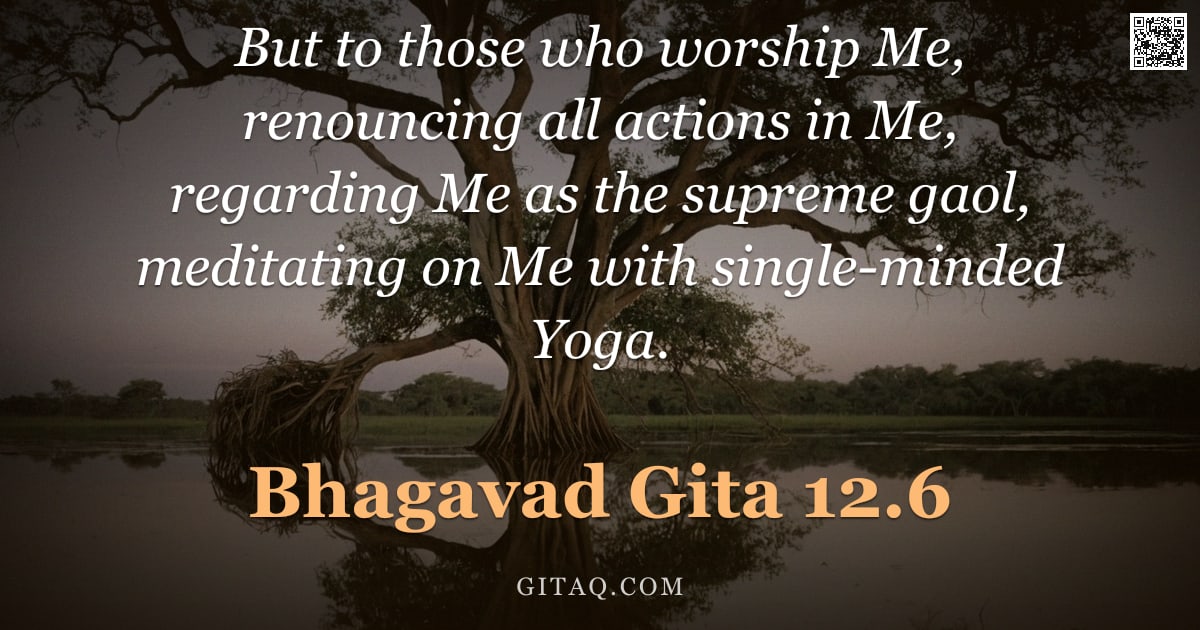
Bhagavad Gita 12.6
Bhakti Yoga · English Translation
ये तु सर्वाणि कर्माणि मयि संन्यस्य मत्परः | अनन्येनैव योगेन मां ध्यायन्त उपासते ||१२-६||
ye tu sarvāṇi karmāṇi mayi saṃnyasya matparaḥ . ananyenaiva yogena māṃ dhyāyanta upāsate ||12-6||
What Does This Verse Mean?
In this verse, Lord Krishna tells Arjuna that those who dedicate every action to Him and make their relationship with the Divine their highest priority are on a profound spiritual path. By surrendering all duties to God and fixing their minds entirely on the Supreme without distraction, they engage in deep meditation known as Bhakti Yoga. This teaching emphasizes that true devotion involves both letting go of personal ownership of actions and maintaining an unbroken focus on the divine presence.
The Teaching Behind It
This verse belongs to Bhakti Yoga (the path of devotion) but integrates elements of Karma Yoga by redefining action as an offering rather than ownership. It develops the concept of 'Maya' or ego-dissolution, where the practitioner renounces the sense of doership ('I am doing this') and replaces it with a singular focus on the Divine as the ultimate goal.
Word by Word
Classical Commentary
Where This Happens
This verse occurs during the Bhagavad Gita's dialogue on the battlefield of Kurukshetra, where Lord Krishna is guiding his friend and cousin Arjuna. Just before this point in Chapter 12, Krishna has outlined various paths to reach Him, including meditation on formless aspects of reality (Nirguna Brahman), which can be difficult for human beings. He introduces this verse as a more accessible path specifically suited for devotees who feel emotionally connected and seek the Lord through personal love rather than abstract philosophy.
Living It Out Today
Consider a professional facing an urgent, high-stakes project deadline that feels overwhelming; instead of obsessing over potential failure or personal glory, they consciously dedicate every step to their higher purpose or conscience. They perform the work with intense focus, treating each task as an offering rather than a burden for self-advancement, which naturally reduces anxiety and prevents burnout. This approach transforms a stressful situation into a meditative practice where the outcome is surrendered while the effort remains wholehearted.
Explained for Children
Imagine you are building a tall tower with blocks for your teacher's birthday party. Instead of trying to keep all the credit or worrying about which block is yours, you give every single block to your teacher and say, 'This whole tower is for them.' You only care that they see how much effort you put in because it was done out of love. Krishna says when we do our best work just for God with a happy heart, without thinking about who gets the praise, we are doing special spiritual practice.
Daily Reflection
Today, you are invited to release the heavy burden of carrying everything on your own shoulders by trusting in something greater than yourself. When you view Krishna not just as an object of worship but as your ultimate destination, every action becomes a gentle offering rather than a struggle for control. This shift from self-reliance to divine reliance brings a profound peace that allows you to move through the world with unwavering devotion.
A Practice for Today
Close your eyes and silently offer every thought, worry, or task currently occupying your mind to the Divine presence within you. Imagine these burdens dissolving into a vast light where only the Supreme remains as your sole focus and refuge.
Key Teachings
- Total Renunciation of Action
The verse calls for 'sarvāṇi karmāṇi mayi saṃnyasya,' meaning the complete surrender of all actions to God. This is not inaction, but a change in attitude where one acts without attachment to personal gain or results. - The Supreme Goal
By regarding the Divine as 'matparaḥ' (the supreme goal), the devotee aligns their entire consciousness with God. This reorients life from seeking temporary worldly pleasures to pursuing eternal union with the Absolute. - Single-Minded Meditation
The practice of 'ananyenaiva yogena' describes a yoga without any other object or distraction, focusing exclusively on the Divine. This unwavering concentration transforms daily worship into a continuous state of remembrance and connection.
Themes
Related Verses
Read This Next
- 2.47 — To understand the foundational principle of performing action without attachment to results before surrendering it completely.
- 3.30 — For a direct instruction from Krishna on how to dedicate all works and actions specifically to Him as an offering.
- 12.15 — To explore the qualities of those who are dear to the Divine, which naturally follow from this path of surrender and meditation.
Recommended Reading
GitaQ earns from qualifying purchases as an Amazon Associate.