Bhagavad Gita 12.7
Bhakti Yoga · English Translation
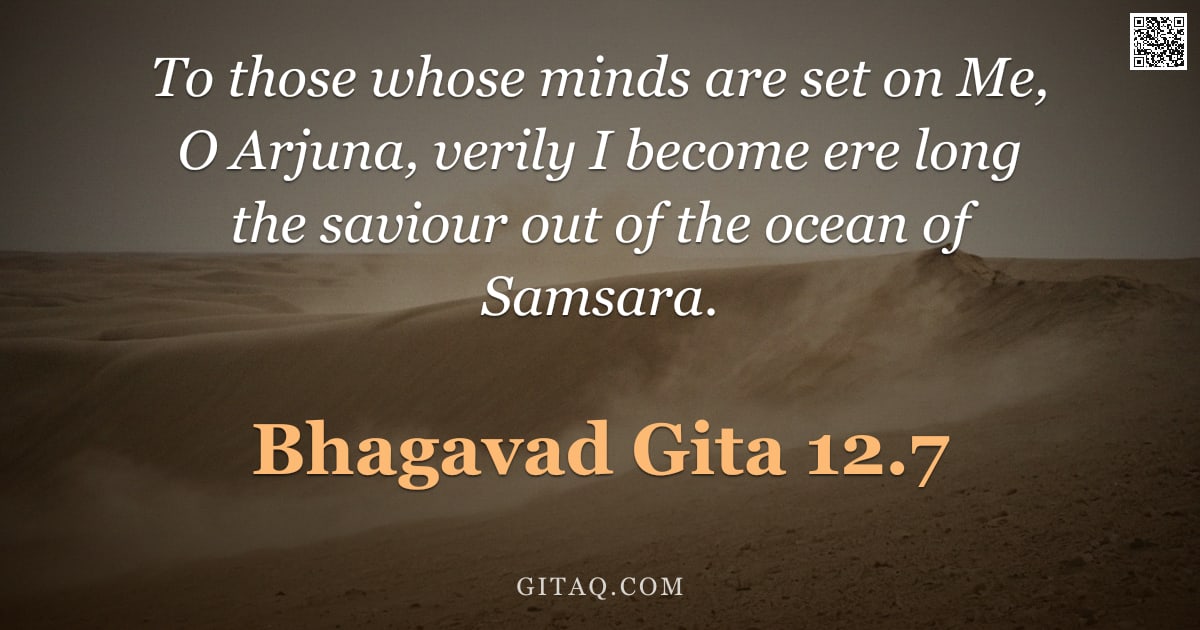
तेषामहं समुद्धर्ता मृत्युसंसारसागरात् | भवामि नचिरात्पार्थ मय्यावेशितचेतसाम् ||१२-७||
teṣāmahaṃ samuddhartā mṛtyusaṃsārasāgarāt . bhavāmi nacirātpārtha mayyāveśitacetasām ||12-7||
What Does This Verse Mean?
In this verse, Lord Krishna promises Arjuna that He will personally rescue anyone who keeps their mind fixed on Him from the difficult cycle of birth and death known as Samsara. The teaching emphasizes that when a devotee surrenders their thoughts completely to God, divine intervention happens quickly without delay. This creates a relationship where spiritual safety is guaranteed through total trust rather than just human effort.
The Teaching Behind It
This verse is a cornerstone of Bhakti Yoga (the path of loving devotion), which posits that total emotional and mental surrender to the Divine guarantees liberation. It develops the concept of Ishvara's grace (Krishna's active role) as the ultimate catalyst for crossing 'Samsara-sagara,' the ocean of worldly suffering.
Word by Word
Classical Commentary
Where This Happens
This verse occurs during the critical dialogue between Lord Krishna and Prince Arjuna on the battlefield of Kurukshetra, where Arjuna has just dropped his bow in despair. After explaining that the soul is eternal (Chapter 2) and describing various paths to God, Krishna introduces Bhakti Yoga as a direct method for liberation. Arjuna, overwhelmed by fear of killing relatives, needs assurance that surrendering his ego and worries will result in divine protection.
Living It Out Today
Consider a professional facing a sudden, catastrophic project failure at work where their career feels on the line. Instead of spiraling into panic or blaming others, they can pause to center their mind with trust in a higher purpose or inner strength, effectively surrendering the outcome. In this state of focused calm and devotion, clarity returns quickly, allowing them to navigate the crisis as if guided by an unseen hand.
Explained for Children
Imagine you are lost in a very big, scary ocean and can't find your way back home. Krishna says that if you call out for help with all your heart and focus only on Him, He will come to save you immediately like a superhero or a strong rescue boat. You don't have to swim alone because when you trust Him completely, He makes sure you are safe before long.
Daily Reflection
Today, consider how often you feel overwhelmed by the waves of anxiety and fear that define our existence in this world. You do not have to struggle alone against these tides because Krishna has promised to personally become your savior for those who keep their minds fixed on Him with devotion. When you surrender your burden to His care, He does not merely offer a hand; He becomes the very force of salvation that carries you safely across the ocean.
A Practice for Today
Sit quietly and visualize yourself as a small boat bobbing on the vast, turbulent ocean of Samsara, filled with worries about birth, death, and worldly changes. Gently shift your focus entirely to Krishna standing calmly at the center of this storm, visualizing Him extending His hands not just to rescue you from the water, but to lift you into a place of absolute safety.
Key Teachings
- Divine Intervention for Steady Minds
Krishna promises direct divine intervention specifically for devotees whose consciousness is fully absorbed in Him. This assurance highlights that spiritual progress relies less on individual struggle and more on the grace of God. - The Ocean of Samsara
Our existence is described as a vast, perilous ocean characterized by birth, death, joy, and sorrow. This metaphor illustrates how difficult it is for humans to cross these cycles without divine assistance or guidance. - Speed of Grace (Nacirat)
The text emphasizes that this rescue happens 'ere long' or quickly once the mind becomes truly devoted. It teaches that God's grace is immediate and responsive to sincere surrender, rather than being a distant reward.
Themes
Related Verses
Read This Next
- 2.47 — This verse establishes the foundation of Karma Yoga and detachment required to steady one's mind for such devotion.
- 3.30 — It expands on the practice of offering all actions to God, deepening the 'mind set on Me' concept found in 12.7.
- 12.15 — This verse describes the qualities of a true devotee who is dear to Krishna and loved by all beings, complementing the promise of salvation.
Recommended Reading
GitaQ earns from qualifying purchases as an Amazon Associate.